

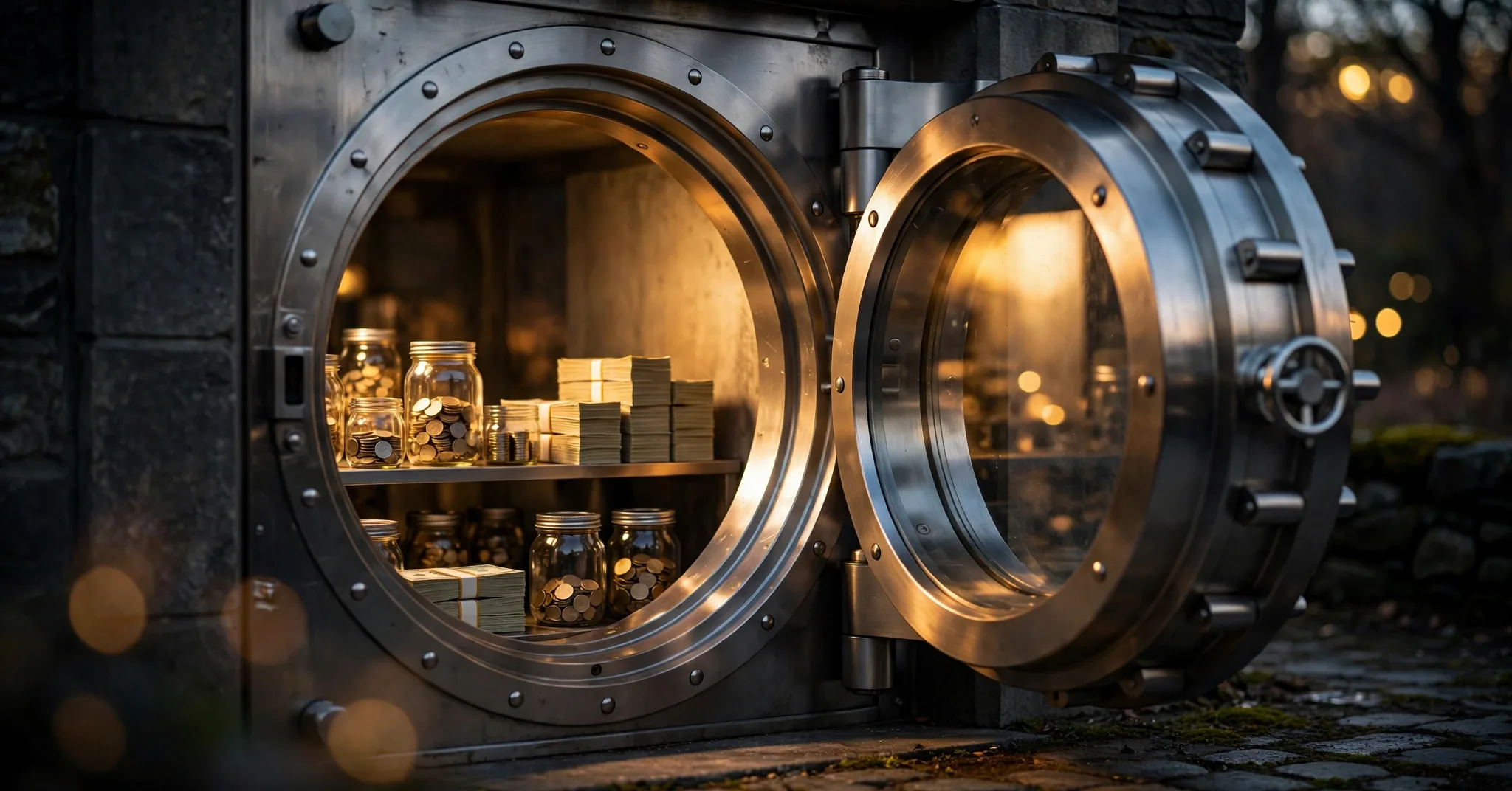
You finally saved real emergency money: your first $1,000 or three full months of expenses. That is a huge win. But here is the uncomfortable truth: where to keep emergency fund money matters almost as much as building it. Park it in the wrong place and a market dip shrinks it, inflation eats it, or your debit card spends it before the emergency arrives.
In this guide you will learn where to keep your emergency fund, which hiding spots sabotage your safety net, and the two-account system that keeps your money safe, separate, and growing.
Key Takeaways
- The #1 rule: your fund must be safe (the balance can never drop) and liquid (reachable in 1-3 days without penalties).
- The best place to keep emergency fund money is a separate high-yield savings account at a different bank from your checking.
- In 2026 top online accounts pay 4% to 4.5% APY, so $10,000 earns $400 to $460 a year instead of about $1 at a big bank.
- A money market account is a strong runner-up. No-penalty CDs and Treasury bills suit the deeper layers of a large fund.
- Never keep emergency money in stocks, crypto, penalty CDs, cash at home, or retirement accounts.
- Tier it: one month of expenses in the HYSA for fast access, the rest growing in a second safe account.
What Is an Emergency Fund?
Short answer: An emergency fund is cash set aside only for unexpected, necessary expenses: a job loss, a medical bill, or an urgent car repair. It is not money for planned spending, sales, or vacations. Its single job is to stop one bad week from turning into years of credit card debt.
Think of it as self-funded insurance, unlike regular savings for goals like a vacation. Our guide to emergency fund vs regular savings explains the split, because mixing the two is how safety nets quietly disappear.
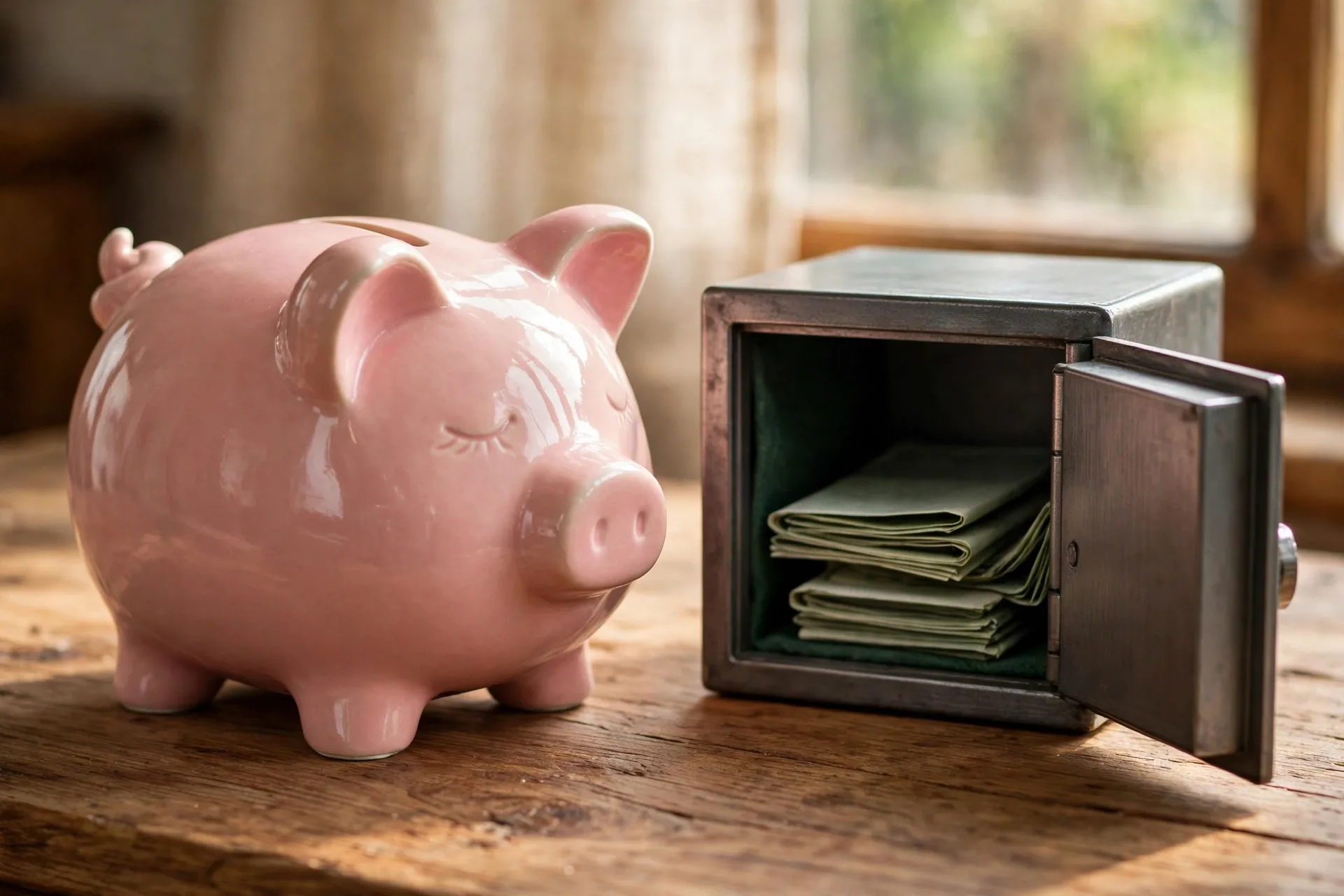
What Is the #1 Rule for Where to Keep Emergency Fund Money?
Short answer: The #1 rule is that your emergency fund must be both safe and liquid. Safe means the balance can never fall, which rules out stocks and crypto. Liquid means reaching the money within one to three days without penalties, fees, or forced selling. Fail either test and it is the wrong home.
Run every option through two questions. Can the balance drop? If yes, it fails: your fund must be worth the same on your worst day as on your best. Can I reach it fast without paying? Penalties, lockups, and tax hits all fail the liquidity test. The sweet spot is an FDIC-insured account that pays real interest and sits one or two steps away from everyday spending.
Where to Keep Emergency Fund Money: The Best Options, Ranked
Short answer: Ranked best to worst for where to keep emergency fund money: a high-yield savings account (the winner), a money market account (a strong runner-up), a no-penalty CD or short-term Treasury bills (for part of a large fund), and a small checking buffer (instant access only).
1. High-Yield Savings Account: The Winner for Most People
A high-yield savings account, or HYSA, is an FDIC-insured savings account paying far more than a regular bank account: roughly 4% to 4.5% APY at the best online banks in 2026, versus about 0.01% at big traditional banks. On $10,000, that is about $460 a year versus about $1.
Transfers clear in one to three business days and the balance never drops. Open it at a different bank from your checking and nickname it “Emergency Fund.” That short delay stops impulse raids while keeping cash reachable. New here? Read what a high-yield savings account is first.
2. Money Market Account: A Strong Runner-Up
An emergency fund money market account pays similar high rates, is FDIC-insured, and often includes check-writing or a debit card. The tradeoff is higher minimums, often $500 to $2,500. Pick this for check access; otherwise the HYSA wins on simplicity.
3. No-Penalty CD or Short-Term Treasury Bills: For a Slice of a Large Fund
Once your fund passes three months of expenses, a no-penalty CD (fixed rate, withdrawable after about six days) or short-term Treasury bills (4 to 17 week terms, government-backed) can hold the deeper layers. Keep tier one in the HYSA.
4. A Small Buffer in Checking: Instant Access Only
Keep $300 to $500 in checking for same-day emergencies like a tow truck. Never keep the full fund there, where it mixes with spending money and disappears.
What Is the Best Savings Account for Emergency Fund Money?
Short answer: The best savings account for emergency fund money has a competitive APY around 4% or higher, no monthly fees, no minimum balance, FDIC insurance, and one-to-three-day transfers to your checking. Ignore teaser rates and pick a strong base rate instead.
Compare the base rate, not the promo: a steady 4.2% beats a 5% teaser that drops to 3% in months. Demand no fees and no minimum balance. Confirm FDIC insurance on the BankFind tool, and skip fintech apps that cannot name their partner bank. Open it at a different bank from your checking: that friction protects the fund.
Where Should You NEVER Keep Your Emergency Fund?
Short answer: Never keep emergency money in stocks, crypto, penalty CDs, cash at home, or retirement accounts like a 401(k). Each can shrink your fund, charge you to access your own money, or both. Emergency money belongs in FDIC-insured accounts only.
Stocks. Markets can drop 20% or more right when layoffs hit. Losing your job the same month your $10,000 fund falls to $7,500 is the worst possible timing. Stocks are for money you will not touch for five-plus years.
Cryptocurrency. Crypto can swing 10% in a day and has zero FDIC insurance. An asset that can lose a third of its value overnight is a speculation, not a safety net.
CDs with early withdrawal penalties. A standard CD locks money for 6 months to 5 years and charges 3 to 12 months of interest for early withdrawal. Emergencies do not wait for maturity dates. Only no-penalty CDs qualify.
Cash hidden at home. Cash under the mattress earns zero, loses value to inflation, and can be stolen or destroyed with no insurance to make you whole. Home is the worst bank built.
Retirement accounts. Early 401(k) or IRA withdrawals trigger a 10% penalty plus income tax, so $5,000 can cost you $1,500 or more. A 401(k) loan often comes due the moment you lose your job. Retirement money is for retirement.
How Much Should You Save, and Should You Tier Your Emergency Fund?
Short answer: Save in stages: $1,000 first, then one month of essentials, then three to six months. Yes, tier the fund: one month of expenses in a high-yield savings account for fast access, the rest in the same or a second HYSA or no-penalty CDs.
With $2,800 a month in essentials, Tier 1 is $2,800 in a HYSA at a separate bank. Tier 2 adds $5,600 to $14,000 toward three to six months, in the same HYSA or no-penalty CDs.
For the full build plan, see how to build an emergency fund from scratch.
Juggling debt? Keep a $1,000 starter fund while paying minimums, then pick your plan with our debt snowball vs debt avalanche comparison.
What Are the Exact Steps to Fix Where You Keep Your Emergency Fund This Week?
Short answer: Open a separate high-yield savings account, move your emergency fund into it, nickname it, automate a payday transfer, and keep a small checking buffer. The right container matters from the very first dollar, not just once the fund is fully built.
- Open the account. An FDIC-insured online bank at 4%+ APY with no fees. About 15 minutes online.
- Move the money. Shift existing emergency savings out of checking or old savings.
- Nickname it. “Emergency Fund – Do Not Touch.”
- Automate. A transfer the day after each payday, even $25.
- Keep a buffer. $300 to $500 in checking for same-day needs.
Frequently Asked Questions
Should you invest your emergency fund?
No. Investing accepts the risk the balance drops, and emergency money must never drop. A 20% dip the month you lose your job turns $10,000 into $7,500. Keep it FDIC-insured; invest only money you will not need for five-plus years.
Is a money market account or a high-yield savings account better for an emergency fund?
For most people, the HYSA wins: simpler, no minimums, top rates. Pick a money market account only if you want check-writing or debit card access. Rates are close enough that convenience, not yield, decides.
Can I keep my emergency fund in my checking account?
Only a $300 to $500 buffer for same-day emergencies, never the full fund. Checking money mixes with spending money, earns almost nothing, and nothing stops impulse purchases. A separate account is what makes your brain treat the money as off-limits.
How quickly should I be able to access my emergency fund?
One to three business days for the bulk of it, which a HYSA delivers. Keep tier one (about one month of expenses) there, plus a few hundred in checking. Anything slower than three days fails the liquidity test.
Is $10,000 enough for an emergency fund?
It depends on monthly essentials. At $2,800 a month, $10,000 covers three and a half months, solid for a stable two-income household. Freelancers, single earners, and volatile industries should target six months of essentials.
What happens to my emergency fund if the bank fails?
Nothing, if the account is FDIC-insured and deposits stay under $250,000 per depositor per bank. The FDIC protects your money even if the bank collapses. Another reason a HYSA beats cash at home or crypto.
The Bottom Line
Where you keep your emergency fund decides whether it actually protects you. A high-yield savings account at a separate bank gives you the mix you need: safe, liquid, and earning around 4% or more. Everything else either risks the money or punishes you for touching it.
Your move this week takes under an hour: open the account, move the money, nickname it, and automate the next deposit. A year from now your safety net will be bigger and earning interest every month, and you will barely have thought about it.