


Introduction
How to teach kids about money at home is a question most parents ask too late, and the short answer is this: start at age 3 with coins and jars, add a small allowance at age 6 or 7, and let your child make real money choices with real money, in small amounts, every week. Kids who practice with $5 learn the same lessons adults learn with $500, and the cost of a mistake stays small while the lesson stays big.
This guide covers the best age to start, 7 fun ways to teach kids about money at home, how much allowance to give, fixed allowance versus chore-based allowance, a 5-step plan to teach kids to save for a goal, what teens need before age 18, 5 mistakes parents make, and a simple weekly routine that keeps the lessons going. It ends with answers to 6 common questions.
Key Takeaways
- How to teach kids about money at home starts with real money in small amounts: 3 jars, a small allowance, and one real choice per week.
- Children as young as 3 can learn that money buys things, and children aged 6 to 7 can start a weekly allowance (Source: SoFi, 2026).
- The 3 jars are save, spend, and share, and a common split is 50% spend, 30% save, and 20% share for younger kids, or the 50/30/20 rule for older kids.
- A common rule of thumb sets allowance at $1 per week for each year of age, so a 10-year-old gets $10 a week (Source: SoFi, 2026).
- The Consumer Financial Protection Bureau (CFPB) groups money milestones by age, from young children to teens to young adults (Source: CFPB, 2026).
- Let your child spend their own money, make a bad buy, and feel the result, because a $5 mistake at age 8 teaches more than a lecture.
What Is the Best Age to Teach Kids About Money?
The best age to teach kids about money is age 3, because children aged 3 can link coins to buying things, and children aged 6 to 7 can handle a weekly allowance with 3 simple rules. Money lessons work best in small steps that match what a child can already do, not in one big talk at age 16.
Age 3 to 5 is the coin stage. Children at this age learn to name coins, count small amounts, and see that money leaves your hand when you buy something. A clear jar works well here, because a child can watch coins pile up and watch the level drop after a spend. The Consumer Financial Protection Bureau (CFPB) groups money milestones by age, with separate activities for young children, school-age children to preteens, and teens to young adults (Source: CFPB, 2026). You can find those age-based activities on the CFPB Money as You Grow page.
Age 6 to 8 is the allowance stage. A child at this age can save for a goal that is 2 to 4 weeks away, compare 2 prices, and wait for a want. Start a weekly allowance at age 6 or 7, and keep the amount small enough that a mistake costs less than $10 (Source: SoFi, 2026).
Age 9 to 12 is the planning stage. A child at this age can track money in a notebook, split money into 3 jars without help, and plan a purchase that is 4 to 8 weeks away. This is the right age for a first savings account and a first small earning job, such as a lemonade stand or pet sitting for a neighbor.
Age 13 to 18 is the real-money stage. A teen can run a debit card with a set limit, earn pay from a part-time job, read a pay stub, and open a custodial investment account with a parent.
| Age group | Money skill to teach | Money tool to use |
|---|---|---|
| Ages 3 to 5 | Coins buy things; money runs out | Clear jar, coins, play store |
| Ages 6 to 8 | Save, spend, share; wait for a want | 3 jars, weekly allowance |
| Ages 9 to 12 | Track money; plan a purchase 4 to 8 weeks out | Notebook, savings account, small jobs |
| Ages 13 to 18 | Budget a paycheck; use a debit card; invest basics | Debit card, custodial account, pay stub |
7 Fun Ways to Teach Kids About Money at Home
The 7 fun ways to teach kids about money at home are 3 jars, a clear allowance, a home shop, grocery store lessons, a kids savings account, a needs-versus-wants waiting list, and money games with books. Each way takes less than 30 minutes to set up, and each way gives your child a real choice with real money.
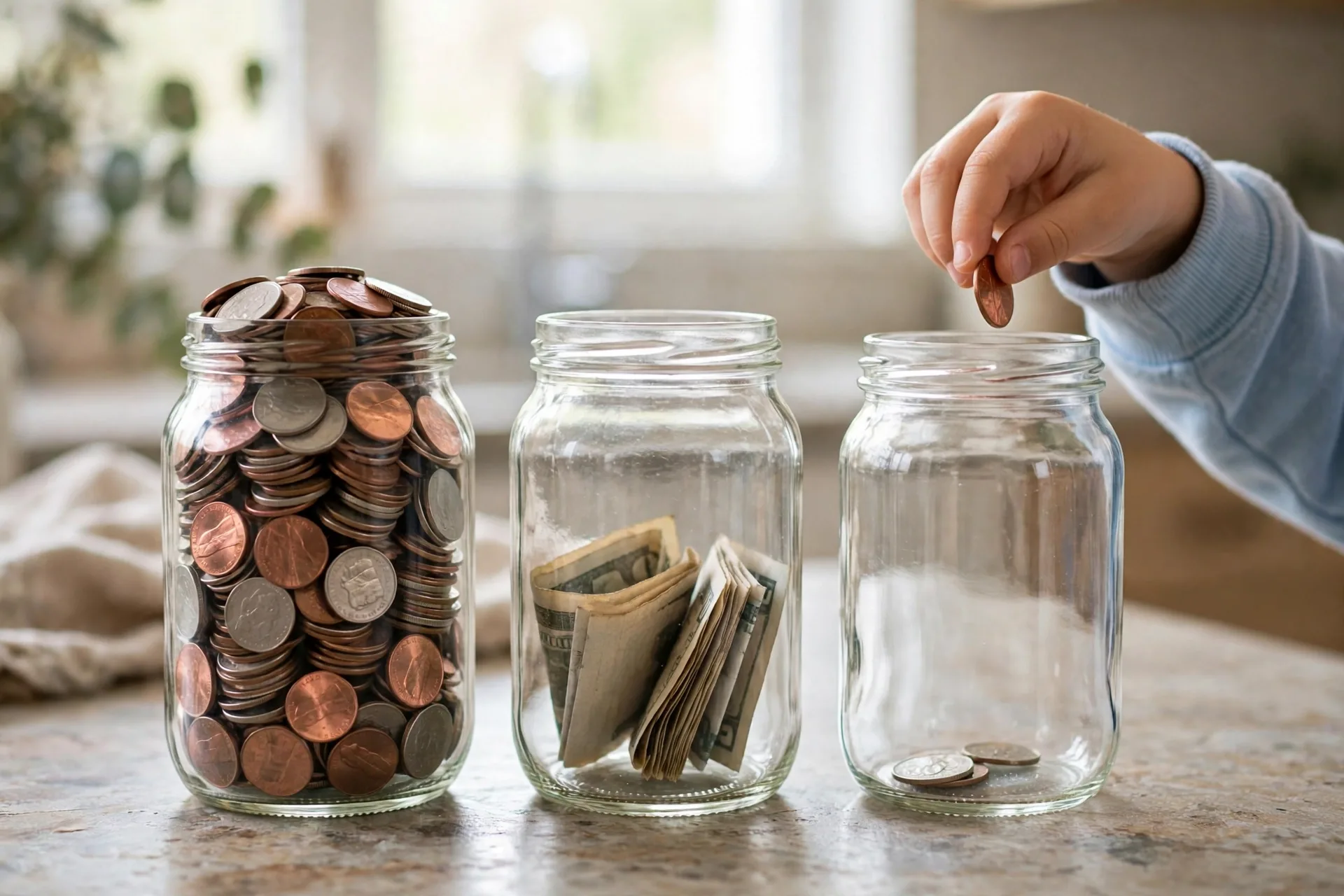
1. Start With 3 Jars: Save, Spend, and Share
The 3-jar method is a money system that splits every dollar a child gets into 3 labeled jars: save, spend, and share, and the jars make the split visible. Label 3 clear jars or envelopes, and split each dollar your child receives the same way every time. A simple split for younger kids is 50% spend, 30% save, and 20% share. Older kids can use the 50/30/20 rule: 50% for needs, 30% for wants, and 20% for saving or giving, a split the Nebraska Department of Banking and Finance recommends for kids learning to budget (Source: Nebraska Department of Banking and Finance, 2026).
The spend jar pays for small treats your child picks. The save jar pays for a goal your child names, such as a $25 toy in 5 weeks. The share jar pays for a gift or a donation your child picks. Keep the jars on a kitchen shelf where your child sees them every day. In our house, the jars worked best on the kitchen counter, in plain sight, because our daughter checked her save jar every morning and counted down the weeks to her goal without a single reminder from us.
2. Pay an Allowance With Clear Rules
An allowance is a set amount of money that a parent gives a child on a regular schedule so the child can practice money choices, and an allowance works best with 3 written rules. Rule 1 sets the amount and the pay day, such as $7 every Saturday. Rule 2 sets what the allowance must cover, such as snacks, small toys, and gifts for friends. Rule 3 sets what happens when the money runs out: no extra money until the next pay day.
Pay the allowance on the same day each week, like a real payday. Small bills help a young child split money into jars, so pay a 7-year-old in $1 bills when you can. Let your child pick one thing to buy with the spend jar each week, and let a bad buy stand. A toy that breaks in 2 days teaches more about value than 10 warnings about cheap toys.

3. Open a Small Shop at Home
A home shop is a play market where family members buy and sell small items or services with play money, and the home shop teaches prices, change, and profit in one game. Set up a table with 5 to 10 small items, such as snacks, drawings, bookmarks, or a 15-minute chore service. Give each family member the same amount of play money. Let your child set a price, take payment, and make change. Then switch roles so your child buys from you.
A family market day works even better. Each person makes something to sell, such as art, smoothies, or jokes, and each person earns play money for chores first, then spends it at the market. Stephen Day, director of the Virginia Commonwealth University Center for Economic Education, tested this exact game with families and found it teaches budgeting, prices, and trade in a low-pressure setting (Source: VCU News, 2025).
4. Turn Grocery Trips Into Money Lessons
A grocery trip is a money lesson that shows your child unit prices, store brands, and the gap between needs and wants, and one trip teaches more than one worksheet. Give your child 3 small jobs on each trip. Job 1: find 2 items on the list and read the price out loud. Job 2: compare the store brand with the name brand and pick the cheaper one when the size matches. Job 3: hold the list and say no to one item that is not on it.
Ask one question per trip, and change the question each week. Ask which costs more per ounce, the big box or the small box. Ask why a small bottle costs more than a big bag. Ask which aisle holds the priciest items per pound. Kids who hunt for prices learn that a price tag is a choice, not a fact. For a full plan to cut the bill your child helps you shop, read our guide on smart ways to save money on groceries.

5. Open a Kids Savings Account and Show the Interest
A kids savings account is a bank account in a child’s name, held with a parent, that pays interest on deposits and shows the balance on a statement, and the account turns saving into a number your child can watch grow. Take your child to the bank, let them hand over the deposit, and let them keep the receipt. Show your child the statement each month and point at 2 numbers: the deposits and the interest. Interest is money the bank pays your child for keeping money in the account, and the number is small at first, often a few cents a month on a small balance.
Add a parent match to make interest real. Offer 50 cents for each dollar your child deposits into savings, a match that Ameriprise suggests as a simple way to show how saving grows (Source: Ameriprise, 2026). A $10 deposit becomes $15 with your match, and your child sees the reward the same week. Move the save jar money into the account once a month, and let your child watch the balance climb toward the goal.

6. Teach Needs Versus Wants With a Waiting List
A waiting list is a paper list where your child writes a want, waits 7 days, and then decides if the want still matters, and the list stops impulse buys without a fight. Tape the list to the fridge. When your child asks for a toy, a game, or a snack, write the item, the price, and the date on the list, then wait 7 days. After 7 days, ask 3 questions: Do you still want it? Do you have the money in your spend jar? Is there something you want more? If the answer is yes to all 3, your child buys it with their own money.
The list works because wants fade fast. Most items lose their pull in a week, and your child learns the difference between a need and a want from their own list, not from a lecture. Needs are food, clothes that fit, school supplies, and a working bike. Wants are a second toy like the first, a snack seen in an ad, and a game a friend owns. Keep the list short, 3 to 5 items at a time, and clear bought items off the list each week.
7. Play Money Games and Read Money Books Together
Money games and money books are play activities that teach counting, prices, and saving without a lesson, and 20 minutes of play a week builds the same habits as 20 minutes of homework. Play store with real coins and a cash register toy for ages 4 to 6. Play Monopoly Junior or The Game of Life for ages 7 to 10, and talk out loud about each money choice during the game. Play a stock market game with fake money for ages 11 and up, and track 3 companies your child knows, such as a shoe brand, a game company, and a snack company.
Read one money book a month together. The CFPB Money as You Grow Bookshelf lists books by age that weave money skills into stories kids already like (Source: CFPB, 2026). The FDIC Money Smart program adds 14 free interactive games for kids and a Reality Fair simulation where youth make adult money choices in a single day (Source: FDIC, 2026). You can use those free games at home on the FDIC Money Smart page.

How Much Allowance Should Kids Get?
How much allowance kids should get depends on age and on what the allowance must cover, and a common rule of thumb sets $1 per week for each year of age, so a 6-year-old gets $6 a week and a 12-year-old gets $12 a week (Source: SoFi, 2026). The rule is a starting point, not a law. Adjust the amount to your family budget and to the costs your child must pay from it.
Start small, and raise the amount when the job grows. A 6-year-old who buys only small treats needs less than a 12-year-old who pays for school lunches, bus fare, and gifts. Tie each raise to a new cost your child takes over, and say the cost out loud: “Your allowance goes from $8 to $12 because you now pay for your own school snacks.” Keep the amount steady for at least 3 months before the next raise, so your child can plan around a number that stays put.
| Age | Weekly allowance starting point | What it should cover |
|---|---|---|
| Ages 5 to 6 | $5 to $6 | Small treats, one save-jar goal |
| Ages 7 to 9 | $7 to $9 | Treats, small toys, a gift for a friend |
| Ages 10 to 12 | $10 to $12 | Treats, toys, school extras, gifts |
| Ages 13 to 15 | $13 to $15 | Snacks, outings, clothes extras |
| Ages 16 to 18 | $16 to $20 | Food out, transport, entertainment |
Never pay more than your budget allows. A $5 allowance paid every week without fail teaches more than a $20 allowance that stops after 3 weeks. If money is tight, pay $3 a week and keep the 3-jar split, because the habit matters more than the amount.
Should Allowance Be Fixed or Tied to Chores?
Allowance should be fixed, not tied to basic chores, because basic chores are part of family life, while extra jobs can earn extra pay on top of a fixed allowance. The fixed method gives your child a steady income to plan around, and the chore method teaches that work earns money. Most families do best with a mix: a fixed base plus paid extra jobs.
A fixed allowance teaches budgeting. Your child knows $10 arrives every Saturday, so your child can plan a $30 goal in 3 weeks. A chore-based allowance teaches work and pay. Your child earns $2 for washing the car or $3 for raking leaves, so your child links effort to income. The risk of a chore-only system is a week with no pay when no chores get done, and then no money to practice with. The risk of a fixed-only system is a child who sees money as free.
| Method | How it works | Best for | Watch out for |
|---|---|---|---|
| Fixed allowance | Same amount every week, no strings | Budgeting, saving goals, steady practice | Child may see money as free |
| Chore-based allowance | Pay per chore completed | Work ethic, effort and income link | No pay in a slow week, no practice money |
| Fixed base plus extra jobs | $5 to $10 fixed, plus $2 to $5 per extra job | Most families, balance of both | Keep the rules written down |
Pick one method, write the rules on one page, and stick to it for 3 months. Basic chores, such as making a bed, clearing a plate, and tidying a room, stay unpaid, because every family member does them. Extra jobs, such as washing the car, mowing a lawn, or helping a neighbor, earn pay. To explain what a budget is before you set the rules, read our guide on what is a budget.
How to Teach Kids to Save Money for a Goal
To teach kids to save money for a goal, pick one goal, set a weekly amount, track it on paper, and celebrate the day the goal is reached. A goal turns saving from a rule into a prize, and a visible tracker turns waiting into progress your child can see.
- Pick one goal together. Let your child name the item and the price, such as a $30 art set or a $45 game.
- Count the weeks. Divide the price by the weekly save amount. A $30 goal at $5 a week takes 6 weeks.
- Make a tracker. Draw 6 boxes on paper, one per week, and let your child color one box after each deposit.
- Move the money each week. Put the save-jar money into the jar or the savings account on the same day each week.
- Celebrate the buy. Go together, let your child pay, and keep the receipt in the tracker as proof the plan worked.
Set the first goal 3 to 4 weeks away, not 3 months away. A short first win teaches the link between saving and buying. Then set a longer goal, 8 to 12 weeks out, such as a bike part or a game console fund. If your child spends the save jar early, do not refill it. Let the goal date move back by the same number of weeks, and let your child feel the cost of the choice.
What Should Teens Learn About Money Before 18?
What teens should learn about money before 18 is how to run a debit card, read a pay stub, file a simple tax return, and compare a savings account with a first investment, because those 4 skills cover the first year of adult money life. Start each skill one at a time, in the order your teen needs it.
Open a teen checking account with a debit card at age 14 or 15, and set a weekly spending limit with your teen. Review the statement together each month and sort each charge into needs and wants. When your teen gets a first job, sit down with the first pay stub and point at 3 lines: gross pay, tax withheld, and net pay. Show your teen that tax takes a bite before the money reaches the account.
Teach credit with a clear rule: a credit card is a loan, and the full balance gets paid each month. A teen who turns 18 with a debit card habit and a savings habit has a head start over a teen who never touched real money. For ideas that fit teens ready to earn, see our guide on how to make money as a teen.
Looking for teen earning ideas? Read our guide on how to make money as a teen for 13 real ways teens earn money.

5 Mistakes Parents Make When Teaching Kids About Money
The 5 mistakes parents make when teaching kids about money are paying for every want, rescuing a child who runs out of money, keeping money a secret, tying all pay to chores, and waiting until the teen years to start.
- Paying for every want. A child who never pays for a want never learns the price of one. Fix it by picking 3 things your child now pays for from the spend jar.
- Rescuing a child who runs out of money. An advance on next week teaches your child that overspending has no cost. Fix it by saying no once, and letting the week run out.
- Keeping money a secret. A child who never hears about bills thinks money comes from a card with no limit. Fix it by talking out loud at the store: “This costs $4, and we have $10 for snacks this week.”
- Tying all pay to chores. A child who earns only by chores stops doing unpaid family work. Fix it by paying a fixed base and paying extra only for extra jobs.
- Waiting until the teen years. A teen with no practice years must learn saving, budgeting, and credit in one year. Fix it by starting with coins and jars at age 3 to 5.
A Simple Weekly Routine That Keeps the Lessons Going
A simple weekly routine that keeps money lessons going takes 15 minutes a week: pay day on Saturday, a 5-minute money talk on Sunday, and one real choice at the store during the week. The routine matters more than any single lesson, because habits form from repeats, not from talks.
Saturday is pay day. Pay the allowance, split it into the 3 jars, and color one box on the goal tracker. Sunday is money talk day. Ask 2 questions: What did you buy this week, and was it worth it? What is your goal balance now? During the week, give your child one real choice at the store: pick between 2 items, compare 2 prices, or decide to skip a want and add the money to the save jar.
Browse the Personal Finance guides on Savvy Cash Flow for more beginner money guides that build on these lessons. Keep the routine going for 3 months, then raise the allowance or add a new skill, such as tracking spending in a notebook.
Frequently Asked Questions
At what age should I start teaching my child about money?
Start teaching your child about money at age 3, with coins, a clear jar, and short talks at the store, because children aged 3 can link money to buying things. Add a weekly allowance at age 6 or 7, a savings account at age 9 to 12, and a debit card at age 14 to 15. Each step matches what a child can already do.
How much allowance should I give my child?
Give your child $1 per week for each year of age as a starting point, so a 7-year-old gets $7 a week and a 12-year-old gets $12 a week (Source: SoFi, 2026). Adjust the amount to your budget and to the costs the allowance must cover. Pay the same amount on the same day each week, and keep it steady for 3 months before a raise.
Should I tie allowance to chores?
Tie allowance to chores only for extra jobs, not for basic chores, because basic chores are part of family life while extra jobs teach that work earns money. Pay a fixed base each week for budgeting practice, then pay $2 to $5 per extra job, such as washing the car or mowing a lawn. Write the rules on one page.
How do I teach my child the difference between needs and wants?
Teach your child the difference between needs and wants with a 7-day waiting list, because a want that fades in a week was never a need. Write the item, price, and date on a fridge list, wait 7 days, then ask if your child still wants it, has the money, and wants it more than anything else. Needs are food, clothes that fit, and school supplies.
What is the best way to teach kids to save money?
The best way to teach kids to save money is a 3-jar split with a named goal, a paper tracker, and a parent match of 50 cents per dollar saved. Pick one goal 3 to 4 weeks away, save a set amount each week, color one tracker box per deposit, and celebrate the buy. Short first wins teach the saving habit fast.
Should kids have their own bank account?
Kids should have their own savings account from age 9 to 12, held with a parent, because the account shows interest and a balance on a statement. Take your child to the bank, let them hand over deposits, and review the statement each month. Move save-jar money into the account monthly, and add a parent match to make growth visible.
Conclusion
How to teach kids about money at home comes down to 3 habits: give your child real money in small amounts, let your child make real choices with it, and talk about money out loud every week. Start with 3 jars at age 3, add a weekly allowance at age 6 or 7, open a savings account at age 9 to 12, and hand over a debit card at age 14 to 15. Use the grocery store, a home shop, and a waiting list as your classroom, and use a 15-minute weekly routine to keep the lessons going. Kids who practice with $5 today handle $500 with care tomorrow, and the best time to start is this week.
This article shares general information for parents, not personal financial advice. Every family should pick amounts and rules that fit its own budget.