


Introduction
Frugal habits that save thousands a year are small, repeatable money systems that cut the 3 biggest budget categories first: housing, transport, and food. The 9 habits in this guide save a typical household $3,000 to $8,000 a year, and the first 3 habits deliver more than half of that total. You do not need a raise, a second job, or a month of sacrifice to start.
This guide shows you each habit with its yearly saving, a worked example in dollars, and a first step you can take this week. You will see a savings table that adds the 9 habits to a yearly total, a frugal-versus-cheap comparison that keeps quality spending safe, and a 30-day plan that starts with the 3 habits that pay the most. You will also get answers to 6 common questions about frugal living.
Key Takeaways
- Frugal habits that save thousands a year target housing, transport, and food first, because those 3 categories take 63 percent of average household spending.
- The 9 habits in this guide save $3,000 to $8,000 a year for a typical household, and the first 3 habits deliver more than half of the total.
- Automate the saving on payday, so the money moves before spending starts, and track spending for 30 days before you cut anything.
- A 48-hour rule on purchases over $100 stops most impulse buys, and a quarterly subscription audit finds $200 to $600 a year in forgotten charges.
- Frugal living cuts waste, not joy: protect spending on your top 3 joys and cut hard everywhere else.
What Are Frugal Habits That Save Thousands a Year?
Frugal habits that save thousands a year are repeatable money systems that cut waste in the biggest budget categories, and they save $3,000 to $8,000 a year for a typical household. Frugal habits that save thousands a year work because they change a few large, automatic costs instead of dozens of tiny daily choices. A frugal habit is a system you set once and repeat, not a rule you must remember every day.
Frugality is the quality of being sparing, thrifty, and prudent in the consumption of resources, and it involves the avoidance of waste and extravagance. Read the frugality definition on Wikipedia for the full background on the term. A frugal habit has 3 parts: a clear trigger, a fixed action, and a dollar result you can measure. A habit that has no dollar result is a wish, not a habit.
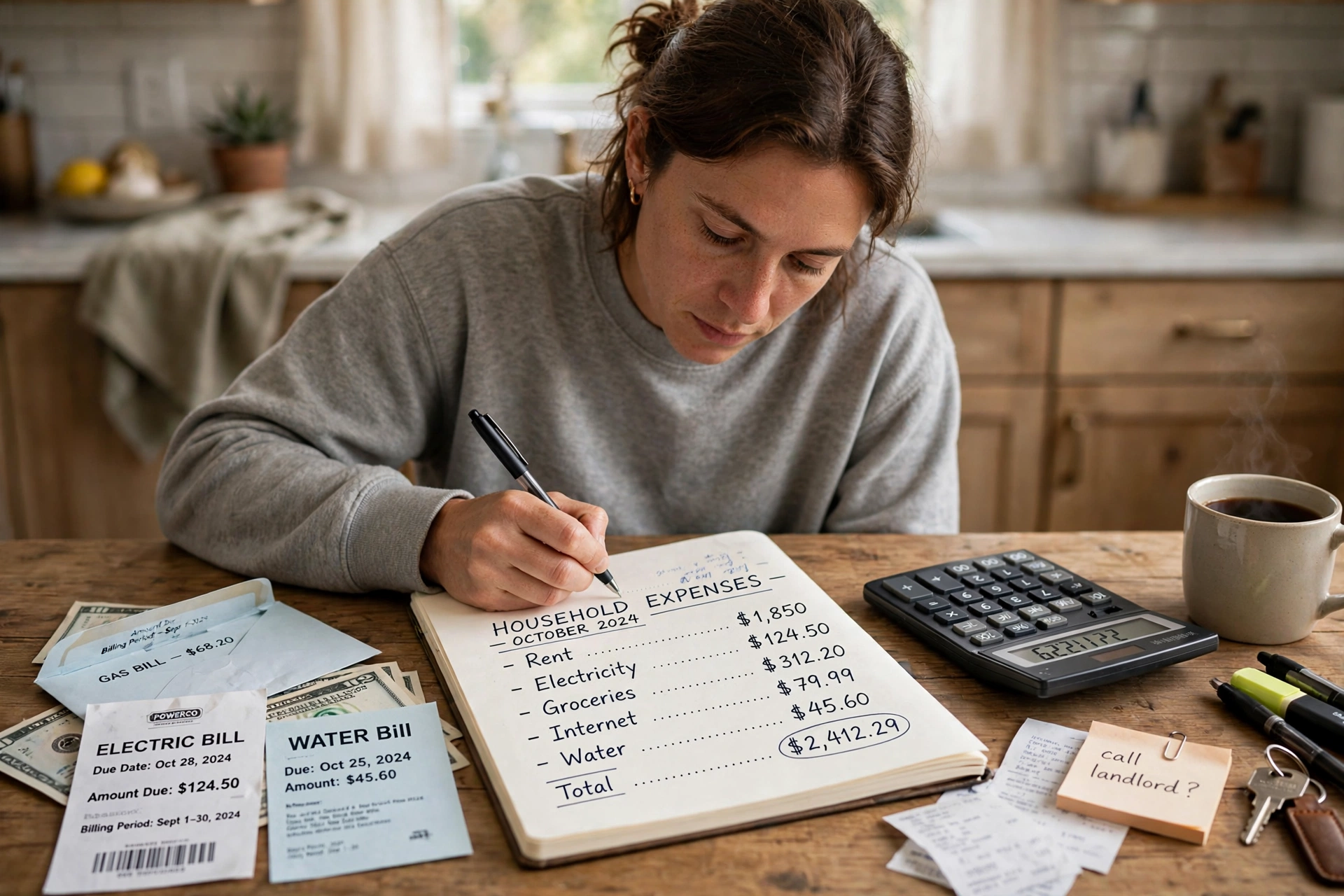
The 9 habits below follow one order: big fixed costs first, then food, then recurring bills, then daily behavior. That order is the whole point. A 5 percent cut on housing saves more than a 50 percent cut on coffee, because housing costs $26,266 a year for the average household while coffee costs a few hundred dollars. The average United States household spent $77,280 in 2024, and housing, transport, and food took over 60 percent of that total (Source: Bureau of Labor Statistics, 2024).
How Much Can 9 Frugal Habits Save in a Year?
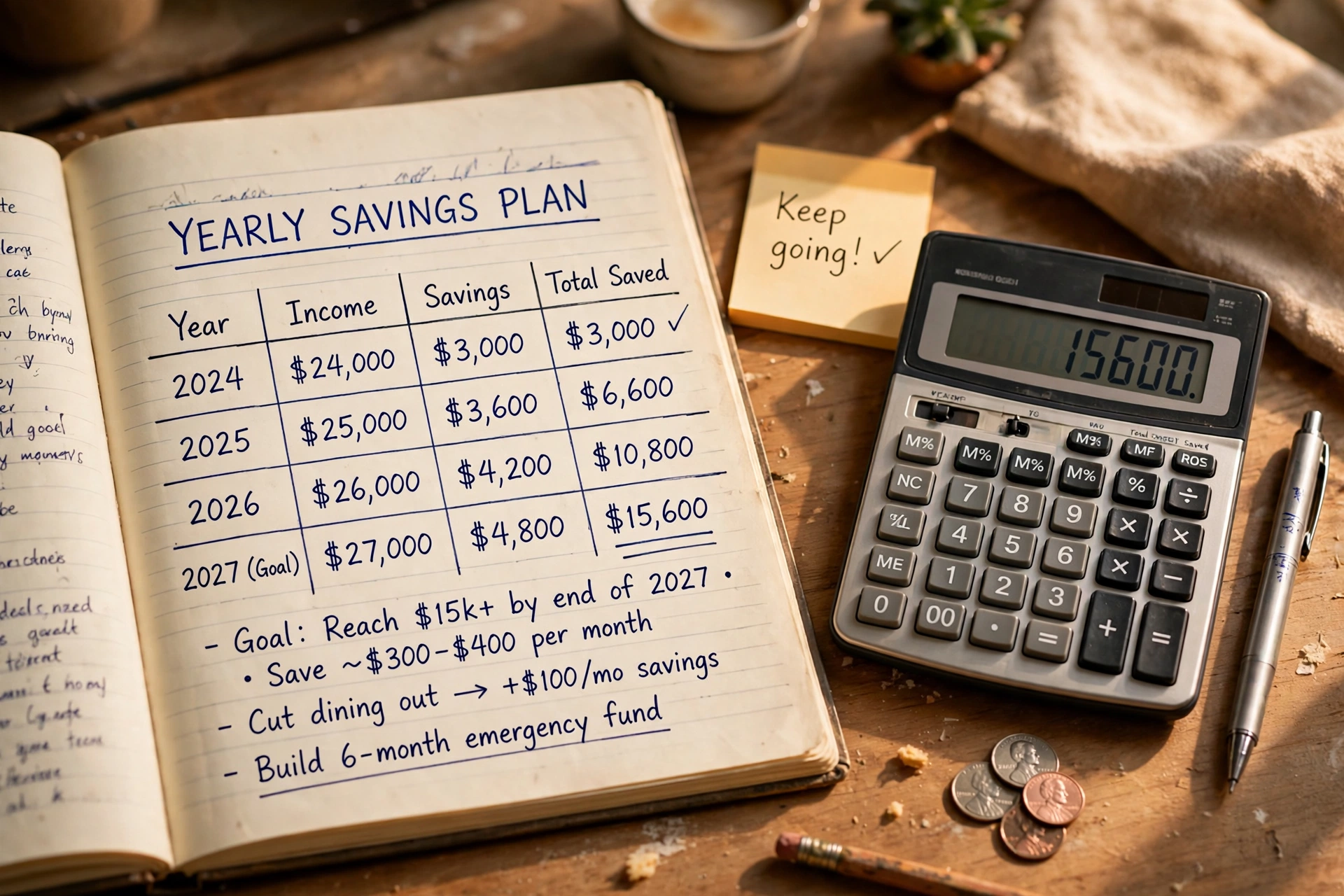
The 9 frugal habits in this guide save $3,000 to $8,000 a year for a typical household, and a household that adopts only the first 3 habits saves $2,700 to $6,600 a year. The range is wide because housing and car costs vary by city and family size, and the low end of the range still beats a year of skipping coffee by a factor of 5. The table below uses the low end of each habit so the total stays honest.
| Habit | Yearly saving (low to high) |
|---|---|
| 1. Right-size housing costs | $1,200 to $3,000 |
| 2. Keep your car longer and drive less | $1,000 to $3,000 |
| 3. Plan meals and cook at home 5 nights a week | $500 to $1,800 |
| 4. Automate savings on payday | $600 to $1,200 in new savings |
| 5. Audit subscriptions every quarter | $200 to $600 |
| 6. Negotiate bills once a year | $240 to $600 |
| 7. Buy secondhand first | $400 to $800 |
| 8. Use a 48-hour rule on purchases over $100 | $500 to $1,000 |
| 9. Track spending for 30 days | $300 to $840 |
| Total if you use all 9 | $5,940 to $13,840 |
The table total runs higher than the $3,000 to $8,000 headline range because few households use every habit at full strength, and some savings overlap. A realistic first-year total for a household that adopts 5 to 6 habits well is $3,000 to $5,000. The Frugal Living guides on Savvy Cash Flow cover each of these areas in more depth, with step-by-step plans for food, gifts, and one-income households.
Habit 1: How Do You Right-Size Housing Costs?
You right-size housing costs by keeping housing at or below 30 percent of your income, and a $250 monthly cut saves $3,000 a year. Housing is the biggest line in most budgets, so a small change here beats a dozen small cuts elsewhere. The average household spent $26,266 on housing in 2024, which was 33.4 percent of total spending (Source: Bureau of Labor Statistics, 2024).
Right-sizing housing does not mean moving to a smaller home this month. Right-sizing housing means you check 4 options in order, and you take the first one that fits. The 4 options are: negotiate the rent at renewal, refinance the mortgage when the rate drop covers the closing cost, add a roommate or rent a spare room, and move to a smaller place at the next natural move. A tenant who offers a 12-month renewal at the current rent instead of accepting a $75 monthly increase saves $900 a year, and the landlord avoids a vacant month that costs far more than $900.
A household that pays $2,000 a month and moves to $1,750 saves $3,000 a year, and a $400 cut saves $4,800 a year. That saving repeats every year with no extra work, and it also pulls down property tax, insurance, and utility costs that rise with home size. Start with the renewal talk 60 days before your lease ends, and bring 3 comparable rents from your area so the request rests on numbers. For a one-income household the housing cut matters most, and our guide to frugal living tips for families on one income shows how one paycheck covers the same habits.
Habit 2: How Do You Keep Your Car Longer and Drive Less?
You keep your car longer by driving it for 10 years instead of trading it every 5 years, and one payment-free period of 5 years saves about $32,000 over a decade. The average new-car payment is $767 a month and the average used-car payment is $537 a month (Source: Experian, 2025). A household that pays $537 a month for 60 months and then drives the same car for 60 more months without a payment keeps $32,220 that a trade-in cycle would hand to a dealer.
Keeping a car longer works only if you maintain the car you have. Service it on schedule, rotate tires every 6,000 miles, check brakes once a year, and keep a $50 monthly repair fund so a $600 repair never lands on a credit card. A $600 repair costs less than 2 months of a $537 car payment, and it buys another year of payment-free driving.
Driving less adds a second saving on top of the car payment. A household that carpools twice a week, batches errands into one trip, and walks for trips under 1 mile cuts fuel and wear by $40 to $80 a month, or $480 to $960 a year. Check your insurance at the same time: a household that runs 3 quotes every 2 years saves $400 to $1,500 a year on auto coverage alone, because carriers raise prices on loyal customers while new-customer quotes stay flat.
Habit 3: How Do You Plan Meals and Cook at Home 5 Nights a Week?
You plan meals and cook at home 5 nights a week by picking 5 dinners on Sunday, writing the list from those meals, and shopping once with a set budget. Food away from home averaged $3,945 a year per household in 2024 (Source: Bureau of Labor Statistics, 2024). A household that shifts half of that spending to home cooking saves $1,800 to $2,000 a year without going to zero restaurant meals.
Meal planning has 5 steps, and the whole system takes 30 minutes a week. The steps are: check the fridge, freezer, and pantry first; pick 5 dinners that reuse 3 core ingredients; write the shopping list from those 5 dinners; shop once with a $100 to $150 weekly budget; and cook double on 2 nights so leftovers cover lunch. A $15 lunch 5 days a week costs $3,900 a year, while a $2 homemade lunch costs $500 a year, so packed lunches alone save $3,250 a year for one worker.
The habit fails when the plan asks for 7 new recipes a week, so keep 8 to 10 repeat dinners in rotation and change only 2 each week. A repeat dinner is a win, not a rut, because it cuts the decision time that sends people to a delivery app at 6 pm. For a full weekly system, read our guide to frugal meal planning for beginners, which builds the 5-dinner plan step by step with a sample week and a shopping list.

Habit 4: How Do You Automate Savings on Payday?
You automate savings on payday by moving a fixed amount to a separate savings account on the morning you get paid, before any spending starts. A $50 transfer per paycheck saves $1,200 a year on a biweekly schedule, and a $100 transfer saves $2,400 a year. The amount matters less than the timing, because money that never sits in the checking account never gets spent.
Automation has 3 parts: a payday transfer to a high-yield savings account, a separate account that you do not link to a debit card, and a raise rule that sends half of every raise to savings. The raise rule stops lifestyle creep, which is the habit of spending more as you earn more. A $200 monthly raise that splits $100 to savings and $100 to spending still feels like a raise, and it adds $1,200 a year to savings with no extra effort.
The saving also builds the cushion that most households lack. The Federal Reserve reports that 63 percent of adults would cover a $400 emergency expense with cash or its equivalent, which means 37 percent would borrow, sell something, or fail to cover a $400 bill (Source: Federal Reserve, 2026). A $50 per paycheck transfer builds a $400 cushion in 4 months, and a $1,000 cushion in 10 months. Start at $25 per paycheck if $50 feels tight, and raise the amount by $10 every 2 months until you reach your target.
Habit 5: How Do You Audit Subscriptions Every Quarter?
You audit subscriptions every quarter by listing every recurring charge on your card statement, canceling the ones you did not use in the last 30 days, and rotating the rest. Americans waste about $200 a year on subscriptions they have forgotten about (Source: CNET, 2025). A quarterly audit finds $200 to $600 a year in most households, and it takes 30 minutes.
The audit has 4 steps. The steps are: open the last 3 card and bank statements; list every charge that repeats monthly or yearly; mark each one used, unused, or shared; and cancel every unused one on the spot, then set a calendar repeat for the first Saturday of the next quarter. Cancel the annual plans too, because a $120 yearly charge that you forgot is still $120. When I audited my own subscriptions last quarter, I found 2 streaming services I had not opened in 4 months, and canceling them freed $26 a month, or $312 a year, with no change to what I watch.
Rotation is the second half of the habit. Keep 2 streaming services at a time and swap one each month, instead of paying for 5 services at once. A household that pays for 5 services at $15 each spends $900 a year, while a household that keeps 2 and rotates spends $360 a year, so rotation alone saves $540 a year.

Habit 6: How Do You Negotiate Bills Once a Year?
You negotiate bills once a year by calling each provider, asking for the retention or loyalty rate, and quoting a competitor price. A single 15-minute call saves $20 to $50 a month on a phone, internet, or insurance bill, or $240 to $600 a year. Providers keep lower rates for customers who ask, because keeping a customer costs less than finding a new one.
Negotiate 4 bills in order: phone, internet, insurance, and any loan or credit card rate. The call script has 4 lines: state the years you have been a customer, state the competitor price you found, ask what loyalty rate they can offer, and ask for a supervisor if the first answer is no. A phone plan that drops from $65 to $20 a month saves $540 a year, and an internet plan that drops from $80 to $55 saves $300 a year.
Write the renewal dates on one page and set a reminder 30 days before each one, because a bill that renews on autopilot never gets a better price. Check the bill after the call, because a promised discount that never appears on the statement is not a saving. If a provider refuses twice, switch, and use the switch as the next negotiation point with the new provider in 12 months.
Habit 7: Why Buy Secondhand First?
You buy secondhand first because a used item in good shape costs 50 to 80 percent less than the same item new, and the saving repeats on every purchase. A household that buys clothes, furniture, kids gear, and home goods secondhand saves $400 to $800 a year, and the items work the same as new ones. Buying secondhand is a buying order, not a ban on new things: check used first, and buy new only when used fails the quality test.
The habit works best on 5 categories: kids clothes and gear, furniture, home decor, books and media, and sports gear. A kids jacket that costs $60 new costs $12 to $15 at a thrift shop or consignment store, and a child outgrows it in one season either way. A solid wood table that costs $800 new costs $150 to $250 used, and it lasts longer than a $300 flat-pack table. Cars are the biggest secondhand win of all, because a 3-year-old car costs 30 to 40 percent less than the same model new, and the car still has most of its useful life left.
Set 3 quality rules so secondhand buying stays frugal instead of cheap. The rules are: buy only items you already need, check the item in person before you pay, and skip anything with a safety risk, such as a used car seat or a used helmet. A secondhand item that breaks in a month costs more than a new one, so quality is the test, not price alone.

Habit 8: How Does a 48-Hour Rule Stop Impulse Buying?
A 48-hour rule stops impulse buying by making every purchase over $100 wait 48 hours, and about half of the urges die in that window. The rule saves $500 to $1,000 a year for most households, because impulse buys cluster in the $100 to $300 range. A $200 purchase that you skip once a month saves $2,400 a year, and most skipped purchases are never missed.
The rule has 3 parts: a $100 threshold, a notes app list with the date beside each item, and a 48-hour wait before you buy. The threshold matters, because a rule that covers every $5 coffee fails in a week, while a rule that covers only $100 purchases lasts for years. Write the item, the price, and the date, and check the list after 48 hours. If you still want the item and it fits the budget, buy it, because the rule is a pause, not a ban.
Habit 9: Why Track Spending for 30 Days Before You Cut Anything?
You track spending for 30 days before you cut anything because the log shows where the money actually goes, and most households find $300 to $840 a year in spending they did not know existed. Tracking is a measurement habit, not a budget, and it takes 2 minutes a day. A household that writes down every purchase for 30 days sees the real leaks, and the leaks are rarely the ones they guessed.
Tracking has 3 steps. The steps are: write every purchase in a notes app on the same day you make it, add the total each Sunday, and sort the month into 5 groups at the end: housing, transport, food, bills, and everything else. The “everything else” group holds the surprise, because it collects the $6 coffees, the $28 delivery fees, and the $15 app charges that feel small alone and add to $200 a month together.
Do not judge the log while you write it, because judgment stops the habit in week 2. The log is a map, not a test, and the cuts come after the 30 days, when you pick the 2 biggest leaks and fix only those. A household that tracks for 30 days and then cuts the top 2 leaks saves more than a household that cuts 10 things on day one and quits on day 12. Keep the log going for one more month after the cuts, so you can see the new total and prove the saving to yourself.
Frugal Habits vs Cheap Habits: When to Use Which
Frugal habits cut waste and protect quality, while cheap habits cut quality to save a few dollars, and the test is simple: a frugal cut still feels fine after 2 weeks, while a cheap cut still hurts after 2 weeks. Cheap living cuts quality at any cost, and it often costs more later, because a $15 pair of shoes that splits in 3 months costs $60 a year, while a $60 pair that lasts 2 years costs $30 a year.
| Choice | Frugal version | Cheap version |
|---|---|---|
| Shoes | One $60 pair that lasts 2 years | Four $15 pairs that split every 3 months |
| Food | Cook 5 nights, eat out 2 nights | Skip meals or buy only the cheapest calories |
| Car | Maintain a used car for 10 years | Skip oil changes and pay for a new engine |
| Clothes | Buy secondhand quality, or buy once | Buy the lowest price, replace often |
| Fun | Free library, park, and home movie nights | Cut all fun, then binge spend later |
| Gifts | Homemade or thrifted gifts with thought | Skip gifts and strain the relationship |
Use the frugal version when the item affects health, safety, work, or a relationship. A frugal household spends more on the 3 things it values most, and less on everything else. Name your top 3 joys, protect spending on those 3, and cut hard everywhere else.
How to Start Frugal Habits in 30 Days
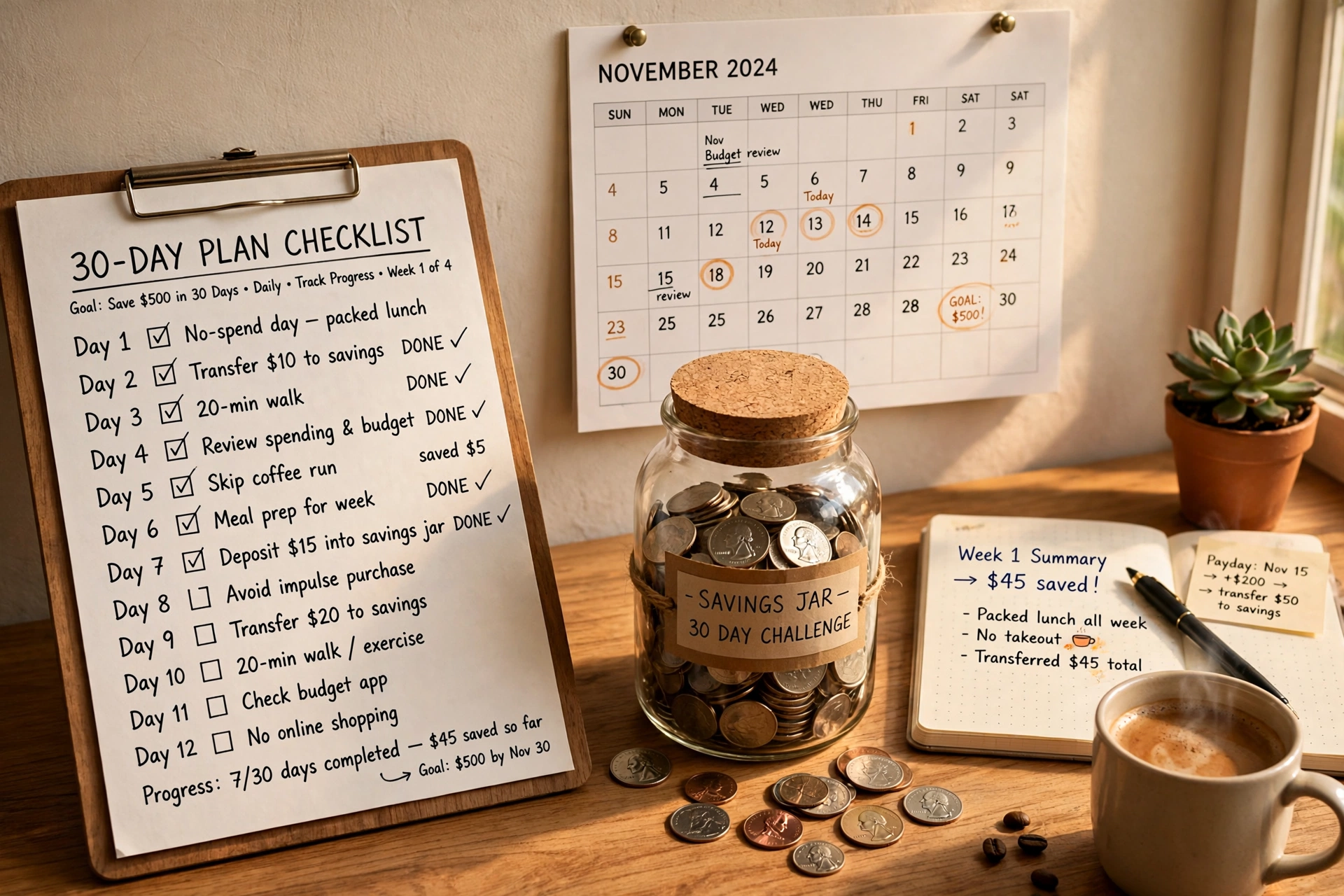
You start frugal habits in 30 days by adopting 3 habits in week 1, adding 2 habits a week, and moving the saving to a separate account every Friday. The plan below runs in 4 weeks, and it asks for about 2 hours of work in total. Do not start all 9 habits on day one, because a plan that asks for everything fails in week 2.
- Week 1: track every purchase in a notes app, and set a $50 payday transfer to a separate savings account.
- Week 1: list every subscription, cancel the unused ones, and set a quarterly audit reminder.
- Week 2: pick 5 dinners, write the list from those meals, and shop once with a set budget.
- Week 2: put every purchase over $100 on a 48-hour list, and delete saved cards from shopping apps.
- Week 3: call your phone and internet providers, ask for the loyalty rate, and quote a competitor price.
- Week 3: check used listings first for the next 3 things you need, and set the quality rules before you shop.
- Week 4: check your housing cost against the 30 percent rule, and start the renewal talk 60 days before the lease ends.
- Week 4: add the month total, move the saving to the separate account, and pick the 2 habits to keep next month.
At the end of 30 days, keep the 3 habits that saved the most and the 2 habits that felt easiest, and drop the rest until next month. A 30-day plan that ends with 5 habits is a win, because 5 habits save $2,000 to $4,000 a year, and those habits compound in year 2. For a focused reset month, try the no-spend month challenge after this 30-day plan, because the challenge pauses the leaks that the log found.
What Mistakes Make Frugal Habits Fail?
Frugal habits fail when a household cuts everything at once, tracks nothing, and treats a slip as a failure, so the fix is to cut 2 things, track the result, and restart the next day. First, cutting everything at once fails because willpower runs out in week 3, so cut the 2 biggest leaks first. Second, buying cheap instead of frugal fails because a cheap item breaks and costs twice, so buy quality once. Third, a slip is one purchase, not a failed month: log it, find the trigger, and keep going the next day.
Conclusion
Frugal habits that save thousands a year are not a month of sacrifice. Frugal habits that save thousands a year are 9 small systems that cut housing, transport, and food first, automate the saving on payday, and stop the leaks that drain $200 to $600 a year in forgotten charges. A household that starts with 3 habits saves $2,700 to $6,600 a year, and a household that keeps 5 habits saves $3,000 to $5,000 a year in year one, with more in year 2 as the housing and car habits compound.
Start this week with the 3 moves that pay the most: track spending for 7 days, set a $50 payday transfer, and audit subscriptions for 30 minutes. Those 3 moves take about 1 hour in total, and they show you the real numbers behind your budget. Savvy Cash Flow covers frugal living, budgeting, and saving in plain guides like this one, so pick the next guide that fits your biggest leak and keep the habit going. The money was there all along. The habits keep it there.
Frequently Asked Questions
How much can frugal habits save in a year?
Frugal habits save $3,000 to $8,000 a year for a typical household, and the first 3 habits deliver more than half of that total. Housing, transport, and food take 63 percent of average spending, so cuts there pay the most. Start with 3 habits, track the result for 30 days, and add 2 more habits each month.
What is the best frugal habit to start with?
The best frugal habit to start with is automating a $50 payday transfer to a separate savings account, because it works with no willpower and builds a cushion in weeks. Pair it with tracking spending for 30 days, so you see where the money goes. Those 2 habits together save $900 to $2,000 a year for most households.
Is frugal living the same as being cheap?
No, frugal living is not the same as being cheap. Frugal living cuts waste and protects quality, while cheap living cuts quality to save a few dollars and often costs more later. A frugal household buys one $60 pair of shoes that lasts 2 years, while a cheap household buys four $15 pairs that split every 3 months.
How do I save thousands a year on a low income?
You save thousands a year on a low income by cutting the biggest bills first: negotiate rent at renewal, switch phone and internet plans, and cook at home 5 nights a week. Even on a low income, those 3 moves save $1,500 to $3,000 a year. Automate $25 per paycheck to start, then raise it by $10 every 2 months.
Do frugal habits really save thousands, or just a few dollars?
Frugal habits really save thousands when they target the biggest categories, because housing costs $26,266 a year and transport costs $13,318 a year for the average household. A $250 monthly housing cut alone saves $3,000 a year. Small cuts like coffee help, but they add hundreds, not thousands, on their own.
How long does it take for frugal habits to work?
Frugal habits start working in the first month, and the full saving shows in 3 to 6 months. A subscription audit saves money in week one, a payday transfer builds a cushion in 4 months, and a housing or car change pays every month for years. Track the total monthly, so you can see the saving grow.