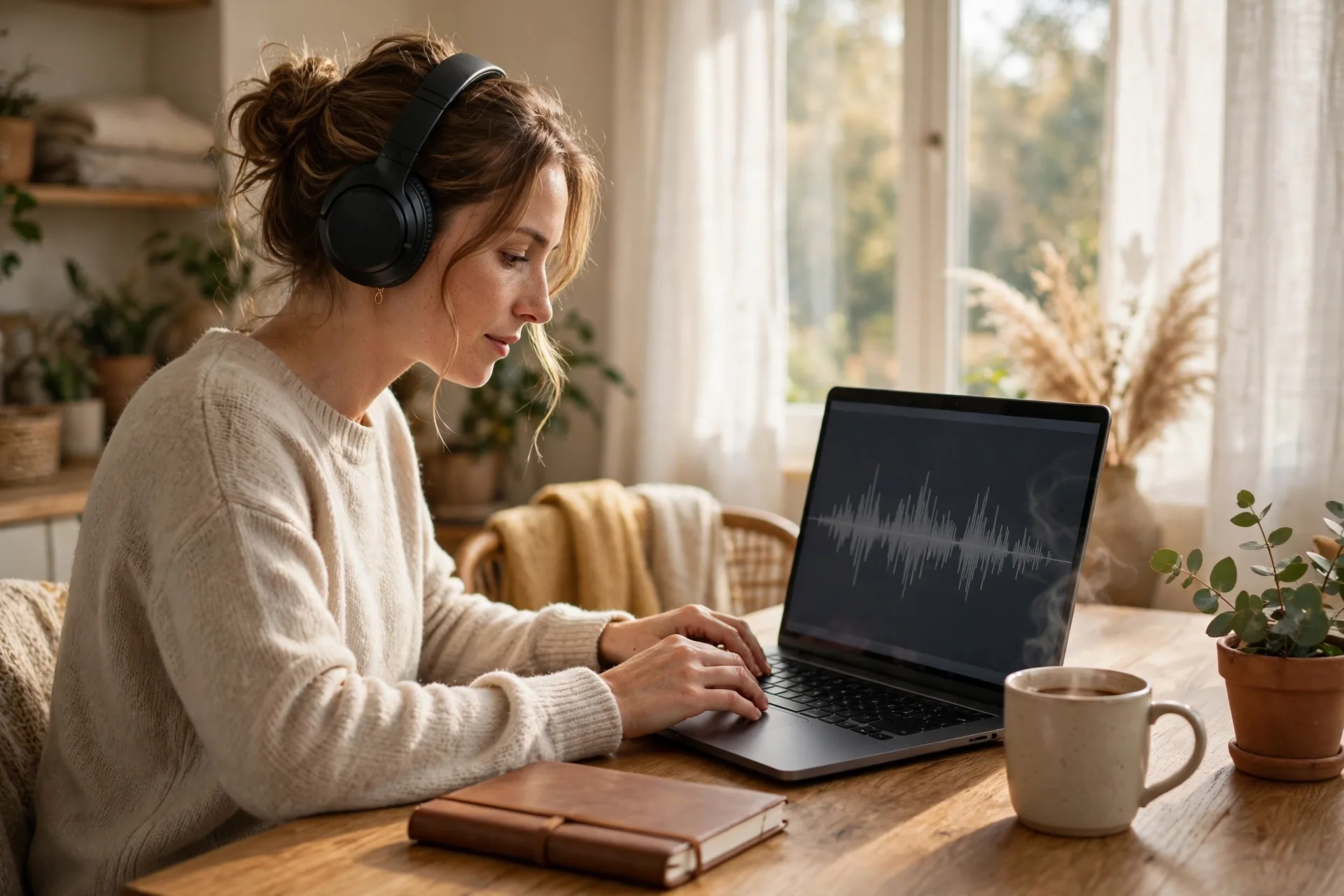
Introduction
You can make money transcribing audio from home by listening to recorded audio and typing it into text for clients who pay per audio minute or per audio hour. Beginners start on platforms such as Rev, GoTranscript, and TranscribeMe, earn $15 to $30 per audio hour at entry level, and raise pay by typing faster, passing accuracy tests, and moving into legal or medical work.
Audio transcription is a real work-from-home job that turns listening and typing into paid work. This guide explains what transcription is, what beginners earn, which skills and tools you need, the 7 steps to start, where to find jobs, how general, legal, and medical transcription compare, how to pass platform tests, how artificial intelligence (AI) changed the work in 2026, which scams to avoid, and how to grow from side income to steady pay.
Key Takeaways
- Transcription is typing spoken audio into text, and clients pay per audio minute or per audio hour, not per hour you work.
- Beginners earn $15 to $30 per audio hour on platforms, and legal or medical specialists earn $60 to $150 per audio hour.
- You need a typing speed of at least 60 words per minute (WPM), strong grammar, good headphones, and free transcription software to start.
- Rev, GoTranscript, and TranscribeMe accept beginners who pass a skills test, and each one pays weekly or on a regular schedule.
- AI now drafts clean audio, so the best-paid human work is editing AI drafts, verbatim files, and legal or medical audio.
- Never pay a fee to apply for transcription work, and always check a platform on its own site before you sign up.
What Is Audio Transcription?
Audio transcription is the process of listening to a recording and typing every word into a written document that a client can read, search, and store. Transcription turns speech into text. The audio can be a podcast episode, a business meeting, a court deposition, a doctor dictation, a research interview, or a lecture. The finished document is called a transcript.
Transcriptionists work as independent contractors in most cases. A transcriptionist picks a file from a platform queue or accepts a file from a direct client, types the transcript, formats it to the client style guide, and submits it by a deadline. A style guide is a set of rules for speaker labels, timestamps, filler words, and inaudible sections.
Transcription has 3 main types. General transcription covers meetings, interviews, podcasts, and lectures, and it needs no formal training. Legal transcription covers court hearings and depositions, and it needs legal vocabulary and strict formatting. Medical transcription covers doctor dictations and patient notes, and it needs clinical vocabulary and training.
How to Make Money Transcribing Audio From Home: What Beginners Earn
Beginners make money transcribing audio from home at $15 to $30 per audio hour on general transcription platforms, which works out to $5 to $15 per real hour of work because 1 audio hour takes 2 to 3 hours to type at beginner speed. Pay rises with speed, accuracy, and specialty. Experienced general transcriptionists earn $30 to $60 per audio hour. Legal transcriptionists earn $75 to $150 per audio hour. Medical transcriptionists earn $60 to $120 per audio hour. AI transcript editors earn $20 to $45 per audio hour. (Source: BriefBuck (2026); Damongo (2026))
The pay unit matters more than the pay number. Clients pay per audio hour, which means 1 hour of recording, not 1 hour of your time. A beginner types 1 audio hour in 2 to 3 hours. A practiced transcriptionist types the same hour in about 90 minutes. Difficult audio with several speakers takes 4 to 6 hours per audio hour. Divide every advertised rate by your real speed before you judge it.
Platform pay shows the same pattern. Rev pays transcriptionists $0.40 to $1.10 per audio minute, which is $24 to $66 per audio hour. GoTranscript pays from $0.65 per audio minute for English work, up to $1.75 per audio minute. TranscribeMe pays $15 to $22 per audio hour and splits files into short clips of 2 to 4 minutes. Daily Transcription pays $45 to $66 per hour of material for general work and $60 to $90 per hour of material for AI editors, and it asks for 1 to 2 years of experience. (Source: iamtypist.dev (2026), pay checked October 26, 2026)
Medical transcription has official wage data: the United States Bureau of Labor Statistics (BLS) lists median pay of $40,410 a year, or $19.43 an hour, for medical transcriptionists in its May 2025 survey, and it projects medical transcriptionist jobs to fall 4 percent over the next decade. (Source: U.S. Bureau of Labor Statistics (2025))
If you want more ways to earn from home, browse the Make Money Online guides on Savvy Cash Flow for side hustles that pair well with transcription.

What Skills Do You Need to Transcribe Audio From Home?
You need a typing speed of at least 60 words per minute (WPM), 98 percent accuracy, strong English grammar, sharp listening, and the discipline to follow a style guide exactly. Typing speed sets your real hourly pay, because faster typing turns the same audio hour into fewer work hours. Accuracy keeps clients, because a transcript with wrong names or numbers is useless.

Grammar matters as much as speed. Platform tests check grammar, punctuation, and style guide rules before they check speed. Most entry tests fail people on formatting, not on hearing, so read the full style guide before you take any test.
Listening skill means hearing words through accents, background noise, fast speech, and overlapping speakers. Practice with real audio before you apply. Find an interview recording, transcribe 15 minutes of it, and time yourself. That timed number is your real speed.
You do not need a degree or a certificate for general transcription. Legal transcription needs legal vocabulary and formatting knowledge, which you can learn from a short course or a handbook. Medical transcription usually needs a training program and a credential such as Registered Healthcare Documentation Specialist (RHDS), and training programs run $1,500 to $2,500 and take 6 to 12 months. (Source: Hustlers Library (2026))
What Equipment and Software Do You Need to Transcribe Audio From Home?
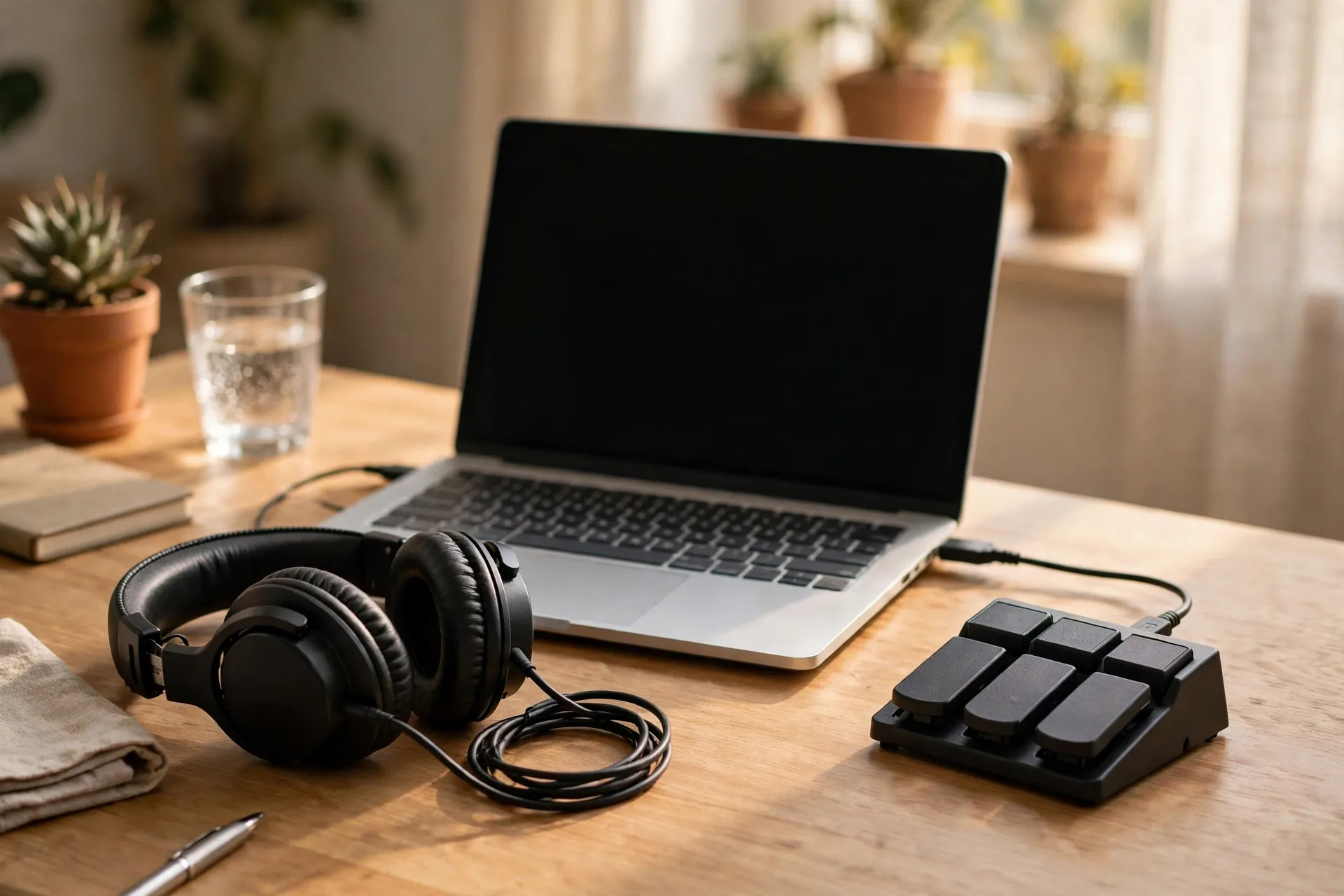
You need a reliable computer, good closed-back headphones, free transcription software, and a stable internet connection to transcribe audio from home. A foot pedal is helpful at volume, and it costs $30 to $80, but you do not need one before your first paid job. Total startup cost runs $60 to $230 if you buy headphones and a foot pedal, and $0 if you already own both. (Source: Hustlers Library (2026))
Headphones matter more than any other purchase. Closed-back headphones block room noise and reproduce speech clearly. The Sony MDR-7506 is a long-standing professional pick at about $90.
Express Scribe by NCH Software is the most used free transcription player, and it supports foot pedals, variable playback speed, and most audio formats. oTranscribe is a free browser-based option for light use.
A USB foot pedal lets you play, pause, and rewind audio without lifting your hands from the keyboard. The Infinity IN-USB-2 is the standard beginner pick at about $55, and a foot pedal can raise output speed by 20 to 40 percent. Buy it in month 2, after you know the work suits you. When I timed a 10-minute practice interview at 65 words per minute, the file took 42 minutes to finish, and most of that time went to replaying two speakers who talked over each other.
7 Steps to Start Transcribing Audio From Home
To start transcribing audio from home, test your typing speed, practice on real audio, learn style guide rules, pick 1 beginner platform, pass its test, complete your first paid files, and then raise your rate by adding a specialty. The 7 steps below take most beginners 2 to 4 weeks from first practice to first pay.
- Test your typing speed and accuracy. Use a free typing test. Aim for 60 WPM with 98 percent accuracy before you apply anywhere.
- Practice on real audio for 2 weeks. Transcribe podcast interviews and meeting recordings. Time each file and learn how long 10 audio minutes really take you.
- Study 1 style guide in full. Pick the style guide of the platform you plan to join. Learn its rules for speaker labels, timestamps, filler words, and inaudible marks.
- Pick 1 beginner platform and apply. Rev, GoTranscript, and TranscribeMe all accept beginners who pass a test. Apply to 1 platform first so you can focus on its test.
- Pass the grammar test and the transcription sample. Read every instruction twice. A careful transcript at 65 WPM beats a sloppy one at 90 WPM.
- Complete your first 10 paid files. Take short, clean files first. Build your accuracy score and your speed before you chase hard files.
- Add a specialty after 3 to 6 months. Pick legal, medical, verbatim, or AI post-editing. Each specialty raises your per-audio-hour rate by 1.5 to 2 times.
Where Can You Find Transcription Jobs From Home?
You can find transcription jobs from home on beginner platforms such as Rev, GoTranscript, and TranscribeMe, on freelance marketplaces such as Upwork and Fiverr, and through direct clients such as podcasters, researchers, and law firms. Platforms give steady volume and low pay. Direct clients give higher pay and need outreach. Most working transcriptionists use both at once.
The table below compares 6 legit platforms using pay published on each company own page on October 26, 2026. (Source: iamtypist.dev (2026))
| Platform | Pay | Payout | Experience needed | Best for |
|---|---|---|---|---|
| Rev | $0.40 to $1.10 per audio minute | Weekly, PayPal | Skills test and sample | Beginners with strong English |
| GoTranscript | From $0.65 per audio minute, up to $1.75 | Weekly, PayPal or Payoneer | Short test | Beginners, many languages |
| TranscribeMe | $15 to $22 per audio hour | Regular payouts | Exam and training | Short tasks in spare time |
| Speechpad | $0.25 to $2.50 per audio minute | Twice a week | Application | Variety of jobs |
| Wordibly | $0.18 to $0.65 per audio minute | Twice a month, PayPal or Payoneer | Grammar and typing test | Editing AI drafts |
| Daily Transcription | $45 to $66 per hour of material | Contractor pay | 1 to 2 years | Experienced transcribers |
Direct clients pay more than platforms. Podcast producers, academic researchers, market research firms, and law firms hire transcriptionists directly at $1.00 to $2.50 per audio minute. (Source: Hustlers Library (2026)) Post a clear service on Upwork or Fiverr with a narrow niche, such as podcast transcription, and a stated turnaround time. A narrow service wins more jobs than a general one.

If you like flexible online work, learn how to become a virtual assistant with no experience next, because virtual assistant work pairs well with transcription once your home office is set up.
General vs Legal vs Medical Transcription: Which Pays Best?
Legal transcription pays best at $75 to $150 per audio hour, medical transcription pays $60 to $120 per audio hour, and general transcription pays $15 to $60 per audio hour, so legal work pays 2 to 5 times more than general work for the same audio hour. The pay gap comes from training, risk, and rules, not from typing speed alone.
| Type | Training needed | Pay per audio hour | Real hourly pay | Entry route |
|---|---|---|---|---|
| General transcription | None formal | $15 to $60 | $5 to $40 | Rev, GoTranscript, TranscribeMe |
| Legal transcription | Legal vocabulary and formatting | $75 to $150 | $35 to $70 | Allegis, law firms, court agencies |
| Medical transcription | Clinical training, RHDS credential | $60 to $120 | $30 to $60 | Hospitals, clinics, health systems |
| AI post-editing | Editing and proofreading skill | $20 to $45 | $20 to $45 | Wordibly, Daily Transcription, Upwork |
| Verbatim transcription | Verbatim style rules | $60 to $90 | $25 to $45 | Research firms, legal teams |
General transcription is the widest door. The audio is meetings, interviews, podcasts, and lectures. No certificate is needed, and the pay is lowest because AI drafts clean general audio well.
Legal transcription needs strict formatting and legal terms. Depositions, hearings, and witness statements must follow court rules. Errors carry real consequences, so clients pay more and rebook transcriptionists they trust.
Medical transcription needs anatomy, drug names, and clinical terms. A wrong drug name is a patient safety issue, not a typo. Training takes 6 to 12 months, and the credential opens steady work from hospitals and clinics.
AI post-editing is the newest lane. A client runs audio through AI first, then pays a human to fix names, speaker turns, and technical terms. The work pays $25 to $60 per audio hour and takes 3 to 5 hours per audio hour instead of 10, so the real hourly pay is the highest on the board for fast typists. (Source: Damongo (2026))
How Do You Pass Transcription Tests and Get Hired?
You pass transcription tests by reading the style guide in full, typing a clean sample at 60 WPM or faster, and submitting formatting that matches the guide exactly, because most entry tests fail people on formatting, not on hearing. Rev reports pass rates below 30 percent on the first attempt, so practice before you apply. (Source: Hustlers Library (2026))
Prepare in 4 moves. First, take a free typing test and lift your speed to 60 WPM with 98 percent accuracy. Second, transcribe 5 practice files with the platform style guide open beside you. Third, learn the keyboard shortcuts for play, pause, and 5-second rewind, and stop reaching for the mouse. Fourth, type in a first pass and correct in a second pass, because stopping to fix each error breaks your rhythm.
On test day, slow the playback to 0.75 speed instead of rewinding the same line. Listen ahead while you type, so you type one phrase behind what you hear. Check names, numbers, and speaker labels twice. If you fail a test, wait, practice the weak spot, and retake it.
How Did AI Change Transcription Work in 2026?
AI changed transcription work in 2026 by taking over the first draft of clean single-speaker audio, which cut entry-level rates, and by creating paid human work in editing AI drafts, verbatim files, and legal or medical audio that software still handles badly. Clean audio with 1 speaker is now transcribed well enough by software that few clients pay a person to type it from zero.
The work that still pays well has overlapping speakers, heavy accents or poor recordings, technical, legal, or medical terms, strict formatting or legal consequences, or a finished file a producer can publish without touching it. AI still fails on names, speaker turns, homophone errors, and technical terms, and fixing those errors is a real skill with large volume.
The shift shows on job pages. Rev legal roles now include editing AI drafts. Wordibly has an AI-assisted rate. Daily Transcription hires AI Editors at $60 to $90 per hour of material, which is more than its general transcription rate. (Source: iamtypist.dev (2026)) Position yourself against AI, not beside it: sell speaker identification in overlapping talk, domain-accurate terms, confidential handling under a non-disclosure agreement (NDA), and a finished file that needs zero cleanup.
What Transcription Scams Should You Avoid?
You should avoid any transcription job that charges a fee to apply, promises high pay with no test, asks for bank details before you complete work, or offers to sell you an approved account, because legit platforms never charge workers to join. Scams in this field follow the same 4 patterns every time.
Fee scams charge for access to jobs, starter kits, or certificates. Rev, GoTranscript, TranscribeMe, Speechpad, Wordibly, and Daily Transcription charge no application fee. Pay scams promise $50 or more per hour with no test and no experience, while real entry pay is $15 to $30 per audio hour. Account scams offer to sell you an approved Rev or GoTranscript account, which breaks platform rules and can cost you your pay. Data scams ask for bank details, ID scans, or passwords before you complete any work, while a legit platform pays through PayPal or Payoneer after approved work.

How Do You Grow Transcription From Side Income to Steady Pay?
You grow transcription from side income to steady pay by raising your speed to 80 WPM or faster, adding 1 specialty, moving from platforms to direct clients, and turning one-off jobs into monthly retainers. Each step raises pay without adding hours.
Raise speed first, because speed is your rate. Doubling your speed doubles your income with no negotiation. Learn keyboard shortcuts, build a text expansion list for names and terms that repeat, and use templates for regular clients.
Add a specialty second. Legal, medical, verbatim, or technical audio pays 1.5 to 2 times more per audio hour than general audio. One niche course or one completed legal project is usually enough to cross the line.
Move to direct clients third. After 3 to 6 months of platform work, pitch podcasters, researchers, and law firms. Direct clients pay $1.00 to $2.50 per audio minute. Ask each happy client for a referral, because people who hire transcriptionists usually know others who need one.
Turn one-off jobs into retainers fourth. A podcast that ships weekly will pay the same per-episode rate for a year if you propose a monthly retainer. Sell a bundle, not a transcript: a speaker-labeled transcript, timestamps, show notes, and a chapters file command a 30 to 50 percent premium over a raw transcript. (Source: Damongo (2026))
Track your money like a business. Transcription income is taxable, even when no form arrives. The IRS gig economy tax center states that you must report gig income on a tax return even if the income is part-time, temporary, or not reported on a Form 1099. Set aside 25 to 30 percent of each payment for tax, and keep a simple record of every payment and expense.
Frequently Asked Questions
How much can a beginner make transcribing audio from home?
Beginners earn $15 to $30 per audio hour on general transcription platforms, which is $5 to $15 per real hour of work because 1 audio hour takes 2 to 3 hours to type at beginner speed. Pay rises with typing speed, accuracy, and specialty, and experienced general transcriptionists earn $30 to $60 per audio hour.
Do you need experience to start transcription work from home?
No, you do not need experience to start general transcription work from home, because Rev, GoTranscript, and TranscribeMe accept beginners who pass a grammar test and a transcription sample. You need a typing speed of at least 60 WPM and strong grammar, and 1 to 2 years of experience is needed only for higher-paid roles such as Daily Transcription.
How long does it take to transcribe 1 hour of audio?
It takes a beginner 2 to 3 hours to transcribe 1 hour of clean audio, about 90 minutes once practice has settled in, and 4 to 6 hours for difficult audio with several speakers. Speed, audio quality, speaker count, and accents all change the time, so divide a per-audio-hour rate by your real speed before you accept a job.
Is transcription still worth it with AI in 2026?
Yes, transcription is still worth it as a specialty in 2026, because medical, legal, and verbatim work pays well and is short of people, while general transcription alone is one of the lower-paid options once you count real hours. AI took the easy first draft, and the growth is in editing AI drafts and handling audio that software fails on.
What is the best transcription site for beginners?
Rev and GoTranscript are the best transcription sites for beginners, because both pay weekly, publish their rates, and accept beginners who pass a skills test. TranscribeMe suits spare minutes with short 2 to 4 minute clips, and Daily Transcription pays the most per audio hour but asks for 1 to 2 years of experience.
Can you make money transcribing audio from home with no degree?
Yes, you can make money transcribing audio from home with no degree, because general transcription needs typing speed, grammar, and listening skill, not a formal credential. A degree or certificate is needed only for medical transcription, which usually asks for a training program and an RHDS credential.
Conclusion
You can make money transcribing audio from home by starting on a beginner platform, typing clean general audio at 60 WPM or faster, and moving into legal, medical, or AI post-editing work that pays $60 to $150 per audio hour. The work is real, the startup cost is low, and the pay grows with speed and specialty, not with hours alone. Pick 1 platform this week, take its test, and finish your first paid file. That first file is the step that turns practice into income, and Savvy Cash Flow covers more home income ideas like this one for readers who want to earn on their own schedule.