

Introduction
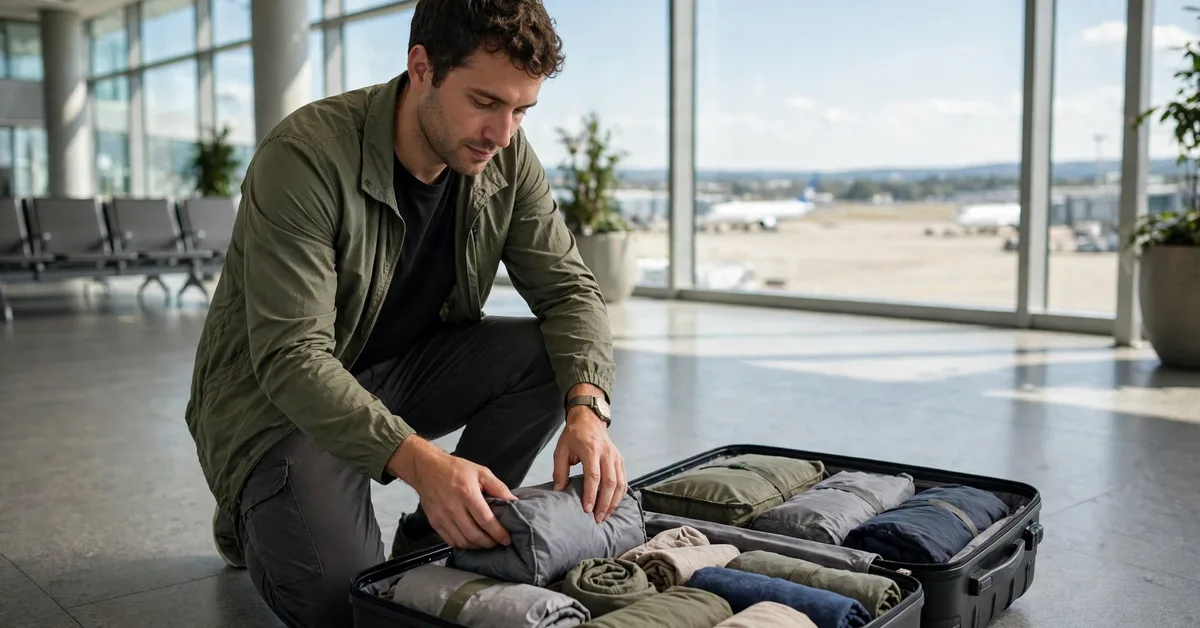
A budget travel packing list is a short, fixed list of clothes, toiletries, electronics, and documents that fits in one carry-on bag and one personal item, so you pay no checked bag fee and no overweight fee on your trip. A budget travel packing list works because the first checked bag now costs $45 each way on most US airlines.
This guide gives the exact 7-day list with quantities, the 2026 fee tables by airline, the size and weight limits, the liquids rules, and a 7-day packing plan you can copy before your next trip. The list has 4 parts: the fee math, the airline limits, the complete list with quantities, and the packing routine that fits it all in one bag. The guide also covers what to leave behind, overweight fees, budget airline rules, and the changes for families and cold weather.
Key Takeaways
- A budget travel packing list fits a 7-day trip in one carry-on and one personal item, and it saves $90 per person per round trip in checked bag fees.
- The first checked bag costs $45 each way on American, Delta, United, and JetBlue in 2026, and a family of 4 pays $360 on one round trip.
- Pack 4 tops, 2 bottoms, 7 sets of underwear and socks, 1 light jacket, and 2 pairs of shoes for a 7-day trip, and do laundry once mid-trip.
- Keep liquids in containers of 3.4 ounces (100 ml) or less in one quart-sized bag, and buy full-size toiletries on arrival.
- Weigh your bag at home with a $10 to $12 luggage scale, because an overweight bag adds a $100 to $200 fee on top of the checked bag fee.
What Is a Budget Travel Packing List?
A budget travel packing list is a packing list that limits every item to what fits in a free carry-on bag and a free personal item, so a traveler pays zero in airline bag fees. A budget travel packing list differs from a normal packing list because every item on a budget travel packing list earns its place by weight, size, and use. A budget travel packing list has 5 groups: clothing, toiletries, electronics, documents and money, and trip extras. Each group has a fixed count, and the count covers 7 days.
A budget travel packing list suits any trip of 7 days or less, and the same list stretches to 14 days with one laundry stop. A budget travel packing list works for US domestic flights, European budget flights, and road trips, because the same small bag also skips the bag drop line and the baggage carousel. Browse the Budget Travel guides for more trips that use the same cost-first method.
How Much Do Extra Fees Cost in 2026?
Extra fees cost $90 per person for one checked bag on a round trip in 2026, and extra fees cost $360 for a family of 4 on the same round trip, because the first checked bag costs $45 each way on most US airlines. A second checked bag costs about $55 each way, so 2 bags on a round trip cost about $200 per person. An overweight bag adds a $100 to $200 fee on top of the checked bag fee (Source: Byline Travel (2026)). A bag paid at the airport or within 24 hours of departure costs $5 more each way than a bag paid online at booking.
| Airline | First checked bag, each way | Round trip, 1 bag | Family of 4, round trip |
|---|---|---|---|
| American | $45 | $90 | $360 |
| Delta | $45 | $90 | $360 |
| United | $45 | $90 | $360 |
| JetBlue | $45 | $90 | $360 |
| Alaska | $40 | $80 | $320 |
| Southwest, Basic fare | $35 | $70 | $280 |
| Spirit / Frontier | $45 to $85 | $90 to $170 | $360 to $680 |
The table uses 2026 fees (Source: Byline Travel (2026)). Southwest ended free bags on Basic fares in late 2025, so Southwest Basic now charges $35 for the first bag. Spirit and Frontier fees change with route and distance, so the Spirit and Frontier range is wide. The family of 4 column assumes 1 bag per person on a round trip. A traveler who takes 4 round trips a year and checks a bag each time pays $360 to $680 a year in bag fees alone. A carry-on bag that costs $80 to $150 once pays for itself in 1 to 2 trips, then keeps saving on every trip after. Pair the fee math with the 13 cheap travel hacks that actually work in 2026 to cut the rest of the trip cost too.
Carry-On Size and Weight Limits by Airline
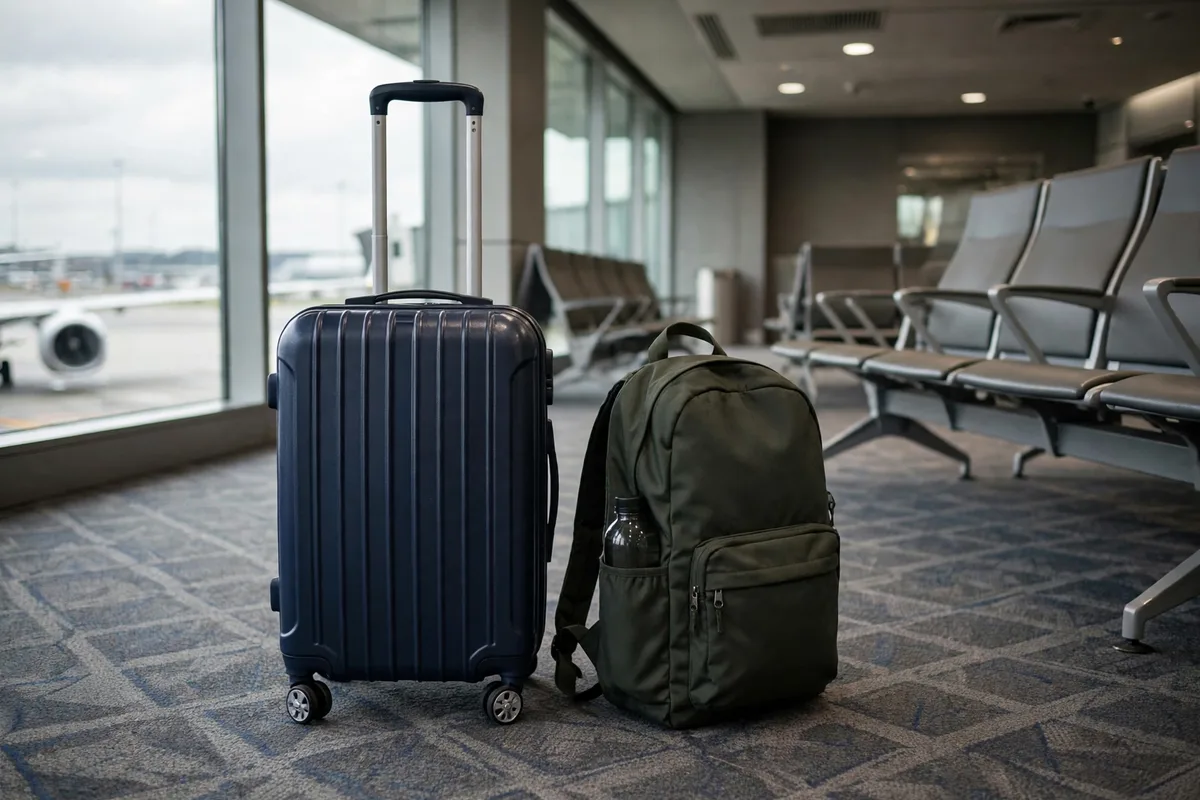
Carry-on size limits are 22 x 14 x 9 inches on most US airlines, and carry-on weight limits do not apply on most US domestic flights, because US carriers check the size of a carry-on bag and do not weigh it at the gate. A personal item is a second, smaller bag that fits under the seat in front of you, and a personal item measures about 18 x 14 x 8 inches on most US airlines. The International Air Transport Association (IATA) recommends a maximum cabin bag size of 56 x 45 x 25 cm (22.0 x 17.7 x 9.8 inches), but the IATA guideline is voluntary and each airline sets its own limit (Source: Wikipedia (2026)). Read the hand luggage size rules for the full table of airline size limits by carrier.
| Airline | Carry-on size | Weight limit | Personal item |
|---|---|---|---|
| American | 22 x 14 x 9 in | No limit | 18 x 14 x 8 in |
| Delta | 22 x 14 x 9 in | No limit | Fits under seat |
| United | 22 x 14 x 9 in | No limit | 17 x 10 x 9 in |
| Southwest | 24 x 16 x 10 in | No limit | Fits under seat |
| JetBlue | 22 x 14 x 9 in | No limit | 17 x 13 x 8 in |
| Frontier | 24 x 16 x 10 in | 35 lbs | 14 x 18 x 8 in |
| Ryanair, free allowance | 40 x 20 x 25 cm | 10 kg | Under seat only |
| easyJet, free allowance | 45 x 36 x 20 cm | 15 kg | Under seat only |
| Wizz Air, free allowance | 40 x 30 x 20 cm | 10 kg | Under seat only |
Measure your bag with the wheels and handle included, because airlines measure the full outside size. A bag that measures 22 x 14 x 9 inches on paper can fail the sizer when the wheels add half an inch, so measure the bag yourself before you buy it. European carriers weigh carry-on bags at the gate and enforce 8 to 10 kg limits, so a bag that passes in the US can fail in Europe. Pack the heavy items in your personal item on European flights, because the personal item often escapes the weight check.
The Complete Budget Travel Packing List
The complete budget travel packing list for a 7-day trip has 31 items in 5 groups, and the complete list fits in one carry-on bag plus one personal item when you roll soft clothes and use 3 packing cubes. The list below gives the exact count for each item. The counts assume warm weather and one laundry stop on day 4. Cold weather adds 2 items: a packable down jacket and a base layer top.
| Group | Item | Quantity for 7 days |
|---|---|---|
| Clothing | T-shirts or tops | 4 |
| Clothing | Long-sleeve shirt | 1 |
| Clothing | Pants or trousers | 2 |
| Clothing | Shorts or skirt | 1 |
| Clothing | Underwear | 7 |
| Clothing | Socks | 7 |
| Clothing | Sleepwear | 1 |
| Clothing | Light jacket | 1 |
| Clothing | Walking shoes, worn on plane | 1 pair |
| Clothing | Sandals or second shoes | 1 pair |
| Toiletries | Toothbrush | 1 |
| Toiletries | Toothpaste, travel tube | 1 |
| Toiletries | Shampoo bar, solid | 1 |
| Toiletries | Deodorant stick | 1 |
| Toiletries | Sunscreen stick, solid | 1 |
| Toiletries | Lip balm | 1 |
| Toiletries | Medications, full supply | 1 set |
| Electronics | Phone | 1 |
| Electronics | Phone charger | 1 |
| Electronics | Power bank | 1 |
| Electronics | Universal adapter | 1 |
| Electronics | Headphones | 1 |
| Documents | Passport or photo ID | 1 |
| Documents | Payment cards | 2 |
| Documents | Travel insurance details | 1 copy |
| Extras | Reusable water bottle, empty | 1 |
| Extras | Laundry soap sheets | 1 pack |
| Extras | Packing cubes | 3 |
| Extras | Luggage scale | 1 |
| Extras | Foldable daypack | 1 |
| Extras | Small first-aid kit | 1 |
Pick one color family for all 4 tops and both bottoms, so every top works with every bottom. Black, navy, grey, and white mix with each other, and 4 tops plus 2 bottoms make 8 outfits. Merino wool tops cost more up front and earn the price back on the road, because one merino top wears 3 to 4 days without washing and dries overnight. A capsule wardrobe is a small set of clothes in one color family where every piece works with at least 2 other pieces.
How to Pack a Carry-On in 7 Steps
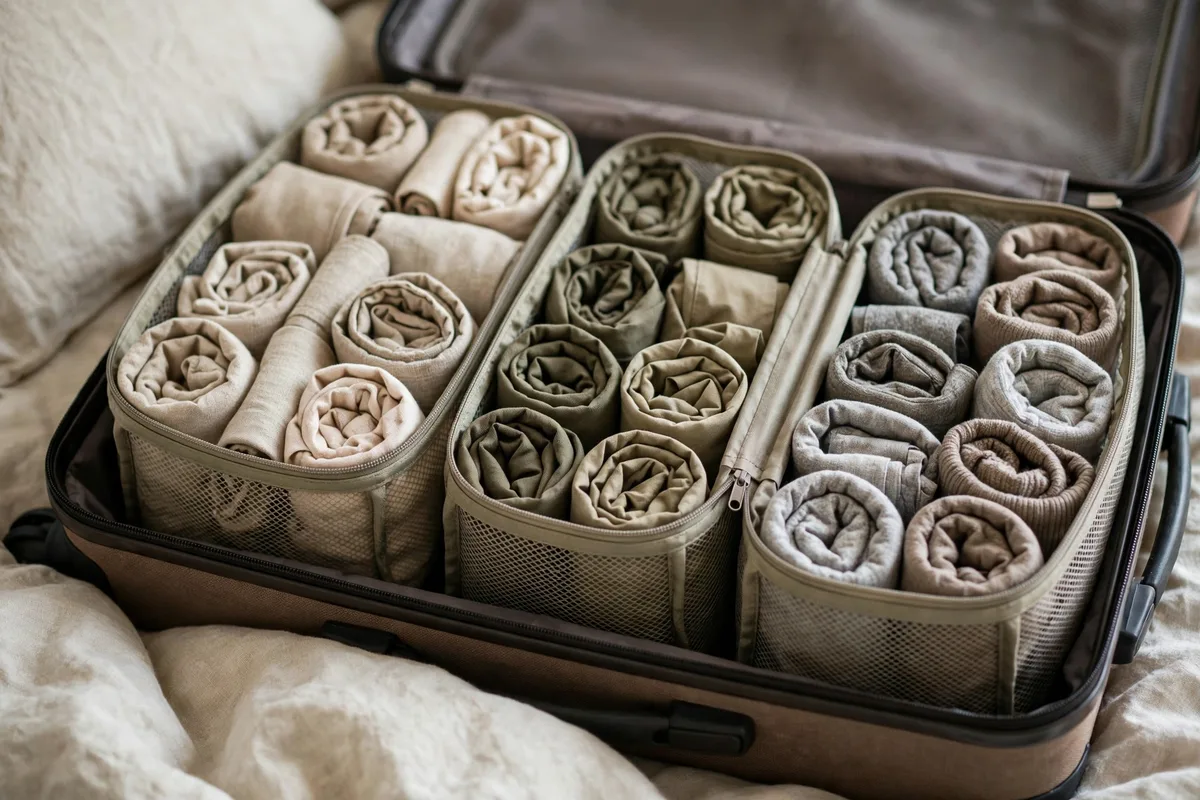
To pack a carry-on in 7 steps, lay out every item, cut the pile by one third, roll soft clothes into packing cubes, put heavy items at the bottom, fill shoes with small items, put liquids on top, and weigh the bag before you leave. The 7 steps take about 30 minutes the first time and about 15 minutes once you know the routine.
- Lay out every item on the bed and cut the pile by one third.
- Roll soft clothes and place them in packing cubes by type.
- Put heavy items, shoes and toiletries, at the bottom near the wheels.
- Fill shoes with socks, chargers, and other small items.
- Put the liquids bag at the top for fast security checks.
- Wear the bulkiest jacket and shoes on the plane.
- Weigh the bag and check the size against the airline gauge.
Step 1 saves the most space, because most travelers pack for 3 trips they will never take: the fancy dinner, the cold snap, and the extra outfit. A firm rule helps: an item that has no outfit and no day on the plan stays home. Step 2 beats folding, because rolled clothes fill the corners of a cube and wrinkle less than folded stacks. Step 6 moves 3 to 5 pounds off the bag and onto your body, and the jacket doubles as a blanket on a cold flight. Test the full bag in the airline sizer at home if you have one, or measure the bag with a tape measure after you close it.
What to Leave Behind and Buy on Arrival
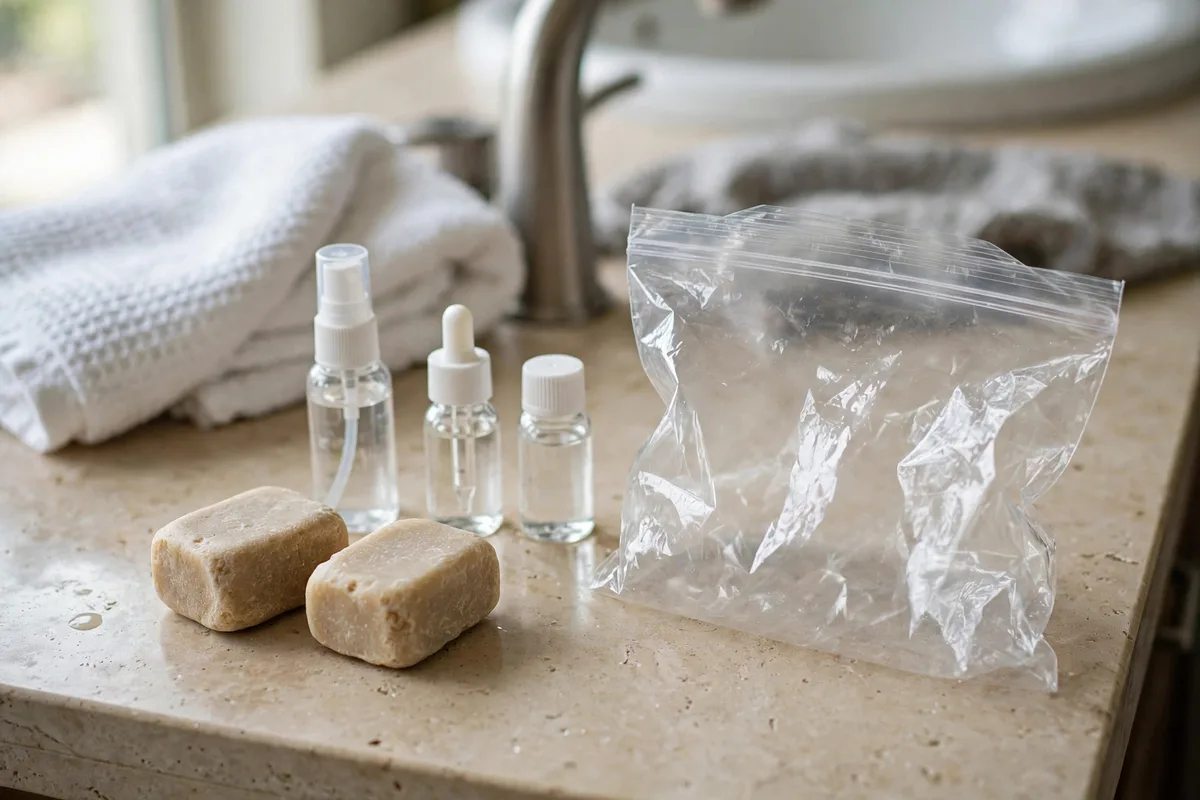
Leave behind full-size toiletries, a third pair of shoes, a hair dryer, paper books, and a full towel, and buy the toiletries on arrival, because full-size bottles are the most common reason a carry-on fails the liquids rule and forces a $45 checked bag. The Transportation Security Administration (TSA) 3-1-1 rule limits liquids, gels, and aerosols in a carry-on to containers of 3.4 ounces (100 ml) or less, all in one quart-sized clear bag, with one bag per passenger. A full-size shampoo bottle alone breaks the rule, so the bottle costs $45 in bag fees plus the price of the shampoo.
| Item | Pack it or leave it | Buy on arrival | Why |
|---|---|---|---|
| Full-size shampoo | Leave it | $3 to $5 | A full bottle breaks the 3-1-1 liquids rule |
| Full-size sunscreen | Pack a solid stick | $0 | A solid stick is not a liquid, so it flies free |
| Third pair of shoes | Leave it | $0 | 2 pairs cover walking and evenings on most trips |
| Hair dryer | Leave it | $0 | Most hotels and rentals provide one |
| Paper books | Leave them | $0 | Load an e-reader or a phone with books |
| Full towel | Leave it | $0 | Pack a quick-dry microfiber towel only for beach trips |
| Full-size lotion | Leave it | $4 to $6 | A travel tube or a solid bar covers 7 days |
Solid toiletries fix most of the liquids problem. A solid shampoo bar, a solid deodorant stick, and a solid sunscreen stick take no space in the quart bag, and the quart bag then holds only toothpaste, contact solution, and one small bottle. Pack the quart bag at the top of the carry-on, because security asks you to pull it out, and a bag buried under clothes costs 5 minutes at the checkpoint. Learn how to find cheap flights step by step before you book, so the fare you compare already includes the bag rules for your airline.
How to Avoid Overweight Fees
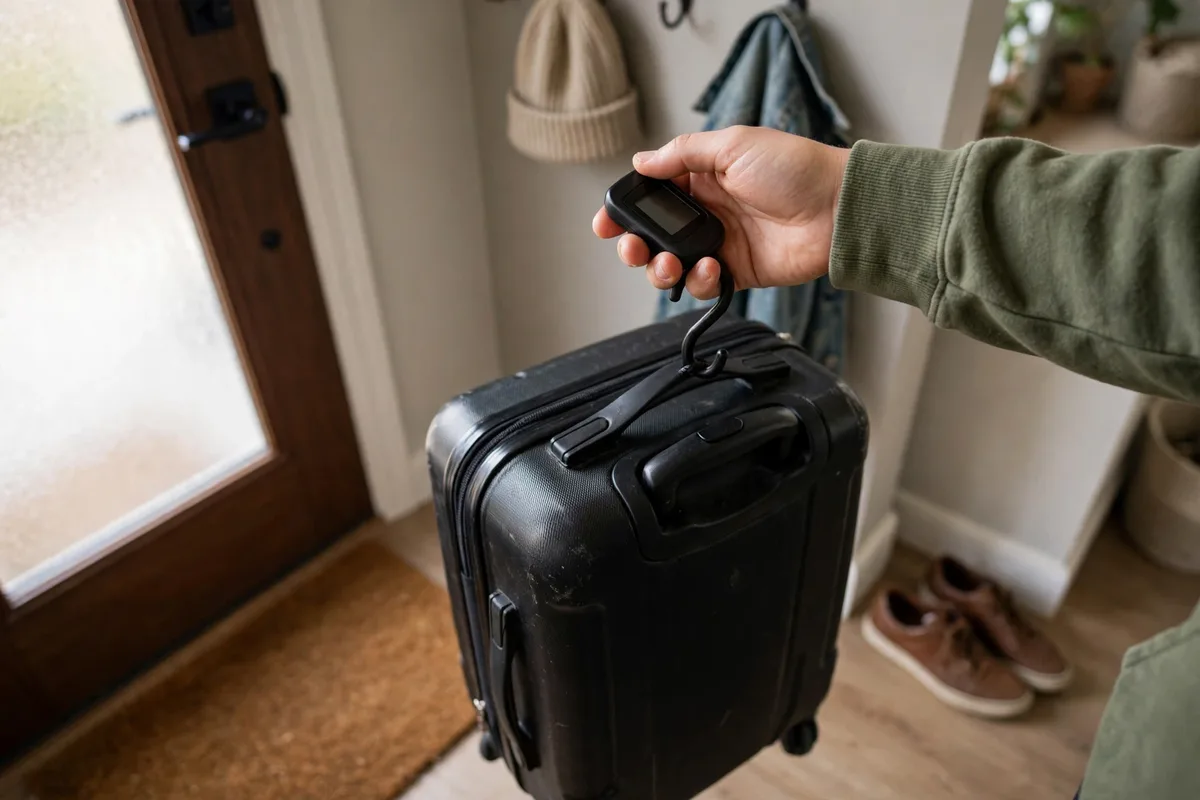
To avoid overweight fees, weigh your bag at home with a $10 to $12 luggage scale, weigh it again after you repack at the hotel, and move heavy items to your personal item when the carry-on is over the limit. An overweight checked bag adds a $100 to $200 fee on top of the checked bag fee (Source: Byline Travel (2026)), and a bag that is 1 pound over pays the same fee as a bag that is 20 pounds over. The scale pays for itself the first time it catches an overweight bag.
On a past trip to Lisbon, I weighed my carry-on at home and found it 3 pounds over the 10 kg limit for the return flight. I moved the guidebook and the power bank to my personal item, wore the heavy jacket on the plane, and the bag passed the gate check with room to spare. The same routine works on the way home: weigh the bag in the hotel room before you leave for the airport, because souvenirs and wet clothes add 2 to 4 pounds on most trips. Keep a small gap in the bag for the return leg, or keep the foldable daypack empty so it can hold the extra items on the way home.
Budget Airlines vs US Airlines: Different Rules
Budget airlines and US airlines use different free baggage rules, because US majors give a free overhead carry-on on most fares while European budget airlines give only a small free under-seat bag and charge for the overhead bag. A packing list that works on Delta can fail on Ryanair, so check the free allowance for your exact airline and fare before you pack.
| Rule | US major airlines | European budget airlines |
|---|---|---|
| Free overhead carry-on | Yes, 22 x 14 x 9 in | No, costs $20 to $60 each way |
| Free personal item | Yes, under seat | Yes, 40 x 20 x 25 cm on Ryanair |
| Weight check at gate | Rare on domestic flights | Strict, 8 to 10 kg |
| Checked bag fee | $45 each way | $45 to $85 each way |
| Gate bag fee | Higher than online | Higher than online |
| Prepay saving | $5 less online | $10 to $20 less online |
The low-cost carrier (LCC) model cuts the base fare and charges for each extra, so a $40 Ryanair fare with a $50 bag fee costs more than a $70 full-service fare with a free bag. Compare the total trip cost, not the headline fare, before you book. Pay for any bag online at booking, because the gate price is the most expensive way to pay on every airline. A carry-on that fits Ryanair’s free 40 x 20 x 25 cm bag fits every airline, so pack to the smallest limit on your route when you fly 2 airlines on one trip.
Packing for Families and Cold Weather
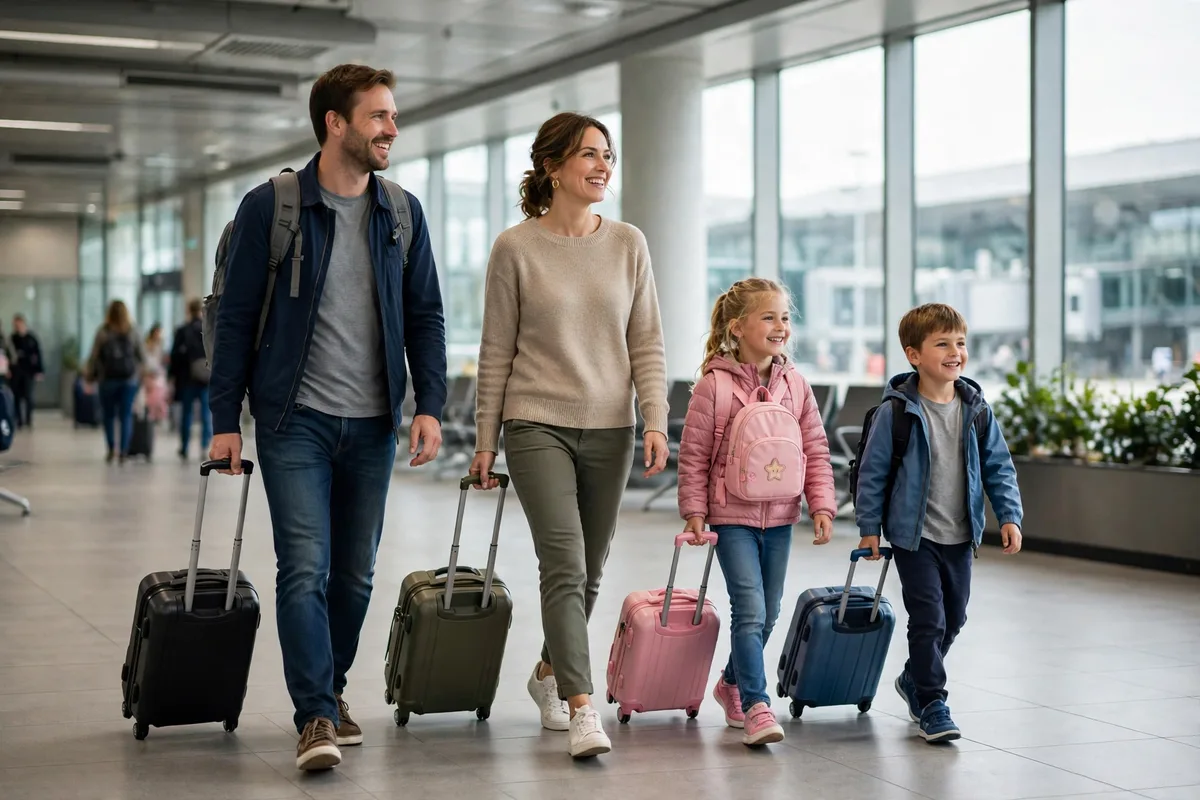
Packing for families means each child carries a small backpack with their own clothes and snacks, and packing for cold weather means wearing the coat and boots on the plane and packing layers instead of bulk. A family of 4 that packs carry-on only saves $360 on one round trip, and the saving pays for a night in a hotel or 2 days of meals. Give each child a backpack with 3 tops, 2 bottoms, underwear, socks, a water bottle, and a snack bag, and keep one shared toiletry bag in the adult carry-on. Pack one change of clothes for each child in the personal item, because a spill on the plane costs more in stress than the space the clothes take.
Cold weather adds 3 items to the 7-day list: a packable down jacket, a base layer top, and warm socks. Wear the coat, the boots, and the thickest sweater on the plane, because worn clothes do not count against the bag weight. Pack layers that stack: a base layer, a mid layer, and a shell jacket give 3 warmth levels from 3 thin pieces, while one thick sweater gives only 1 level. Merino base layers dry overnight in a hotel room, so 2 base layers cover a full week. See how to save money on hotels every trip for the stay side of the same trip, because a room with a kitchen and a washer cuts food and laundry costs on family trips.
Your 7-Day Packing Plan
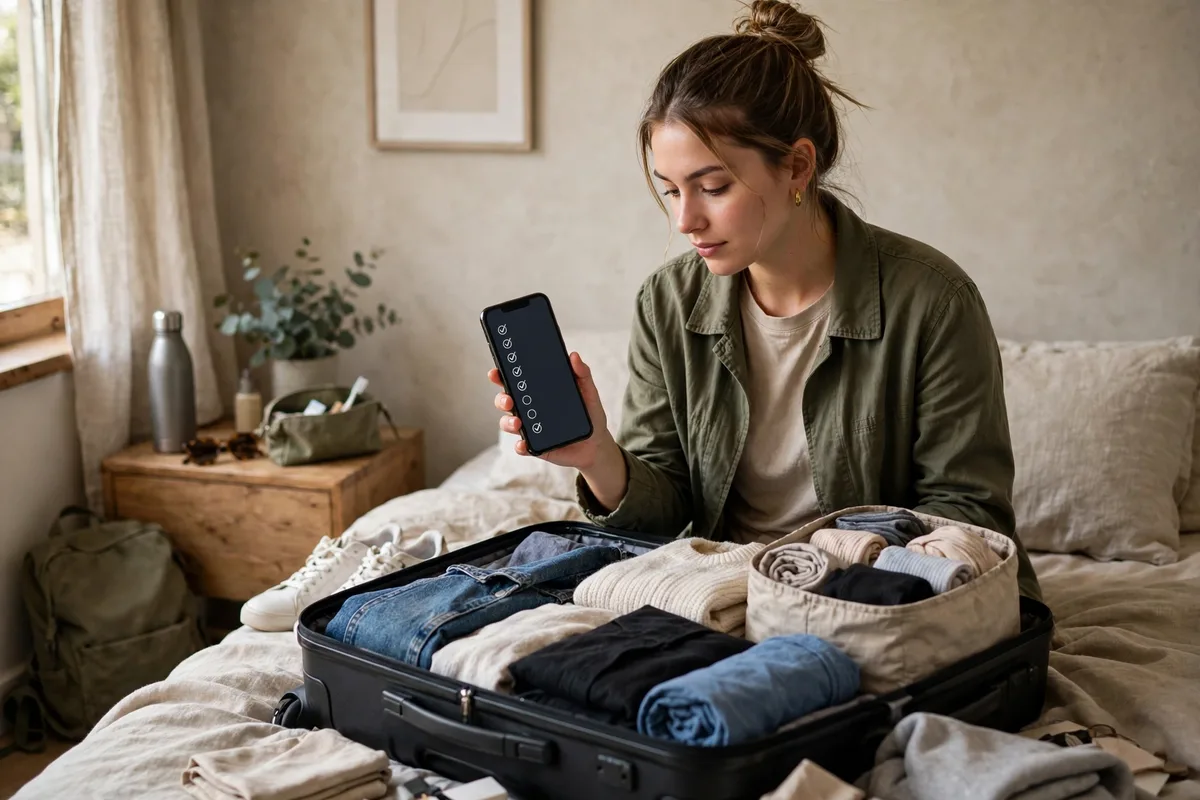
Your 7-day packing plan starts 7 days before departure with the airline rules and ends on travel day with documents and water in your personal item, and the plan spreads the work into 10-minute jobs so nothing gets rushed. Follow the plan in order and check off each day as you finish it.
| Day | Job | Time |
|---|---|---|
| 7 days before | Check airline size and weight rules, wash clothes | 15 minutes |
| 6 days before | Buy missing items: scale, cubes, solid toiletries | 20 minutes |
| 5 days before | Test pack the full bag, weigh it, cut one third | 30 minutes |
| 4 days before | Copy documents, charge devices, download offline maps | 15 minutes |
| 3 days before | Pack toiletries in the quart bag, prep travel snacks | 10 minutes |
| 2 days before | Final weigh, lay out the clothes you will wear on the plane | 10 minutes |
| Travel day | Passport, cards, phone, water bottle in the personal item | 10 minutes |
Day 5 is the day that decides the trip. A test pack shows the real size of the bag, and a test pack shows which items do not fit before the morning of the flight. If the bag fails the test pack, cut the third pair of shoes first, then the extra tops, then the paper books. If the bag still fails, move the heavy items to the personal item and wear the jacket. Leave 30 minutes of spare time on travel day for the security line, because a rushed packer forgets the passport more often than a calm one does.
Conclusion
A budget travel packing list saves $90 per person and $360 for a family of 4 on one round trip, because a budget travel packing list fits a 7-day trip in one free carry-on and one free personal item. The list works on every airline once you check the size and weight limits for your exact fare, and the list works on every trip length once you add one laundry stop. Start with the 31 items in the table, pack to the smallest limit on your route, weigh the bag at home, and buy full-size toiletries on arrival. Find more money guides like this one at Savvy Cash Flow.
FAQ
What is the cheapest way to avoid airline bag fees?
The cheapest way to avoid airline bag fees is to travel with one carry-on bag and one personal item only, because most fares include both bags free and a carry-on only trip pays $0 in bag fees. Check your airline size limit first, roll clothes into packing cubes, wear the bulkiest jacket and shoes on the plane, and keep liquids in one quart bag.
How much are checked bag fees in 2026?
Checked bag fees in 2026 are $45 each way for the first bag on American, Delta, United, and JetBlue, $40 on Alaska, $35 on Southwest Basic, and $45 to $85 on Spirit and Frontier. A second bag costs about $55 each way, and an overweight bag adds $100 to $200 on top of the bag fee.
Can I fit a week of clothes in a carry-on?
Yes, you can fit a week of clothes in a carry-on with 4 tops, 2 bottoms, 7 sets of underwear and socks, 1 light jacket, and 2 pairs of shoes, plus one laundry stop on day 4. Roll soft clothes, use 3 packing cubes, wear the bulkiest items on the plane, and pick one color family so every top works with every bottom.
What size carry-on is allowed on most airlines?
Most US airlines allow a carry-on of 22 x 14 x 9 inches, and most US airlines do not weigh carry-on bags on domestic flights. Southwest and Frontier allow 24 x 16 x 10 inches. European budget airlines allow only a small free under-seat bag, and they enforce weight limits of 8 to 10 kg.
What toiletries can I pack in a carry-on?
You can pack liquids, gels, and aerosols in containers of 3.4 ounces (100 ml) or less, all in one quart-sized clear bag, with one bag per passenger, under the TSA 3-1-1 rule. Solid shampoo bars, solid deodorant sticks, and solid sunscreen sticks are not liquids, so they fly free outside the quart bag.
How do I avoid overweight luggage fees?
To avoid overweight luggage fees, weigh your bag at home with a $10 to $12 luggage scale, weigh it again at the hotel before the return flight, and move heavy items to your personal item when the bag is over the limit. Leave a small gap in the bag for souvenirs, because wet clothes and gifts add 2 to 4 pounds on most trips.