

Last updated: October 2026
Written by Emma for Savvy Cash Flow.
To buy your first stock, open a brokerage account, fund it with money you will not need for 5 years or more, search for the stock by its ticker symbol, enter the dollar amount, pick a market order or a limit order, and confirm the trade during market hours.
A stock is a share of ownership in a company, and a brokerage account is the account that lets you buy and sell stocks on a stock exchange. This guide covers what a stock is, how much money you need, which account to open first, a 7-step buying plan, market order vs limit order differences, single stock vs broad fund choices, fees, automation, beginner mistakes, and when to wait before you buy.
Key Takeaways
- To buy your first stock, open a brokerage account, fund it, search by ticker symbol, and confirm one order during market hours.
- A stock is a share of ownership in a company, and one share gives you a slice of that company, not control of the company.
- You can buy your first stock with $1 at a brokerage that offers fractional shares, and most major brokerages charge $0 account minimums and $0 commissions.
- A market order buys at the current price right away, while a limit order buys only at your set price or lower.
- One broad fund beats one single stock for most first buys, since one fund spreads risk across hundreds of companies.
- Invest only money you will not need for 5 years or more, and check your account once or twice a year, not daily.
Table of Contents
- What Is a Stock?
- How Much Money Do You Need to Buy Your First Stock?
- Which Brokerage Account Should You Open First?
- How to Buy Your First Stock in 7 Steps
- Market Order vs Limit Order: Which One Should Beginners Use?
- Should You Buy a Single Stock or a Broad Fund First?
- What Fees and Costs Should You Check Before You Buy?
- How Do You Automate Investing After Your First Buy?
- 5 Mistakes Beginners Make With Their First Stock
- When Should You Not Buy a Stock Yet?
- Frequently Asked Questions
- Conclusion
What Is a Stock?
A stock is a share of ownership in a company that gives the owner a claim on a slice of the company earnings, a vote in company decisions for common stock, and a share of company value when the stock price rises. A stock is a unit of ownership, and a company divides its ownership into shares. When you buy 1 share, you own 1 slice of the company. When you buy 10 shares, you own 10 slices.
A stock trades on a stock exchange, and a stock exchange is a market where buyers and sellers trade shares during set hours. United States stock exchanges run from 9:30 a.m. to 4:00 p.m. Eastern on weekdays. A ticker symbol is a short code that names a stock, and Apple uses AAPL, Microsoft uses MSFT, and Tesla uses TSLA. You type the ticker symbol into your brokerage app to find the stock.
A stock has 2 main types. Common stock is the standard share type, and common stock usually carries voting rights. Preferred stock is a second share type, and preferred stock usually pays a set dividend before common stock dividends, but preferred stock usually carries no voting rights. A stock price moves each day with company earnings, market news, interest rates, and investor demand, and a sale turns a paper gain or loss into a real gain or loss.
How Much Money Do You Need to Buy Your First Stock?
You need $1 to buy your first stock at a brokerage that offers fractional shares, and you need $0 to open an account at most major brokerages that charge no account minimum. Fractional shares are slices of a full share, and fractional shares let you buy $25 of a $500 stock. A $25 fractional buy gives you 0.05 shares of a $500 stock, and the same math works for any dollar amount.
A high share price no longer blocks a small start. A stock priced at $400 per share once needed $400 for 1 share, and fractional shares now let a beginner buy $50 of that stock. Start with money you can leave alone for 5 years or more. A $50 monthly plan beats a $500 one-time buy that you sell in a panic during a market drop, and a $50 monthly plan builds a habit that lasts. If you want a first-buy plan built around a $100 budget, read our guide on how to start investing with just $100.
Which Brokerage Account Should You Open First?
Open a workplace 401(k) first if your employer matches contributions, open a Roth IRA (Individual Retirement Account) next for retirement money, and open a taxable brokerage account for money you may need before retirement. A brokerage account is an account that holds your stocks and cash, and a brokerage is the firm that runs the account and places your trades. The account is the container, and the stock is what goes inside the container.
A 401(k) is a workplace retirement plan, and an employer match adds money on top of your own contribution, so claim the full match before you invest anywhere else. A Roth IRA (Individual Retirement Account) holds after-tax money, and qualified withdrawals in retirement are tax-free. For 2026, the total IRA contribution limit is $7,500 per year, or $8,600 if you are age 50 or older (Source: Internal Revenue Service (IRS) (2026)).
A taxable brokerage account has no contribution limit and no age rule for withdrawals, and a taxable brokerage account suits goals under 20 years, such as a home purchase in 10 years. Pick a brokerage with 4 features: $0 account minimums, $0 commissions, fractional shares, and automatic investing. Browse the Investing & Wealth guides to compare account types before you open an account. Opening takes 10 to 15 minutes, and a bank transfer then takes 1 to 3 business days to clear.
How to Buy Your First Stock in 7 Steps
To buy your first stock, set a goal, open the right account, fund the account, pick one stock or fund, place the buy order, turn on automatic investing, and review the plan once or twice a year. The active work takes under one hour, and the bank transfer adds 1 to 3 business days.

Step 1: Set a goal and a date
Write one sentence that states the goal and the date. Retirement in 30 years and a home purchase in 10 years each point to a different account and a different holding mix. A written goal stops a market drop from turning into a panic sale.
Step 2: Open a brokerage account or a retirement account
Pick a brokerage with $0 account minimums, $0 commissions, and fractional shares. Opening takes 10 to 15 minutes. Skip platforms that push options trading or margin loans on the signup screen, since those products add risk a beginner does not need.
Step 3: Link your bank account and fund the account
Link a checking account and transfer your first amount. Bank transfers usually take 1 to 3 business days to clear. Start with an amount you can repeat monthly, even if that amount is $25 or $50, and set the transfer for the day after payday.
Step 4: Pick one stock or one broad fund
Pick one holding for your first buy, not five. One broad fund gives you hundreds of companies in one purchase, and one single stock gives you one company only. Check the fee, the holdings, and the risk in plain terms before you buy.
Step 5: Place your first buy order
Search the ticker symbol in the app, enter the dollar amount or share count, pick the order type, and confirm the order during market hours, from 9:30 a.m. to 4:00 p.m. Eastern on weekdays. The order screen shows an estimated total and any fee before you confirm. Take a screenshot of the confirmation, since the confirmation lists the shares bought, the price paid, and the total cost.
Step 6: Turn on automatic investing
Set a recurring transfer from your bank account and a recurring buy into the same holding, timed to payday. Automation turns a good plan into a habit that runs without a monthly decision, and automation keeps you buying in down months as well as up months.
Step 7: Review once or twice a year
Check the plan once or twice a year, and confirm that contributions still run and the fee still sits under 0.10% for a broad fund. Change a holding only for a clear reason, such as a fee rise or a goal change. Daily price checks add stress without adding returns.
Market Order vs Limit Order: Which One Should Beginners Use?
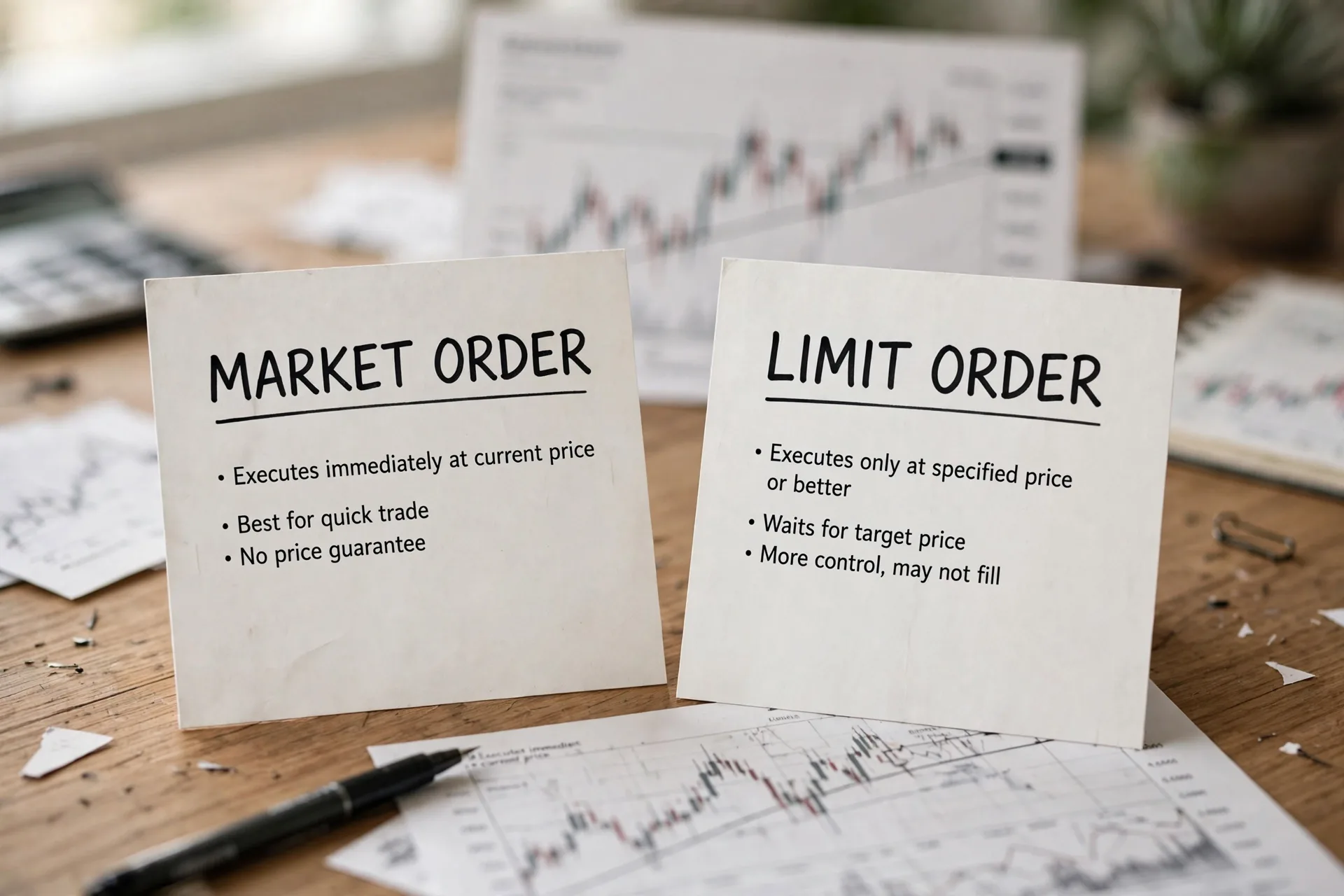
A market order buys at the current price right away, while a limit order buys only at your set price or lower, and beginners should use a market order for a first buy of a well-known stock or fund during market hours. A market order is an order that buys at the best available price at once, and a limit order is an order that sets a maximum price for a buy. The trade-off is speed against price control.
| Feature | Market order | Limit order |
|---|---|---|
| Price you pay | Current market price | Your set price or lower |
| Speed | Fills right away in market hours | Fills only if the price reaches your set price |
| Risk | Price can move a little before the fill | Order may never fill |
| Best use | First buy of a well-known stock or fund | Volatile stock, or a buy outside market hours |
A market order suits a first buy, since a well-known stock trades in large volumes and the price gap between the quote and the fill is usually pennies. A limit order suits a volatile stock, since a volatile stock can jump 5% in minutes and a limit order caps what you pay. A limit order at $50 for a stock trading at $52 fills only if the stock drops to $50 or lower.
Should You Buy a Single Stock or a Broad Fund First?
Buy one broad fund first for the core of your plan, since one broad fund covers hundreds of companies and gives you a complete core holding in a single purchase, and keep any single stock buy to a small learning slice. A broad fund is a fund that holds many stocks at once, and a single stock is a share in one company only. The difference is risk spread: one fund spreads risk, and one stock concentrates risk.

| Choice | What you own | Risk | Best first-buy role |
|---|---|---|---|
| Single stock | 1 company | High, since 1 bad quarter can cut the price sharply | Small learning slice, such as $25 |
| Broad fund | Hundreds of companies | Lower, since 1 company drop barely moves the fund | Core holding, such as $50 to $100 |
A single stock can fall 30% on one earnings report, while a broad fund holding 500 companies barely moves on the same report. A single stock can also rise fast, but a beginner cannot tell in advance which stock will rise. A broad fund removes the need to pick a winner.
If you want a first-buy plan built around a single low-cost fund, read our guide on how to start investing in index funds. The guide to stocks on Wikipedia describes share types and shareholder rights in plain terms, and the guide helps a beginner tell common stock from preferred stock before a first buy.
What Fees and Costs Should You Check Before You Buy?
Check 4 costs before you buy your first stock: the brokerage commission, the fund expense ratio, the bid-ask spread on exchange-traded funds, and any account fee, and keep the fund expense ratio under 0.10% per year for a broad fund. A commission is a fee per trade, and most major brokerages now charge $0 commissions on stock and fund trades. An expense ratio is the annual fee a fund charges, stated as a percent of your balance, and the fund deducts the fee from your holdings automatically.
A $10,000 balance in a fund with a 0.03% expense ratio costs $3 per year, while the same balance in a fund with a 1.00% expense ratio costs $100 per year. The gap repeats every year and compounds, so a high fee quietly eats returns for decades. A bid-ask spread is the gap between the buy price and the sell price, and a wide spread on a thinly traded stock adds a hidden cost to each trade. From my own routine, I check the fee line on each fund page before I buy, and I skip any fund that charges above 0.10% when a cheaper fund tracks the same market.
How Do You Automate Investing After Your First Buy?
Automate investing after your first buy by setting a recurring bank transfer on payday and a recurring buy into the same holding, so the money invests before you can spend it. Automation removes the monthly decision, and the monthly decision is where most plans fail.

Set the transfer for the day after payday, so the money leaves your checking account before weekend spending starts. Pick an amount that survives a bad month, such as $50 or $100, and raise it by $25 each time your pay rises. A plan you keep for 10 years beats a larger plan you drop in 3 months. If you want help setting the monthly number, read our guide on how much you should invest per month.
Check the automation twice a year, since a changed bank account can stop it without a warning. At Savvy Cash Flow, we cover automation, fees, and beginner plans in plain guides, and the guides aim to turn one first buy into a steady habit.
5 Mistakes Beginners Make With Their First Stock
The 5 costliest beginner mistakes with a first stock are buying with money needed soon, buying one stock with the full budget, checking prices daily, paying high fees, and stopping contributions during a market drop. Each mistake is easy to avoid with a written plan.

- Buying with money needed within 5 years. Money needed within 5 years belongs in savings, since a 20% market drop right before you need the money turns a plan into a problem.
- Putting the full budget into 1 stock. One stock can fall sharply on one bad quarter, while a broad fund spreads the same money across hundreds of companies.
- Checking prices daily. Daily moves are noise for a 20-year plan, and daily checks push beginners toward panic sales at the worst moment.
- Paying a 1.00% fee when a 0.03% fund tracks the same market. Fees compound for decades, and a high fee costs far more than a single bad trade.
- Stopping contributions during a market drop. A drop lets automatic contributions buy more shares for the same dollars, so stopping during a drop removes the best buying months.
When Should You Not Buy a Stock Yet?
Do not buy a stock yet with money you need within 5 years, with money you have not yet set aside as a starter emergency fund, or while high-interest debt grows faster than investments can grow. A stock suits long-term goals, and short-term money needs safety and quick access.
Build a $1,000 starter emergency fund first, and keep that fund in a savings account, not in the stock market. Pay down credit card debt before you invest, since credit card interest often runs above 20% per year, and no stock reliably returns 20% per year.
Frequently Asked Questions
How much money do you need to buy your first stock?
You need $1 at a brokerage that offers fractional shares, and $0 to open an account at most major brokerages. A high share price no longer blocks a small start, and a $25 or $50 monthly amount matters more than a large first amount.
Can you buy your first stock with $100?
Yes, you can buy your first stock with $100, and $100 buys a full broad fund holding or fractional shares in 2 or 3 companies. A $100 first buy works best in one broad fund, with a monthly amount added after the first buy.
What is the best first stock for a beginner?
A broad total stock market fund or an S&P 500 fund is the best first buy for most beginners, since one fund gives instant diversification at a fee under 0.10% per year. Pick one fund, not five, and add a single stock later as a small learning slice.
Should beginners use a market order or a limit order?
Beginners should use a market order for a first buy of a well-known stock or fund during market hours, since a market order fills right away and the price gap is usually pennies. Use a limit order for a volatile stock, since a limit order caps the price you pay.
How long does it take to buy your first stock?
The active work takes under one hour, plus 1 to 3 business days for a bank transfer to clear. Account opening takes 10 to 15 minutes, and the order itself takes under 1 minute once the account holds cash.
Can you lose money on your first stock?
Yes, you can lose money on your first stock, since stock prices fall as well as rise, and a single stock can fall 20% or more in a bad year. A broad fund lowers that risk, and a holding period of 5 years or more gives the plan time to recover from drops.
Conclusion
To buy your first stock, open a brokerage account, fund it with money you will not need for 5 years or more, pick one broad fund or one single stock, place one order during market hours, and turn on automatic monthly investing. A first buy is a small step with a large effect, since the first buy turns a reader into an investor and the monthly habit does the rest of the work.
Start this week with 3 actions: open the account, transfer a starter amount you can repeat monthly, and place one order in a broad fund or a single stock you understand. Check the plan once or twice a year, keep fees under 0.10% for a broad fund, and leave the plan alone between checks. The market will rise and fall, and the plan that survives both rises and falls is the plan that builds wealth.
This article is for general information only and is not financial advice. Investing involves risk, including possible loss of principal. Consider speaking with a qualified professional about your situation.