

You have heard it a hundred times: investing is how real wealth gets built. But every guide seems written for someone with thousands of dollars. If you are wondering how to start investing with $100, here is the honest truth: $100 is enough to begin.
Ten years ago, you needed thousands to open a brokerage account. Today, you can start investing with $100 from your phone in about 20 minutes and pay zero commissions. This guide shows you exactly how, step by step.
What Is Investing?
Investing means putting your money into assets, like stocks or funds, that can grow in value over time and pay you returns. Instead of your $100 sitting in checking earning almost nothing, investing puts it to work: you buy small pieces of real businesses, and as those businesses grow, your money can grow with them.
The engine behind it is compound growth: your returns earn their own returns. A dollar invested at 25 is worth far more than a dollar invested at 35. Starting with $100 now beats waiting until you have $10,000 later.
Can You Really Start Investing With $100?
Short answer: Yes. You can start investing with $100 today, because most major brokerages have $0 account minimums, charge $0 commissions, and offer fractional shares. Your $100 can buy a $1.50 slice of a stock that costs $500 per share.
You do not need to be rich to start. You need an account, $100, and about 20 minutes. What matters is building the habit of investing regularly and leaving your money alone to grow.
Why $100 Is Enough to Start Investing in 2026
Short answer: Three changes made small-money investing possible: brokerages dropped minimums to $0, commission-free trading became standard, and fractional shares let you buy expensive stocks in $1 slices. Together, they removed every excuse for waiting.
Not long ago, one share of a $500 stock was out of reach for a $100 budget. Now you can buy $10 or even $1 of that same stock, and split a single $100 across a total market fund and a company you actually use. You get a real, diversified portfolio from day one.
Before You Invest Your $100: Two Smart Moves First
Short answer: Before you invest your first $100, build a small emergency cushion and deal with high-interest debt. Investing works best when a surprise bill cannot force you to sell at the worst moment.
1. Build a $1,000 starter emergency fund. If a $500 car repair would force you to sell your investments, you are not ready yet. Park $1,000 in a separate savings account first. Our guide on how to build your emergency fund shows the fastest way to get there.
2. Attack high-interest debt. Credit card debt at 24% grows faster than investments ever will. Compare methods in our debt snowball vs debt avalanche guide, then invest with a clear conscience.
Find your $100 in your budget. Run your spending through the 50/30/20 budget rule and redirect one or two wants, like a week of takeout, into your investment account instead.
How to Start Investing With $100 in 7 Steps
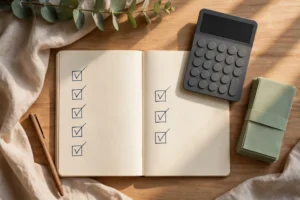
Short answer: Pick a goal, choose a $0-minimum brokerage, open and fund your account, buy one simple index fund, turn on automatic contributions, and leave it alone. Setup takes less than an hour.
Step 1: Decide Your Goal
Saving for retirement decades away? A Roth IRA is hard to beat. Building wealth you might touch in 5 to 10 years? A regular taxable brokerage account is more flexible. Write your goal down in one sentence so you remember it when markets get bumpy.
Step 2: Choose a Beginner-Friendly Brokerage
Look for $0 minimums, $0 commissions, and fractional shares. Most major U.S. brokerages offer all three. Pick the platform whose app feels calmest and simplest. You are buying a boring index fund, not day trading.
Step 3: Open Your Account and Deposit $100
Opening an account takes about 15 minutes: name, address, Social Security number, and employment info. Link your bank account and transfer $100. The transfer usually takes 1 to 3 business days to clear.
Step 4: Pick One Simple Investment
For your first $100, simplicity wins. A total stock market index fund or an S&P 500 ETF gives you instant diversification across hundreds of companies. One fund, one buy, done.
Step 5: Place Your First Buy Order
Search the ticker symbol in the app, enter $100, choose a market order, and confirm during market hours (9:30 a.m. to 4:00 p.m. Eastern, weekdays). Take a screenshot. Your first investment is a milestone.
Step 6: Turn On Automatic Investing
This is the step that turns $100 into real wealth. Set up an automatic transfer of whatever you can afford, even $25 a week, into the same fund. A $100 start plus $100 a month at a 7% average annual return becomes roughly $17,300 in 10 years.
Step 7: Leave It Alone
Check your account once a month at most. The market will rise and fall, and every dip will tempt you to sell. History says investors who hold through the drops end up far ahead of those who panic. Time in the market beats timing the market.
Where Should You Put Your $100? 3 Beginner-Friendly Options

Short answer: For your first $100, the best options are an S&P 500 or total market index fund for instant diversification, fractional shares of companies you know for learning, or a Roth IRA for tax-free retirement growth.
Option 1: An index fund. One purchase spreads your $100 across hundreds of companies, fees are tiny (often under 0.05% a year), and you do not have to pick winners. The simplest way to invest with little money and still be diversified.
Option 2: Fractional shares of companies you know. Buy $25 of a company whose products you use, alongside your index fund. Great for learning, but keep stock picking to a small slice until you have more experience.
Option 3: A Roth IRA. If the money is for retirement, a Roth IRA grows tax-free, and you can withdraw contributions (not earnings) anytime without penalty. The 2026 limit is $7,000 a year if you are under 50, so your $100 fits easily.
The Best Apps to Start Investing With Small Money
Short answer: The best investment apps for beginners with $100 offer $0 minimums, $0 commissions, fractional shares, and plain-language education. Fidelity, Charles Schwab, Robinhood, and SoFi all check these boxes, so pick the app that feels clearest to you.
Judge any app on these five criteria:
- $0 minimum and $0 commissions. Non-negotiable. Fees eat small accounts alive.
- Fractional shares. Lets your $100 reach expensive stocks and funds.
- Automatic investing. Recurring transfers into your fund without manual orders.
- Clear education. Short explainers, not pressure to trade options.
- Real customer support. You will have questions. Make sure humans answer.
Avoid apps that gamify trading or make risky bets feel like a game. Boring is beautiful when you are investing with $100.
5 Mistakes Beginners Make When Investing With $100
Short answer: The costliest beginner mistakes are chasing hot stocks, checking prices daily, paying avoidable fees, waiting years to start, and investing money they will need soon.
1. Trying to pick the next big stock. Your $100 will not become $10,000 from one brilliant pick. It grows from steady contributions to diversified funds over years. Stock picking is entertainment for beginners, not a strategy.
2. Checking your account every day. Daily moves are noise, and constant checking leads to panic-selling at the bottom. Review monthly and ignore the rest.
3. Paying fees you do not need to pay. A fund charging 1% a year versus 0.03% can cost you tens of thousands over decades. With $100, always choose the lowest-fee index option.
4. Waiting until you have “enough” to start. This is the most expensive mistake. Someone investing $100 a month from age 25 ends up with roughly twice as much at 65 as someone who waits until 35 to invest $200 a month.
5. Investing money you need soon. Cash you will need within 3 to 5 years, like a house down payment, does not belong in the stock market. A 20% drop right before you need it turns a plan into a problem.
Frequently Asked Questions
How much money do you need to start investing?
You can start investing with $100 or even less. Most major brokerages have $0 minimums and $0 commissions, and fractional shares let you invest any dollar amount. Contributing regularly matters far more than your starting amount.
Is $100 enough to invest in stocks?
Yes. Fractional shares let you buy portions of expensive stocks, and index funds give you hundreds of stocks in one purchase. A $100 start with regular monthly contributions can grow into thousands over a decade.
What is the best way to invest $100 as a beginner?
Put it in a low-cost total stock market or S&P 500 index fund inside a $0-minimum brokerage account, then set up automatic monthly contributions. You get instant diversification, tiny fees, and a habit that builds real wealth.
How long does it take to double $100 by investing?
At a 7% average annual return, money roughly doubles every 10 years (the rule of 72: 72 divided by 7 is about 10). So $100 today could become about $200 in 10 years and $400 in 20, without adding another dollar.
Should I pay off debt or invest my $100?
It depends on the interest rate. Credit card debt at 20% or more almost always wins, because no investment reliably beats a guaranteed 24% return. Once high-interest debt is gone, investing usually wins. Our debt snowball vs debt avalanche guide helps you pick a payoff method.
Can I lose my $100 by investing?
Yes. All investing carries risk, and your $100 can drop in value, especially short term. That is why you only invest money you will not need for at least 3 to 5 years, and why diversification and long holding periods matter.
Key Takeaways
- You can start investing with $100 today: $0-minimum brokerages, $0 commissions, and fractional shares removed the old barriers.
- Build a $1,000 starter emergency fund and handle high-interest debt before your first investment.
- A low-cost total stock market or S&P 500 index fund is the simplest first buy for beginners.
- Set up automatic monthly contributions, even $25 or $50. The habit matters more than the amount.
- Time in the market beats timing the market. Start now rather than waiting until you have more.
- Keep fees near zero: choose funds charging under 0.10% per year.
- Never invest money you will need within 3 to 5 years.
- Check your account monthly at most. Daily checking leads to panic selling.
The Bottom Line
Starting to invest with $100 is not about the $100. It is about becoming the kind of person who invests. The amount will grow as your income grows, but the habit, the account, and the knowledge you build today are what compound into real wealth over the decades.
Your first move takes less than an hour: pick a $0-minimum brokerage, transfer $100, buy one index fund, and turn on automatic investing. A year from now, you will not remember the $100. You will remember that this was the day you started.
This article is for general information only and is not financial advice. Investing involves risk, including possible loss of principal. Consider speaking with a qualified professional about your situation.