


Introduction
Real-world uses of blockchain now reach far past Bitcoin and trading. Real-world uses of blockchain include cross-border payments, supply chain tracking, digital identity, health records, real estate tokenization, smart contracts, government records, creator royalties, and carbon credit tracking, and each use works because a shared ledger records entries that many computers check and agree on. This guide explains what blockchain is in plain English, how it works in 4 steps, and the 9 uses in detail. It then scores each use as live, pilot, or shut down, works out what a $100 cross-border payment costs with and without blockchain, compares blockchain with a normal database, and closes with a safe beginner checklist, the main risks, and 6 answers to common questions.
Key Takeaways
- Blockchain is a shared ledger, not a coin: a blockchain is a distributed ledger that records entries in blocks, and many computers hold a copy of the same ledger.
- 9 real-world uses of blockchain work today: payments, supply chains, identity, health records, real estate, smart contracts, government records, royalties, and carbon credits each use the same shared-ledger idea in a different way.
- Some uses are live at scale and some are dead: stablecoin payments and DeFi run at large scale, while TradeLens shut down in 2022-2023 and no country runs national blockchain voting.
- A $100 cross-border payment shows the real difference: a bank wire often costs $25 to $50 and takes days, while a stablecoin transfer often costs under $1 in network fees and settles in minutes.
- Blockchain fits shared records between parties that do not trust each other: a normal database wins on speed, cost, and privacy for most small business jobs.
- Beginners should start with a small test amount: learn the basics, use a regulated exchange, check the network fee, and treat any promise of guaranteed returns as a scam signal.
What Is Blockchain in Plain English?
A blockchain is a distributed ledger that records entries in blocks, links each block to the block before it with a cryptographic hash, and stores a copy of the ledger on many computers at once, so no single company controls the record and no single copy can be changed in secret. A blockchain has 3 parts: blocks that hold batches of entries, hashes that link blocks in order, and a network of computers that check new entries against shared rules. A hash is a short code made from the contents of a block, and any change to a block changes its hash, so a changed block no longer matches the chain.
The first blockchain ran Bitcoin in 2009, after a person or group using the name Satoshi Nakamoto published the design in 2008. The Bitcoin blockchain grew past 600 GB by 2024 (Source: Wikipedia, 2026). For the full history of the design, read the blockchain definition on Wikipedia. A blockchain is not a coin, a wallet, or an app. A coin is one thing recorded on a blockchain, a wallet is a tool that holds the keys to move coins on a blockchain, and an app is software that reads or writes entries on a blockchain. For more guides in the same plain style, browse the Cryptocurrency guides.
How Does Blockchain Work in 4 Steps?
To see how blockchain works, follow 4 steps: a user signs an entry with a private key, the network checks the entry against shared rules, approved entries join a new block, and the block links to the chain so every computer updates its copy of the ledger. A private key is a secret code that proves control of an account on the network, and a public key is the address other people use to send value to that account.
- Create and sign the entry. A user fills in the details, such as the recipient address and the amount, then signs the entry with a private key.
- Send the entry to the network. The signed entry goes to computers on the network, and each computer checks the signature and the rules.
- Add the entry to a block. Approved entries join a new block with other recent entries, and the block gets a hash that links it to the block before it.
- Update every copy. The new block goes out to the network, and each computer adds it to its copy of the ledger.
Bitcoin adds a block about every 10 minutes, while Ethereum adds a block every 12 seconds (Source: Wikipedia, 2026). That gap matters for speed: a Bitcoin payment needs about 10 minutes for one confirmation, while an Ethereum payment confirms in seconds.

What Are the 9 Real-World Uses of Blockchain Beyond Crypto?
The 9 real-world uses of blockchain beyond crypto are cross-border payments, supply chain tracking, digital identity, health records, real estate tokenization, smart contracts, government records, creator royalties, and carbon credit tracking, and each use replaces a middleman or a paper record with a shared ledger that many parties can check. The 9 uses below run from the most proven to the most experimental.
1. Cross-Border Payments and Stablecoins
Cross-border payments are the most proven real-world use of blockchain, because stablecoins move dollars across borders in minutes for a small network fee, while a bank wire takes days and costs far more. Stablecoins are crypto tokens tied to a currency such as the US dollar, and stablecoins in circulation reached $305 billion (Source: DefiLlama, 2026). A freelancer in one country can receive a stablecoin payment from a client in another country without a bank in the middle. The catch is the on-ramp and off-ramp: converting local cash into a stablecoin and back adds fees, and those fees vary by country and by exchange.
2. Supply Chain Tracking for Food and Goods
Supply chain tracking uses blockchain to record each step a product takes from farm or factory to shelf, so a buyer can check where a product came from and when it changed hands. Walmart ran a food traceability pilot on IBM Food Trust, and De Beers runs Tracr to track diamonds from mine to shop. The limit is data entry: a blockchain checks the record, not the physical product, so a wrong entry at the start stays wrong all the way through. Walmart later scaled back its food traceability work (Source: WEEX, 2026), which shows that a pilot can work in a demo and still fail to pay off at full scale.

3. Digital Identity You Control
Digital identity on blockchain lets a person hold their own ID credentials in a wallet and share only the proof needed, instead of handing a full document to every service that asks for one. South Korea runs the OmniOne identity system, Bhutan runs a national digital ID program, and the European Union runs the EBSI pilot for cross-border credentials (Source: ScienceTimes, 2026). These systems are pilots, not daily tools for most people, and lost keys remain a hard problem: a lost identity wallet can lock a person out of their own credentials.

4. Health Records Shared Between Providers
Health records on blockchain give each patient one shared record that hospitals, clinics, and labs can add to with permission, so a new doctor can see past tests without chasing paper files from 3 offices. Norway runs a health wallet pilot, and McGill University runs health data research on blockchain (Source: ScienceTimes, 2026). The record itself often stays off the chain, while the chain stores a proof that the record exists and has not changed. Privacy rules limit how far this use can go, and a permissioned chain that limits who can read each entry suits health data better than a public chain.
5. Real Estate Tokenization and Fractional Ownership
Real estate tokenization turns a property into digital tokens on a blockchain, so many buyers can own small shares of one building instead of one buyer paying the full price. Tokenized real-world assets reached $38.9 billion (Source: rwa.xyz, 2026). A $500,000 apartment could split into 5,000 tokens at $100 each, and each token holder owns a share of the rent and the value change. The risks are real: tokens can be hard to sell fast, transfers can face legal limits, and the token is only as sound as the company that holds the property title. The EU Markets in Crypto-Assets (MiCA) rules reached full force in July 2026 (Source: ScienceTimes, 2026), while US rules stay split across agencies.

6. Smart Contracts for Business Agreements
A smart contract is a computer program on a blockchain that runs the terms of an agreement on its own, so a payment or a transfer happens when the agreed condition is met, with no clerk in the middle. A smart contract is a computer program or a transaction protocol that automatically runs the terms of a contract (Source: Wikipedia, 2026). A rental deposit could return to the tenant on its own when the lease ends and the inspection passes, and a freelance invoice could pay on its own when the client marks the work done. Read the smart contract page on Wikipedia for the full definition and history. The main risk is code: a bug in a smart contract can lock or drain funds, and the DAO attack in 2016 drained about $50 million in Ether through a code flaw (Source: Wikipedia, 2026).
7. Government Records and Land Titles
Government records on blockchain put land titles, licenses, and registries on a shared ledger, so a buyer can check who owns a plot and whether a lien sits on it, without waiting weeks for a paper search. Georgia ran a land registry pilot, Sweden tested a property title system, and Dubai runs several government record projects on blockchain. The use is real but slow: land law changes slowly, and a blockchain record still needs a court and a registry to back it in law. No country runs national blockchain voting today, and voting stays the most oversold use in the whole list: a vote needs both secrecy and a checkable count, and no blockchain design has solved both at national scale yet.
8. Creator Royalties and NFT Payments
Creator royalties on blockchain pay artists, writers, and musicians a share each time their work resells, because a smart contract can send a cut to the creator on every sale without a label or a publisher in the middle. A non-fungible token (NFT) is a unique token that proves ownership of one digital item, and NFT sales can carry a royalty rule in the smart contract. The 2026 reality is smaller than the 2021 hype: most marketplaces now let buyers skip royalties, so the automatic cut is a choice, not a guarantee. Creators still gain one thing that matters: a direct payment path from buyer to creator with no middleman taking a large share.
9. Carbon Credits and ESG Tracking
Carbon credits on blockchain record each credit once and track who holds it, so the same credit cannot be sold twice and a buyer can check the project behind it. A carbon credit is a certificate for one tonne of carbon dioxide kept out of the air, and companies buy credits to offset emissions. A blockchain ledger shows the credit from issue to retirement, and retirement means the credit is used and cannot sell again. The limit is the same as supply chains: the ledger proves the credit moved, not that the trees were planted. Buyers still need an independent check of the project on the ground.
New to crypto basics? Read What Is Bitcoin? first, then come back to these uses.
Which Blockchain Uses Are Live, Which Are Pilots, and Which Shut Down?
The honest scorecard is this: stablecoin payments and smart contracts run live at scale, supply chain tracking and digital identity run as live systems and pilots with mixed results, and TradeLens shut down while national blockchain voting never started, so the gap between hype and reality is wide. Most articles still list dead projects as live examples, and the table below fixes that with dates.
| Use | Status in 2026 | Evidence |
|---|---|---|
| Stablecoin payments | Live at scale | $305B stablecoins in circulation (Source: DefiLlama, 2026) |
| Smart contracts and DeFi | Live at scale | DeFi holds $95.7B (Source: WEEX, 2026) |
| Real estate tokenization | Live but small | $38.9B tokenized assets (Source: rwa.xyz, 2026) |
| Supply chain tracking | Live but limited | Walmart scaled back food tracing (Source: WEEX, 2026) |
| Digital identity | Pilot | South Korea OmniOne, EU EBSI pilots (Source: ScienceTimes, 2026) |
| Health records | Pilot | Norway health wallet, McGill research (Source: ScienceTimes, 2026) |
| Carbon credits | Pilot | Live registries, small volumes, verification still manual |
| TradeLens shipping | Shut down | Discontinued 2022-2023 (Source: WEEX, 2026) |
| National blockchain voting | Never started | No country runs it (Source: WEEX, 2026) |
Building a blockchain system costs real money too: a basic build runs $30,000 to $60,000, and an enterprise build runs $500,000 or more (Source: ScienceTimes, 2026). Those figures explain why pilots outnumber live systems: a company can test a use for months and still drop it when the build cost beats the savings.
What Does a $100 Cross-Border Payment Cost With and Without Blockchain?
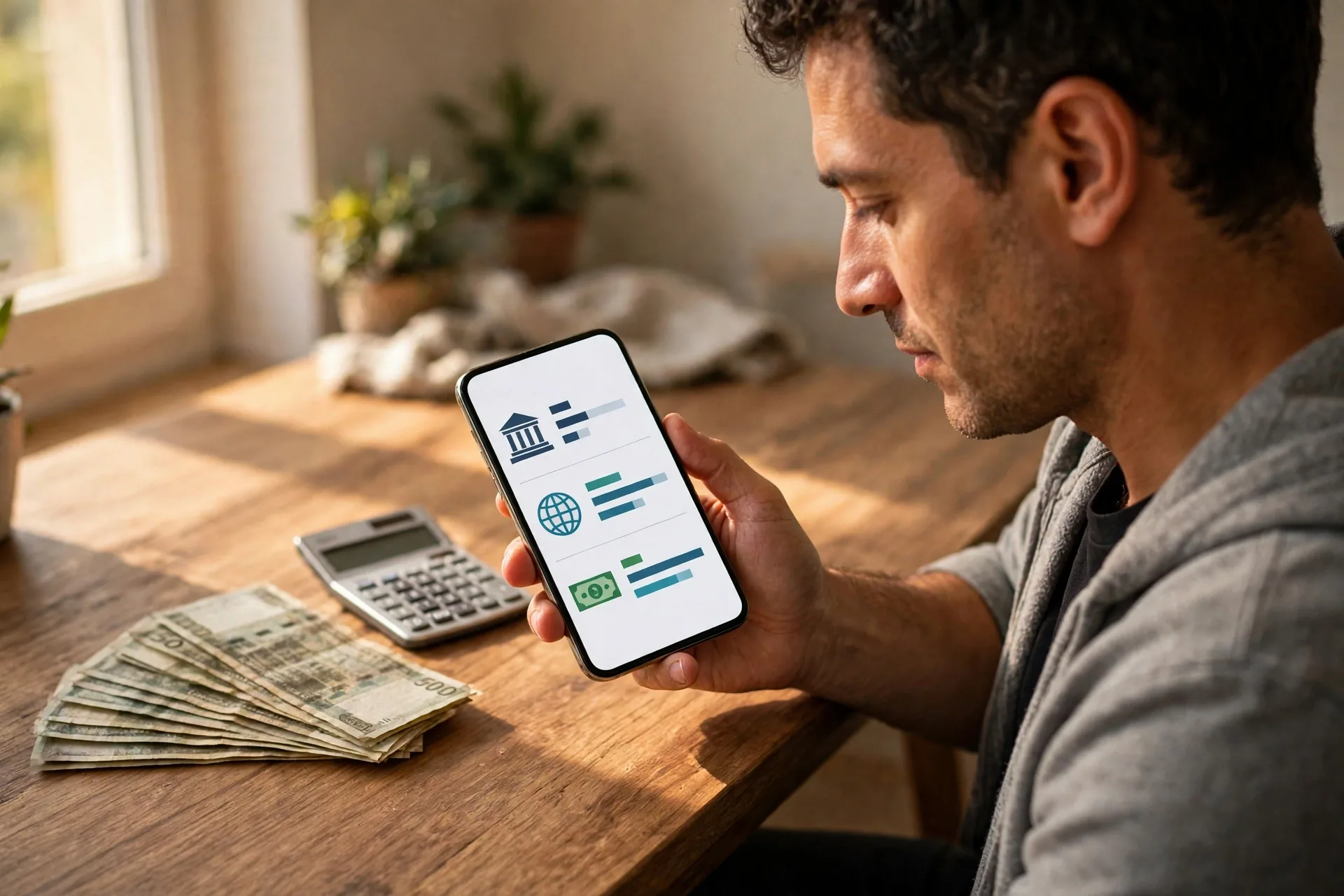
A $100 cross-border payment costs about $25 to $50 and 1 to 5 business days through a bank wire, while the same $100 through a stablecoin often costs under $1 in network fees and settles in minutes, so the blockchain route saves about $24 to $49 and several days on a small payment. The table below shows typical ranges, and fees change by provider, country, and network load, so check live fees before you send.
| Route | Typical fee on $100 | Typical time | Extra cost to check |
|---|---|---|---|
| Bank wire | $25 to $50 | 1 to 5 business days | Exchange rate markup, often 1% to 3% |
| Money transfer shop | $0 to $15 online, more in cash | Minutes to 1 day | Exchange rate markup on the payout |
| Stablecoin transfer | Under $1 network fee on low-fee networks, over $5 on busy networks | Minutes | On-ramp and off-ramp fees, often 0.5% to 2% |
When I checked a stablecoin transfer on a public block explorer, the network fee showed as a few cents, while the same route through a bank quoted a flat $25 wire fee. That one check changed how I think about small cross-border payments: the fee gap is largest on small amounts, because a flat wire fee eats a bigger share of $100 than of $10,000.
Blockchain vs a Normal Database: When to Use Which?
Use a blockchain when several parties that do not trust each other need one shared record, and use a normal database when one owner controls the data, because a normal database is faster, cheaper, and easier to fix, while a blockchain is slower, dearer, and harder to change. The table below makes the trade-off plain.
| Feature | Normal database | Blockchain |
|---|---|---|
| Who controls it | One owner | Many computers share control |
| Speed | Fast, thousands of writes per second | Slow, Bitcoin about 10 min per block, Ethereum 12 seconds per block (Source: Wikipedia, 2026) |
| Cost to run | Low, one server can serve the whole app | Higher, every node stores a full copy |
| Change a record | Owner can edit or delete it | Hard to change, needs network agreement |
| Privacy | Owner sets who sees what | Public chains show all entries to all readers |
| Trust needed | Trust the owner | Trust the shared rules and the network |
| Best for | Private data, fast apps, one company | Shared records between parties that do not trust each other |
Use a blockchain if 2 or more parties need the same record and no one party should control it, if the record must resist secret edits, and if all parties accept slower speed and higher cost. Skip a blockchain if one company owns the data, if speed matters more than shared trust, if records need frequent edits or deletion, or if the data must stay private. A small shop that tracks its own stock needs a normal database, and a group of shippers that share one cargo record may need a blockchain.
How Can a Beginner Try Blockchain Safely?
To try blockchain safely, follow 7 steps in order: learn the basics, pick a regulated exchange, set up a wallet, send a small test amount, check the fee before each transfer, verify every address by hand, and treat any promise of guaranteed returns as a scam signal. Each step takes minutes, and the test amount should be money you can afford to lose.
- Learn the basics first. Read one plain guide on blockchain and one on wallets before you move any money.
- Pick a regulated exchange. Choose an exchange that operates legally in your country and shows its fees in writing.
- Set up a wallet you control. A hot wallet suits small amounts and daily use, and a cold wallet suits larger amounts and long holding. Read our hot vs cold crypto wallets guide to pick the right type.
- Send a small test amount. Move $5 or $10 first, confirm it arrives, and only then send a larger amount.
- Check the network fee before you confirm. Fees rise when the network is busy, so a transfer that costs cents today can cost dollars tomorrow.
- Verify the address by hand. Copy the address, check the first and last 4 characters, and send a test amount to a new address first.
- Learn the scam red flags. A guaranteed return, a rushed deadline, a seed phrase request, and a fake support message are all scam signals. Read our guide on how to avoid crypto scams before you send money to any new project.
Savvy Cash Flow publishes beginner crypto guides in this same plain style, and the wallet and scam guides above are the right next reads after this article. Never share a private key or a recovery phrase with any person or website, and never type a recovery phrase into a website that a stranger linked to you.
What Are the Risks and Limits of Blockchain?
The risks of blockchain are irreversible transfers, lost keys, smart contract bugs, scams, price swings, and rule changes, and each risk can cause a real loss even when the blockchain itself works as designed. A blockchain transfer cannot be undone after confirmation, so a wrong address means lost money with no bank to call. A lost private key locks the wallet, and no password reset exists on a public chain.
Smart contract bugs are a separate risk: code that runs on its own also fails on its own, and the DAO attack in 2016 drained about $50 million in Ether through one code flaw (Source: Wikipedia, 2026). Scams copy the same pattern: fake tokens, fake apps, fake support staff, and promises of guaranteed returns. Price swings add a further risk for any use that holds crypto, because a stablecoin can lose its peg and a token can fall sharply while a transfer is in progress. Regulation adds a last risk: tax rules differ by country, and a use that is legal in one country can face limits in another. In the United States, selling or spending crypto can count as a taxable event, so keep purchase dates, amounts, and sale records from the first transfer.
Blockchain also has hard limits. It cannot check facts from the real world, so a wrong entry stays wrong. It runs slower than a normal database, and every node stores a full copy, so costs grow with use. It does not fix trust on its own: a shared ledger between dishonest parties still holds dishonest entries, and the ledger only proves what was written, not what is true.
Is Blockchain Worth Learning in 2026?
Yes, blockchain is worth learning in 2026, because real-world uses of blockchain now move real money in payments, tokenization, and smart contracts, while the dead uses teach a clear lesson about hype, and a beginner who learns the live uses first can use the technology without falling for the dead ones. Start with the live uses: stablecoin payments, smart contracts, and tokenization. Treat pilots as work in progress, and treat any claim about national voting or a fully blockchain-run supply chain with doubt until a live system with dates backs it. Savvy Cash Flow covers crypto basics, wallets, scams, and staking in plain guides, and the 9 uses in this article give you a map of where the technology works today. Learn the live uses, skip the dead ones, and test with small amounts first.
Frequently Asked Questions
Is blockchain only used for cryptocurrency?
No, blockchain is not only used for cryptocurrency, and real-world uses of blockchain include payments, supply chains, identity, health records, real estate, smart contracts, government records, royalties, and carbon credits. Crypto was the first use, and Bitcoin showed that a shared ledger could move value without a bank. The same ledger now records shipments, titles, credentials, and credits, and each use works because many computers check the same record.
Can blockchain be hacked?
Yes, a blockchain can be attacked, but changing past entries needs control of most of the network, so small public chains face a real risk while large chains like Bitcoin face a much higher cost to attack. The common attacks hit the edges, not the chain: exchanges get hacked, wallets get phished, and smart contracts get drained through code bugs. A 51% attack means one party controls more than half the network and can rewrite recent entries, and smaller chains have suffered such attacks.
How much does it cost to use blockchain?
Using blockchain costs a network fee per transfer, and the fee runs from under $1 on low-fee networks to over $5 on busy networks, plus exchange fees of about 0.5% to 2% when you convert cash to crypto and back. Reading a public ledger costs nothing, and a wallet costs nothing to set up. Building a blockchain system is a separate cost: a basic build runs $30,000 to $60,000, and an enterprise build runs $500,000 or more (Source: ScienceTimes, 2026).
Do I need to buy crypto to use blockchain?
No, you do not need to buy crypto to use blockchain, because many uses run on records and credentials, not on coins, and a reader can learn the technology, check a public ledger, or use a blockchain ID without holding any crypto. You need crypto only when a use moves value: a stablecoin payment, a token purchase, or a smart contract fee. A supply chain check, a credential check, and a land title search need no coins at all.
Is blockchain legal?
Yes, blockchain is legal in most countries, but the rules differ by use and by country, and the EU Markets in Crypto-Assets (MiCA) rules reached full force in July 2026, while US rules stay split across agencies. Owning crypto, running a node, and building on a blockchain are legal in most places. Some countries limit crypto trading or ban it, and tax rules treat crypto as property in the United States, so sales can count as taxable events.
What is the difference between blockchain and Bitcoin?
Blockchain is the shared ledger technology, and Bitcoin is one coin that runs on one blockchain, so blockchain is the system and Bitcoin is the first product built on it. Bitcoin uses a blockchain to record who holds which coins, and the Bitcoin blockchain started in 2009. Other blockchains run other coins and other uses, such as Ethereum smart contracts, stablecoin payments, and tokenized real estate, and each chain follows its own rules.