


Introduction
Frugal meal planning for beginners has one direct answer: pick 5 dinners for the week, write the list from those meals, shop once with a set budget, and cook from the list. That is the whole system. A beginner needs no app, no printed template, and no new skill. A notebook, a pen, and 30 minutes on Sunday cover the full week.
Frugal meal planning for beginners is a weekly habit that matches meals to a set food budget before any shopping starts. It cuts the 3 costs that drain a food budget: wasted food, impulse buys, and takeout ordered when no dinner is planned. This guide gives a 6-step system, a 7-day sample plan for a family of 4, an itemized grocery list of about $75, a scaled plan for one person, fixes for diets and picky eaters, and a restart plan for the week the plan fails.
Key Takeaways
- Frugal meal planning for beginners means planning 5 dinners, writing one list, and shopping once, in about 30 minutes a week.
- A family of 4 can run a full week of dinners on a grocery list of about $75, with dinners near $1.50 to $2.00 per serving.
- The USDA Thrifty Food Plan puts a family of four at $236.30 a week in September 2026, which is $2.81 per person per meal (Source: USDA, 2026).
- Plan 5 dinners, not 7, and let leftovers and one pantry night fill the gaps.
- A price book of 20 staples and a unit price check stop fake sales from eating the savings.
- When the plan fails, run a 10-minute restart: pick 3 dinners, shop the short list, and start again on Monday.
What Is Frugal Meal Planning for Beginners?
Frugal meal planning for beginners is a weekly system that picks meals first, writes one shopping list from those meals, and sets a fixed food budget before the shop, so the shopper buys only food the week will use. Frugal meal planning for beginners is not a diet, and it is not a coupon hunt. Frugal meal planning for beginners is a planning habit with 4 parts: a set of 10 go-to meals, a weekly plan of 5 dinners, one written list, and one shopping trip.
The 10 go-to meals matter most. A beginner who keeps 10 meals the household already likes never faces a blank page on Sunday. Burrito bowls, pasta with meat sauce, fried rice with egg, bean soup, chicken tacos, tuna pasta bake, lentil soup, stir-fry, sheet-pan chicken, and baked potatoes cover a full month of dinners with small changes. New recipes can wait. The first month runs on meals the cook already knows how to make.
A frugal meal plan also sets a number before the shop. The USDA Thrifty Food Plan gives a real benchmark: a family of four costs $236.30 a week, or $1,024 a month, in September 2026 (Source: USDA, 2026). That figure covers every meal and snack made at home. A beginner who spends less than that number wins. A beginner who spends more than that number knows the plan needs work. You can browse more Frugal Living guides on Savvy Cash Flow for more ways to cut household costs without cutting meals.
How Much Money Does Frugal Meal Planning Save?
Frugal meal planning saves a family of 4 about $150 to $300 a month, because a planned shop cuts waste, impulse buys, and takeout, and those 3 leaks cost most households 20 to 30 percent of the food budget. The saving comes from food that gets eaten, not from eating less.
The numbers behind the saving are plain. About one-third of the world’s food is thrown away (Source: Wikipedia, 2026). A 2025 Environmental Protection Agency report estimated that food waste costs each United States consumer $728 a year, or $2,913 a year for a household of four (Source: Wikipedia, 2026). Most of that waste starts with a cart full of food that had no meal attached to it. Food loss and waste starts at the store, not at the bin.
The table below compares the USDA food plan levels for a family of four, so a beginner can see where the household sits and pick a target.
| USDA food plan level | Cost per week | Cost per month | Cost per person per meal |
|---|---|---|---|
| Thrifty | $236.30 | $1,024 | $2.81 |
| Low-Cost | $260.10 | $1,127 | $3.09 |
| Moderate-Cost | $320.50 | $1,389 | $3.81 |
| Liberal | $388.00 | $1,682 | $4.62 |
The Thrifty figure is the USDA reference family: 2 adults aged 20 to 50 and children aged 6 to 8 and 9 to 11, with every meal and snack made at home (Source: USDA, 2026). A household that eats out twice a week pays far more than any of these 4 levels, because one takeout meal for 4 people costs $40 to $60, which is more than a full day of Thrifty-plan food. For a fuller monthly system that pairs meal planning with bills and impulse spending, read the guide to how to save money on groceries every month.
How to Start Frugal Meal Planning in 6 Steps
To start frugal meal planning, follow 6 steps: list 10 go-to meals, check the pantry and fridge, check the weekly sales, pick 5 dinners, write one list by store section, and shop once with a set budget. Each step takes 5 minutes or less, and the full routine runs about 30 minutes a week.
- List 10 go-to meals. Write 10 dinners the household eats without complaint. Keep the list on the fridge. Every weekly plan draws from this list, so no week starts from zero.
- Check the pantry, fridge, and freezer first. Scan what the kitchen already holds before writing anything. Most kitchens hide half a meal: rice, pasta, canned beans, frozen chicken, a half bag of onions. Build meals around those items first.
- Check the weekly sales. Read the store flyer or app and note the 5 best sales. Build 2 or 3 dinners around the sale items. If chicken thighs are on sale, plan tacos on Monday and soup on Friday from the same pack.
- Pick 5 dinners, not 7. Plan 5 dinners and leave 2 nights open. Leftovers cover one night, and one pantry night covers the other. A 7-dinner plan fails the first time a late meeting or a tired evening hits.
- Write one list by store section. Write the list from the 5 dinners, cross off what the kitchen already holds, and group the rest by store section: produce, dairy, meat, pantry. A grouped list means one walk through the store, not 3.
- Shop once with a set budget. Set the dollar limit before leaving home and keep a running total on the phone calculator. If an item is not on the list, it does not go in the cart, with one exception: a real sale on a staple the household always uses, such as rice or coffee.
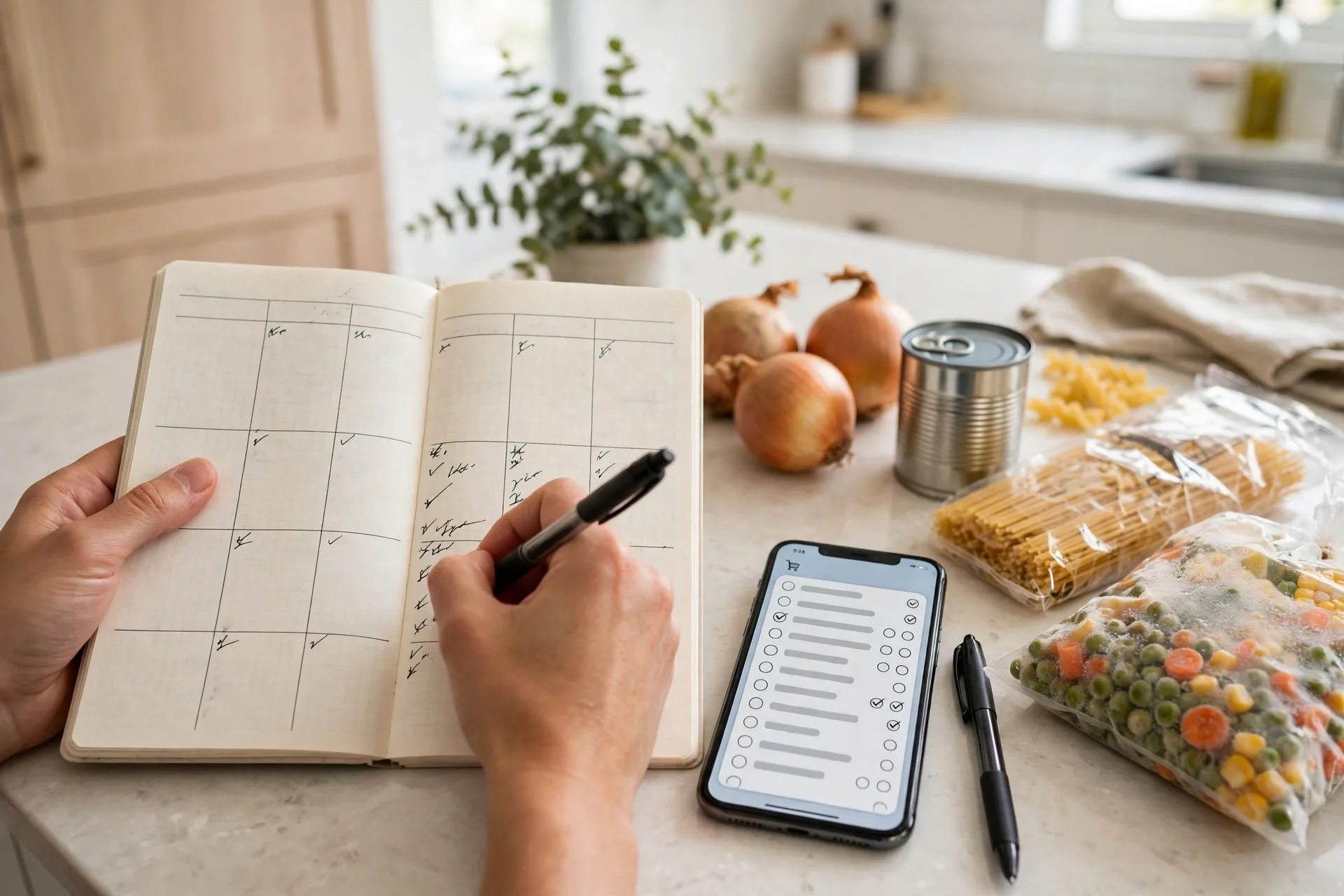
A unit price check belongs in step 6. A unit price is the cost per ounce or pound printed in small text on the shelf tag below the food, and research cited on Wikipedia found that shoppers who learn to use unit prices save around 17 to 18 percent (Source: Wikipedia, 2026). Check the unit price on 3 items per trip until the habit sticks. In my own kitchen, I plan 5 dinners, not 7, and I keep a short list of 10 meals my family eats without complaint, because that list is what keeps Sunday planning under 30 minutes.
Frugal Meal Planning: A 7-Day Sample Plan for a Family of 4
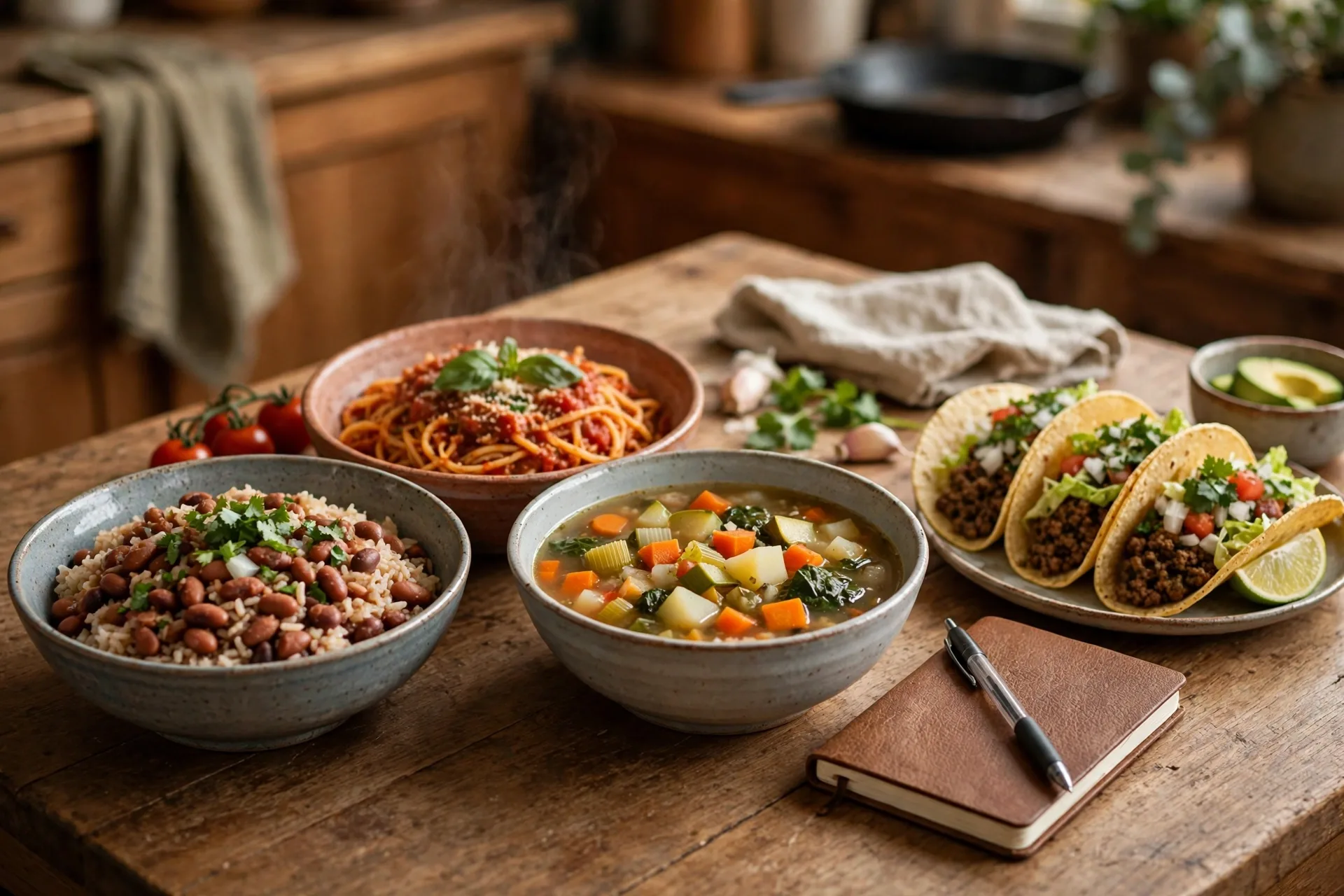
A 7-day frugal meal plan for a family of 4 works when 5 planned dinners, one leftover night, and one pantry night use the same bases with new flavors, so no night needs a store trip. The plan below feeds 4 people for 7 dinners, and every dinner costs about $1.50 to $2.00 per serving.
| Day | Dinner | What it uses |
|---|---|---|
| Monday | Burrito bowls | Rice, black beans, salsa, cheese, tortillas |
| Tuesday | Pasta with meat sauce | Pasta, canned tomatoes, ground beef, onion |
| Wednesday | Fried rice with egg | Rice, eggs, frozen peas, soy sauce |
| Thursday | Bean and vegetable soup | Chickpeas, canned tomatoes, frozen mixed vegetables, broth |
| Friday | Chicken tacos | Tortillas, frozen chicken, black beans, cheese, salsa |
| Saturday | Leftovers night | Tuesday and Friday leftovers, baked potatoes |
| Sunday | Tuna pasta bake | Pasta, tuna, frozen peas, cheese |
Breakfasts stay repeatable: oatmeal, eggs and toast. Lunches stay simple: dinner leftovers and peanut butter sandwiches. The plan reuses 4 bases across the week: rice, pasta, potatoes, and tortillas. One pack of chicken thighs covers Friday tacos and Thursday soup stock. One bag of rice covers Monday burrito bowls and Wednesday fried rice. Reuse is where the saving lives: 4 bases, 5 proteins, and 5 flavors make 7 different dinners.
How to do a pantry challenge turns the same idea into a full week with no grocery trip at all.
What Does a $75 Weekly Grocery List Look Like?
A $75 weekly grocery list for a family of 4 covers 7 dinners, breakfasts, and lunches when the list runs on cheap staples: rice, pasta, beans, lentils, eggs, chicken thighs, frozen vegetables, and seasonal produce. The list below totals $75.06 at typical 2026 store prices, and it matches the 7-day plan above item for item.
| Item | Size | Price |
|---|---|---|
| Long-grain rice | 5 lb | $3.50 |
| Pasta | 2 lb | $2.00 |
| Dried lentils | 2 lb | $3.00 |
| Black beans, canned | 4 cans | $3.60 |
| Eggs | 18 count | $4.50 |
| Chicken thighs | 3 lb | $5.97 |
| Ground beef | 1 lb | $4.99 |
| Canned tuna | 2 cans | $2.50 |
| Frozen mixed vegetables | 2 bags | $2.50 |
| Frozen peas | 1 bag | $1.25 |
| Canned tomatoes | 4 cans | $4.00 |
| Tortillas | 10 count | $2.50 |
| Bread | 1 loaf | $2.50 |
| Rolled oats | 42 oz | $3.50 |
| Milk | 1 gallon | $3.80 |
| Shredded cheese | 8 oz | $2.50 |
| Onions | 3 lb | $2.40 |
| Potatoes | 5 lb | $3.50 |
| Carrots | 2 lb | $1.60 |
| Cabbage | 1 head | $1.50 |
| Bananas | 1 bunch | $0.70 |
| Apples | 2 lb | $2.00 |
| Peanut butter | 1 jar | $3.00 |
| Salsa | 1 jar | $2.50 |
| Garlic | 1 head | $0.75 |
| Cooking oil, pantry share | part bottle | $1.00 |
| Soy sauce, pantry share | part bottle | $1.00 |
| Total | $75.06 |
Prices vary by store and region, so treat the list as a template, not a quote. The method matters more than the exact total: build the list from the plan, price it once, and keep the priced list as next week’s starting point. A 20-item price book works the same way at a bigger scale: write the 20 staples the household buys every week, note the store, size, and unit price for each, and after 4 weeks the lowest real price for every staple is on paper. A sale price above the recorded low is not a sale.

How Do You Meal Plan for One Person?
You meal plan for one person by cooking 3 dinners a week in full batches, freezing single portions, and repeating the same breakfast and lunch every day, because a single person wastes money on bulk packs and family-size deals when half the food spoils. Most meal planning guides assume a family of four, so the tactics for one person differ.
The USDA Thrifty Food Plan puts a single woman aged 20 to 50 at about $70 a week after the 20 percent adjustment the USDA suggests for one-person households (Source: USDA, 2026). A focused single-person plan can run near $55 a week with the same staples: 3 batch dinners, oatmeal or eggs for breakfast, and leftovers for lunch.
The single-person system has 4 rules. First, buy loose produce, not bagged packs, so the shopper takes 2 apples, not 6. Second, buy meat in small packs or ask the butcher counter to split a pack. Third, cook 2 portions, eat one tonight, and pack one for lunch tomorrow. Fourth, keep a stocked freezer of single portions: soup, rice, cooked beans, and pasta sauce all freeze in one-serving containers. A $50 weekly list for one person covers 3 batch dinners, 7 breakfasts, and 7 lunches when the list runs on oats, eggs, rice, beans, frozen vegetables, and one meat pack split across 2 meals. For more single-household tactics, the 15 smart ways to save money on groceries guide covers shopping small and cooking for one without waste.

How Do You Meal Plan With Dietary Needs or Picky Eaters?
You meal plan with dietary needs or picky eaters by building the same cheap base for everyone and swapping only the protein or the topping, because one shared base with 2 or 3 topping choices ends the nightly argument without cooking 2 dinners. The rules bend to the diet, and the plan stays cheap.
A vegetarian week builds on beans, lentils, eggs, and frozen vegetables, and it often saves more, because meat is the priciest item in the cart. Swap the ground beef in Tuesday pasta for lentils, and swap Friday chicken tacos for bean tacos. A gluten-free week swaps pasta and bread for rice, potatoes, and corn tortillas. A dairy-free week drops cheese from burrito bowls and tacos and adds avocado or extra beans. A household that manages blood sugar builds meals around beans, lentils, eggs, and non-starchy vegetables. Check the inventory against the diet before day one, and pull out any item that does not fit.
Picky eaters need choice, not new recipes. A pot of rice, a can of beans, shredded cheese, and a jar of salsa let each person build a bowl they like. Repeat 2 or 3 dinners the kids already like each week, and let each child pick one dinner from the inventory list and help cook it. Choice cuts complaints faster than any new recipe in the house. Keep a short list of 3 backup meals for the night the plan meets a hard no: pasta with butter and cheese, eggs on toast, and peanut butter sandwiches cost under $1 a serving and take 10 minutes.

Frugal Meal Planning vs No Plan: Which Saves More?
Frugal meal planning saves more than no plan for almost every household, because a plan cuts one full impulse shop, one takeout order, and one bin of spoiled food every week, while no plan pays full price for all 3. The comparison below shows where the money goes.
| Feature | Frugal meal planning | No plan |
|---|---|---|
| Weekly grocery spend, family of 4 | About $75 to $236 | $300 to $400 with takeout |
| Takeout nights per week | 0 to 1 | 2 to 3 |
| Food wasted per week | Under $10 | $25 to $55 |
| Shopping trips per week | 1 | 3 to 4 |
| Time spent planning | 30 minutes | 0 minutes, then 20 minutes a day deciding dinner |
| Dinner decision time | 0 minutes, the plan decides | 15 to 20 minutes of daily debate |
No plan wins on one point only: zero planning time on Sunday. That win costs about 2 hours of daily dinner debate across the week, plus the $40 takeout order that ends the debate. A plan costs 30 minutes once and pays it back in 5 calm evenings.
7 Mistakes That Break a Meal Plan
The 7 mistakes that break a meal plan are planning 7 new dinners, skipping the inventory, setting the budget to $0, shopping without a list, buying in bulk before checking the unit price, hiding the plan from the household, and quitting after one bad week. Each mistake has a fix that takes minutes.
- Planning 7 new dinners. New recipes every night burn out the cook by Wednesday. Fix: plan 5 dinners from the 10 go-to meals, and try one new recipe a week at most.
- Skipping the inventory. Winging it means staring into the pantry at 6 PM, finding “nothing to eat,” and ordering pizza. Fix: spend 5 minutes scanning the pantry, fridge, and freezer before writing the list.
- Setting the budget to $0 for extras. A $0 budget turns one missing item into a $45 delivery order. Fix: give the week a small fresh-food budget for milk, eggs, bread, and produce.
- Shopping without a list. Unplanned items fill the cart, and the plan dies in aisle 3. Fix: write the list by store section and keep a running total on the phone.
- Buying in bulk without checking the unit price. A big pack is often cheaper per unit, but not always: a sale on the smaller size can win. Fix: read the unit price on the shelf tag before buying the big pack.
- Hiding the plan from the household. A plan one person runs alone is an argument with extra steps. Fix: tell everyone the dinners, the end date, and the goal before day one.
- Quitting after one bad week. One failed week proves nothing about the system. Fix: run the restart below, change one thing, and try again next Monday.
What Do You Do When the Plan Falls Apart?
When the plan falls apart, run a 10-minute restart: pick 3 dinners from the go-to list, write the short list, shop once, and start again on Monday, because a restart beats a perfect plan that never starts. Burnout weeks happen to every household, and the fix is a smaller plan, not a bigger one.
A no-cook week is a valid plan. Stock 3 no-cook dinners: rotisserie chicken with bagged salad, canned soup with bread, and peanut butter sandwiches with fruit. Each costs under $3 a serving and takes under 10 minutes. A tired week runs on those 3 dinners and nobody notices.
The restart has 4 steps. First, forgive the missed week and throw out nothing: the food in the fridge still cooks. Second, pick 3 dinners, not 5, from the go-to list. Third, write the short list and shop once. Fourth, set a phone reminder for Sunday planning next week, same time, same place. A habit that survives a bad week is a habit that lasts. The first month is the hardest month, and the second month runs on lists already written.
Frequently Asked Questions
How much does frugal meal planning save per month?
Frugal meal planning saves about $150 to $300 a month for a family of four, because a planned shop cuts waste, impulse buys, and takeout by 20 to 30 percent. On a $600 monthly food budget, a 25 percent cut is $150 back. The saving shows up on the first receipt, and it grows as the price book fills in.
How long does meal planning take each week?
Meal planning takes about 30 minutes a week once the system runs: 5 minutes to check the pantry, 5 minutes to check sales, 10 minutes to pick 5 dinners, 5 minutes to write the list, and 5 minutes to set the budget. The first week takes 45 minutes, because the 10-meal go-to list is new.
Can you meal plan on SNAP or a $50 weekly budget?
Yes, you can meal plan on SNAP or a $50 weekly budget, because the same system works at any budget: pick 5 dinners from cheap staples, write one list, and shop once. Rice, beans, lentils, oats, eggs, and frozen vegetables cost under $2 a serving, and food pantries can cover staples the budget cannot.
What are the cheapest healthy meals for beginners?
The cheapest healthy meals for beginners are lentil soup, bean and rice burrito bowls, fried rice with egg, pasta with beans and tomatoes, and oatmeal with fruit. Each costs $1 to $2 a serving, uses 5 ingredients or fewer, and takes under 30 minutes. All 5 meals repeat well across a week.
How do you meal plan if you hate cooking?
You meal plan if you hate cooking by picking 3 no-cook or 10-minute dinners: rotisserie chicken with salad, canned soup with bread, and eggs on toast. Batch cook one pot of soup on Sunday and eat it twice. A plan with 3 easy dinners beats no plan every week.
Does meal planning work for one person?
Yes, meal planning works for one person, because the same system scales down: cook 3 dinners in batches, freeze single portions, and repeat breakfast and lunch daily. A single person can eat well for about $55 a week, against about $70 on the USDA Thrifty plan for one adult (Source: USDA, 2026).
Conclusion
Frugal meal planning for beginners works because it is a small habit with a big payoff: 30 minutes on Sunday, 5 dinners, one list, and one shop. A family of 4 can eat for about $75 a week on the list in this guide, and a single person can eat for about $55. The USDA Thrifty Food Plan sets the benchmark at $236.30 a week for a family of four (Source: USDA, 2026), so a household that plans well beats the benchmark by a wide margin.
Start this Sunday. Write the 10 go-to meals, pick 5 dinners, write one list, and shop once. Run the plan for 4 weeks, compare the 4 weekly totals with the month before, and move the saving into a separate savings account the same week. Savvy Cash Flow covers more money systems like this one, from grocery budgets to emergency funds, so the saving from the kitchen can fund the next goal on the list.