

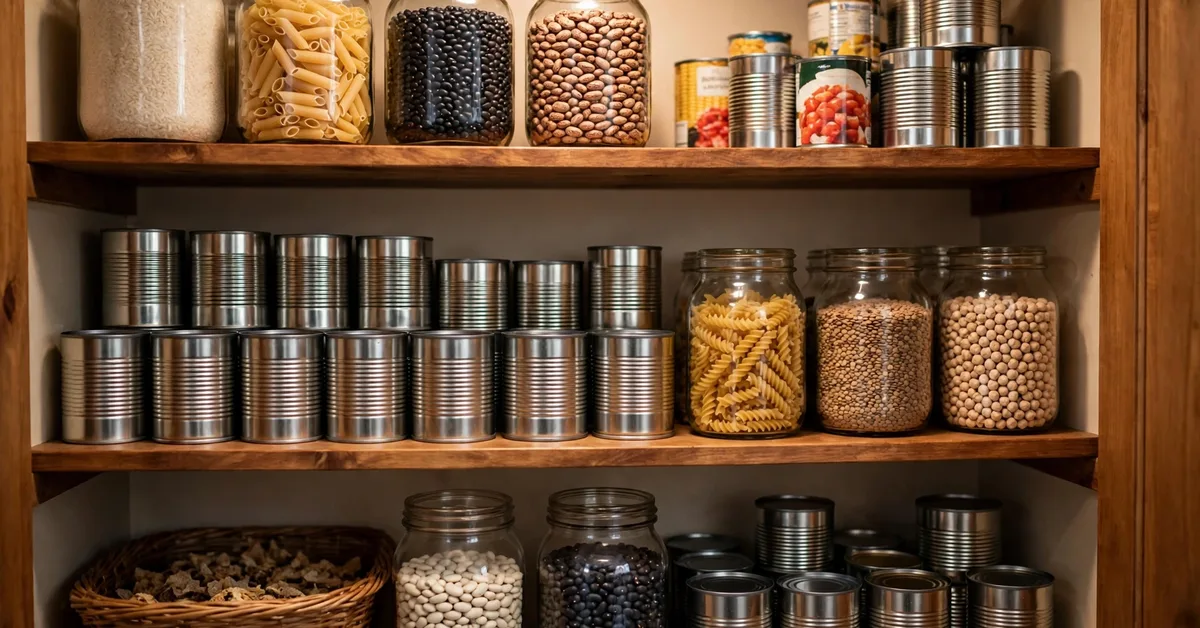
Introduction
How to do a pantry challenge to save money has a short answer: pick 7 days, take a full inventory of your pantry, fridge, and freezer, set a $25 to $40 fresh-food budget, and plan 7 dinners from food you already own. The food is already paid for, so each pantry meal keeps money in your pocket.
This guide defines a pantry challenge, shows the savings math for a family of 4, and gives 5 steps from inventory to dinner. You get a 7-day meal plan for a family of 4 from one sample inventory, a freezer storage chart, rules for kids and picky eaters, fixes for common diets, the 5 mistakes that stop most challenges, and a plan for the money you save.
Key Takeaways
- A pantry challenge is a set stretch of days, usually 7, when you cook from food you already own and buy only a small list of fresh items.
- A family of 4 saves about $150 in one pantry week, and a single person saves about $55.
- Take a full inventory first, plan 7 dinners from the inventory, and eat fridge and freezer food before shelf-stable food.
- Set a $25 to $40 fresh-food budget for milk, eggs, bread, and produce, and keep the first challenge to 7 days.
- Move the money you save into a separate savings account the same week.
What Is a Pantry Challenge?
A pantry challenge is a set stretch of days, usually 7, when you cook from food you already own and buy only a small list of fresh items, so the grocery trip you skip becomes money you keep in your pocket. A pantry challenge is not a fast, and it is not a diet. A pantry challenge is a short plan that turns food already in the kitchen into meals, instead of buying a new cart of groceries.
A pantry challenge has 4 parts: a full inventory, a length of 7 days with written rules, a $25 to $40 fresh-food budget, and a meal plan built from the inventory. Most kitchens hold 1 to 3 weeks of meals right now. You can browse more Frugal Living guides on Savvy Cash Flow for more ways to cut household costs without cutting meals.
How Much Money Does a Pantry Challenge Save?
A pantry challenge saves a family of 4 about $150 in one week, because a normal $180 grocery week drops to about $30 of fresh food, and the $150 you do not spend stays in your bank account at the end of the week. The saving comes from the trip you skip, not from eating less.
| Household | Normal grocery week | Pantry week (fresh food only) | Saved in 1 week | Saved in 12 pantry weeks |
|---|---|---|---|---|
| Family of 4 | $180 | $30 | $150 | $1,800 |
| Single person | $70 | $15 | $55 | $660 |
Run one pantry week each month and a family of 4 keeps about $1,800 a year. A pantry challenge also cuts waste. The United States Department of Agriculture (USDA) estimates that 30 to 40 percent of the food supply in the United States is wasted, equal to about 133 billion pounds and $161 billion worth of food in 2010 (Source: USDA, 2010). Wikipedia’s food loss and waste page lays out the same USDA figures.

How to Do a Pantry Challenge to Save Money
To do a pantry challenge to save money, follow 5 steps: take a full inventory, pick 7 days and write your rules, set a $25 to $40 fresh-food budget, plan 7 dinners from the inventory, and track what you spend and what you use up. Each step takes less than 30 minutes.
Step 1: Take a Full Inventory in 20 Minutes
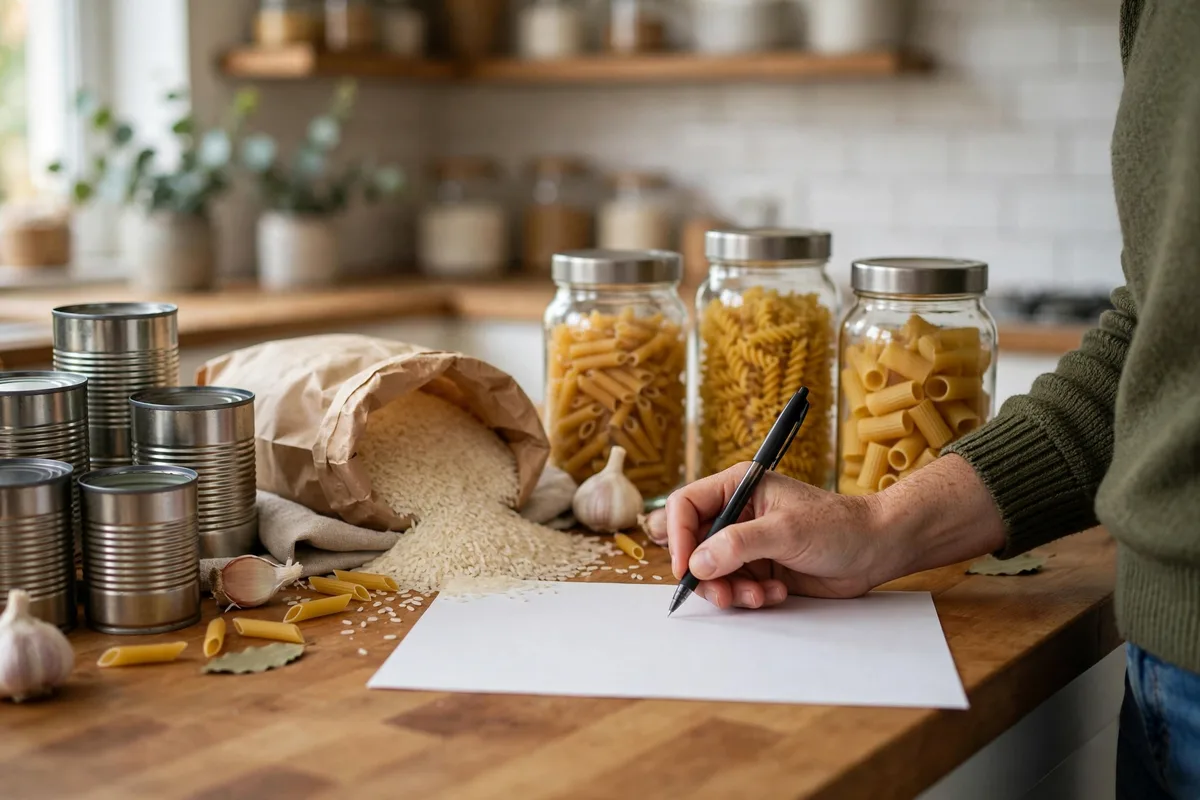
To take a full pantry inventory, pull every item out of the pantry, fridge, and freezer, group the items by type, and write the list down with quantities and dates. Group the items by type: grains, canned goods, proteins, frozen items, sauces, and snacks. Star the items that expire soonest and the bags that are already open, because those items get cooked first.
Step 2: Pick 7 Days and Write Your Rules
To pick your pantry challenge length, choose 7 days for a first challenge, write a fixed end date, and write 5 rules that the whole household agrees to. Seven days is long enough to skip one full grocery trip and short enough to finish. Write 5 rules before day one: fresh food only, no restaurants or delivery, oldest food first, everyone agrees, fixed end date.
Step 3: Set a $25 to $40 Fresh-Food Budget
To set a fresh-food budget, give yourself $25 to $40 for the week for milk, eggs, bread, and fresh produce, and write the number down before day one. A $0 budget backfires: one missing item turns into a $45 delivery order. Spend the budget on items that complete pantry meals, such as milk, eggs, onions, and tortillas. Keep the buy list short: milk, eggs, bread, onions, and 1 or 2 fresh vegetables. Buy them in one trip at the start of the week, and do not go back.
Step 4: Plan 7 Dinners From the Inventory
To plan 7 dinners from the inventory, list every meal the inventory can support, start with the items that expire soonest, and build each dinner from one base, one protein, and one flavor. Bases are rice, pasta, potatoes, and tortillas. Proteins are canned beans, lentils, eggs, tuna, and frozen meat. Flavors are salsa, soy sauce, canned tomatoes, broth, and spices. Keep breakfasts repeatable (oatmeal, eggs, toast) and lunches simple (leftovers, peanut butter sandwiches), so dinners carry the variety.
Step 5: Track Spending and the Used-Up List
To track a pantry challenge, keep every fresh-food receipt in one envelope, keep a running list of items you finish, and compare the pantry week total with a normal grocery week. The used-up list is the real payoff: each finished item is food that would have sat on the shelf, and the list becomes next month’s shopping list. On Sunday night, add up the receipts, subtract the total from your normal weekly spend, and move the saving to savings.
What Should You Eat First During a Pantry Challenge?
Eat the fridge and freezer first, then the pantry shelves, because fresh and frozen food spoils first while rice, pasta, and canned goods keep for months, so eating in that order cuts waste and saves the most money during the challenge. Fresh produce, dairy, and thawed meat belong in the first 3 days, frozen meat and vegetables in days 1 to 4, and canned beans, dried pasta, and rice in the last days.
In my own kitchen, I keep a shelf at eye level for food to eat first, and that one shelf has stopped more waste than any app I tried. Put the oldest frozen bags at the front, and label any mystery bag with tape and a marker before the challenge starts.

Pantry Challenge Meal Plan: 7 Dinners From One Inventory
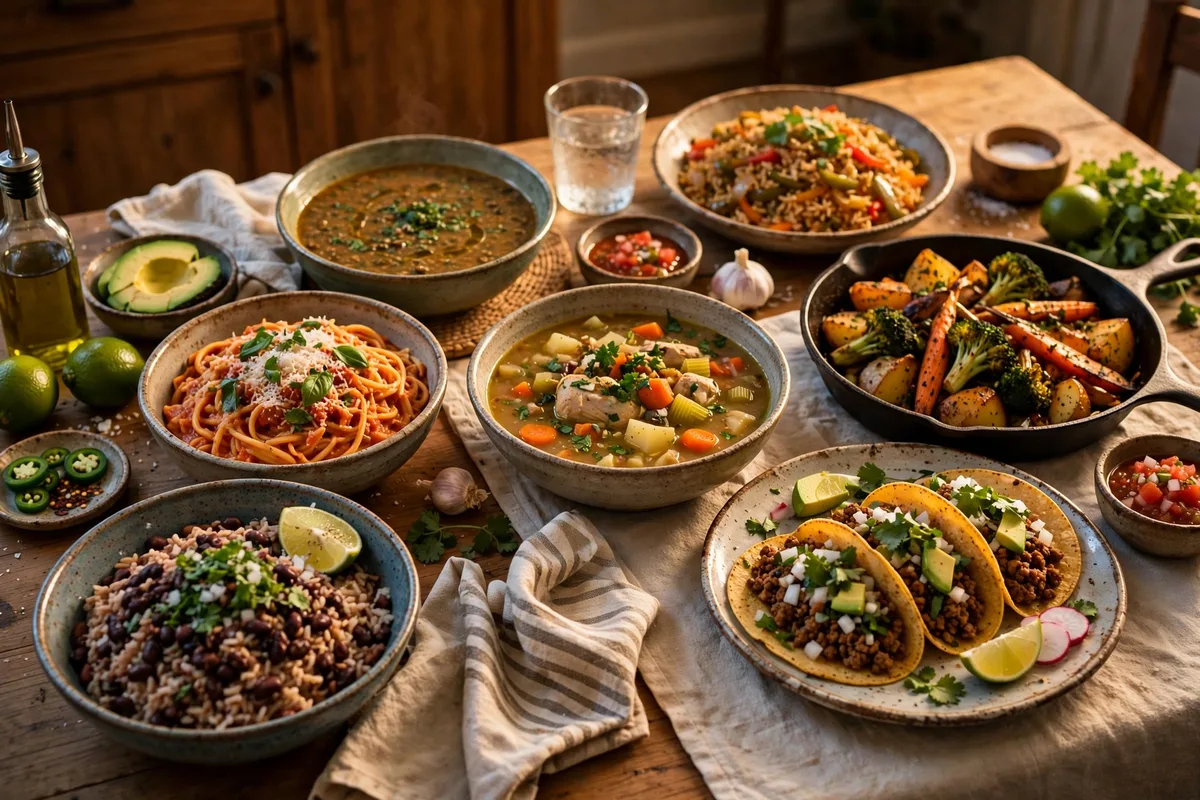
A 7-day pantry challenge meal plan works when you build 7 dinners from one written inventory, reuse the same bases with new flavors, and keep breakfasts and lunches simple, so no night needs a store trip at all during the week. The plan below uses one sample inventory for a family of 4.
Sample inventory: rice, pasta, black beans, chickpeas, diced tomatoes, pasta sauce, frozen chicken, frozen ground beef, frozen vegetables, frozen peas, tuna, peanut butter, oats, eggs, tortillas, cheese, salsa, soy sauce, broth, onions, potatoes, corn, flour, and yeast.
| Day | Dinner | Pantry items used |
|---|---|---|
| Monday | Burrito bowls | Rice, black beans, salsa, cheese, tortillas |
| Tuesday | Pasta with meat sauce | Pasta, canned tomatoes, ground beef, onion |
| Wednesday | Fried rice with egg | Rice, eggs, frozen peas, soy sauce |
| Thursday | Bean and vegetable soup | Chickpeas, canned tomatoes, frozen mixed vegetables, broth |
| Friday | Chicken tacos | Tortillas, frozen chicken, black beans, cheese, salsa |
| Saturday | Tuna pasta bake | Pasta, tuna, frozen peas, cheese |
| Sunday | Use-it-up soup and baked potatoes | Potatoes, leftover beans, frozen vegetables, broth |
Breakfasts are oatmeal, eggs and toast. Lunches are dinner leftovers and peanut butter sandwiches.
For a full grocery plan, read how to save money on groceries every month.
Pantry Challenge vs No-Spend Challenge: Which Saves More?
A pantry challenge saves more for most households, because it cuts one full grocery trip and uses food already paid for, while a no-spend challenge saves more only when dining out and shopping cause most of the overspending in the household budget. The two challenges solve different problems, so pick the one that fits your biggest cost.
| Feature | Pantry challenge | No-spend challenge |
|---|---|---|
| Focus | Food only | All non-need spending |
| Typical saving in a week | $55 to $150 | $100 to $300, depends on habits |
| Best for | A full pantry and freezer | Overspending across categories |
Run the pantry challenge first, because food is the easiest category to measure and the fastest to win.
How Do You Run a Pantry Challenge With Kids or Picky Eaters?
A pantry challenge works with kids when you frame meals as build-your-own bowls, repeat 2 or 3 dinners they already like, and let each child pick one dinner, because choice cuts complaints faster than any new recipe in the house. A pot of rice, a can of beans, shredded cheese, and a jar of salsa let each person build a bowl they like. Repeat the winners twice a week, and let each child pick one dinner from the inventory list and help cook it. These frugal living tips for families on one income show how a $150 weekly grocery cap works for a family of 4.

Can You Do a Pantry Challenge With Dietary Restrictions?
Yes, you can do a pantry challenge with dietary restrictions, because the rules bend to the diet: you build meals only from foods that fit the diet, and you put diet foods on the small buy list when the pantry runs short. A vegetarian challenge builds on beans, lentils, eggs, and frozen vegetables, and it often saves more, because meat is the priciest item in the cart. A gluten-free challenge swaps pasta and bread for rice, potatoes, and corn tortillas. A household that manages blood sugar builds meals around beans, lentils, eggs, and non-starchy vegetables. Check the inventory against the diet before day one, and pull out any item that does not fit.
Is Pantry Food Safe to Eat After the Date on the Label?
Yes, most pantry food is safe to eat after the date on the label, because dates on most foods (except infant formula) mark quality, not safety, so you judge canned and dry goods by look, smell, and the seal, not by the printed date alone. The USDA notes that date labels, except on infant formula, are quality dates set by the maker, not federal safety dates. A can with a dent on the seam, a bulging lid, or a bad smell goes in the trash, whatever the date says.
Use the freezer chart below to sort frozen food during the inventory step. Food held at 0°F stays safe to eat for as long as it stays frozen, and the times below cover quality and taste, not safety (Source: FoodSafety.gov, 2026).
| Frozen food | Best quality window |
|---|---|
| Ground meat (beef, turkey, chicken, pork) | 3 to 4 months |
| Cooked meat or poultry | 2 to 6 months |
| Soups and stews | 2 to 3 months |
| Casseroles or quiche | 2 to 3 months |
Cook anything near the end of its window first, and freeze cooked batches in single-meal packs the day you cook them.
5 Mistakes That End a Pantry Challenge Early
The 5 mistakes that end a pantry challenge early are skipping the inventory, setting the fresh-food budget to $0, starting with a full month, restocking with a blowout shop, and hiding the plan from the household before day one in your home.
- Skipping the inventory. Winging it means staring into the pantry at 6 PM, finding “nothing to eat,” and ordering pizza. Fix: spend 20 minutes on the written list before day one.
- Setting the fresh-food budget to $0. A $0 budget turns one missing item into a $90 “while I am here” trip. Fix: give yourself $25 to $40 and keep the receipts.
- Starting with a full month. Ambition kills more challenges than temptation. Fix: nail 7 days first, then try 2 weeks next time.
- The rebound shop. The challenge ends Sunday, and Monday you “restock” with $280 of groceries. Fix: restock only what the used-up list proves you use.
- Hiding the plan from the household. A challenge one person runs alone is an argument with extra steps. Fix: tell everyone the rules, the end date, and the goal before day one.
What Should You Do With the Money You Save?
Move the money you save into a separate High-Yield Savings Account (HYSA) the same week, because cash left in checking gets spent, while money moved to savings becomes the start of an emergency fund that protects the next surprise bill. The Federal Reserve reports that more than a third of American adults would have difficulty covering a $400 emergency expense with cash or its equivalent (Source: Federal Reserve, 2024). A $150 pantry week covers more than a third of that $400, and 3 pantry weeks cover the whole amount.
Set the destination before you start: an emergency fund top-up, a debt payment, or a sinking fund for car repairs. Then write 3 restock rules: buy a replacement only when you open the last unit; keep a staples list of 10 items; run a mini pantry week the last week of every month. To give the saved money a home, read how to build an emergency fund from scratch, which gives the 3 stages from $1,000 to 6 months of costs.

Conclusion
Learning how to do a pantry challenge to save money pays off fast: a family of 4 saves about $150 in one week, because you cook from food already paid for, plan 7 dinners from one inventory, and move the saved money to savings the same week. Start with 3 moves: take the inventory, write the 5 rules down, and set a $25 to $40 fresh-food budget. More practical money guides wait on Savvy Cash Flow.
Frequently Asked Questions
How long should a pantry challenge last?
Seven days is the best length for a first pantry challenge, because 7 days skips one full grocery trip without draining the pantry, and you can stretch to 2 weeks once a 7-day run feels easy for your household and your budget.
What can I buy during a pantry challenge?
You can buy fresh food you truly need, such as milk, eggs, bread, and produce, capped at $25 to $40 for the week, because a pantry challenge cuts the full grocery trip, not the small items that complete pantry meals.
How much money does a pantry challenge save?
A pantry challenge saves a family of 4 about $150 in one week, and a single person saves about $55, because a normal grocery week drops to $25 to $40 of fresh food, so the rest of the weekly grocery budget stays in your pocket.
Can a pantry challenge work for one person?
Yes, a pantry challenge works for one person, because a single cook needs only 7 small dinners from shared bases, and smaller batches plus a $15 to $25 fresh-food budget fit a one-person kitchen and keep portions right for 7 days.
How often should I do a pantry challenge?
Once a month is the right pace for most households, because a monthly pantry week clears the backlog before food expires, and 12 pantry weeks a year can save a family of 4 about $1,800 from food already paid for.