

Introduction
How to budget with cash only in 2026 means paying for daily spending with physical cash, paying fixed bills with cash or money orders, and tracking every dollar by hand, and the method works for anyone who wants a hard limit on spending. This guide covers what a cash-only budget is, why cash still works in 2026, 7 setup steps, a worked month on $3,200 of take-home pay, 5 ways to pay fixed bills with cash, a no-bank-account path, envelope categories, a cash versus card comparison, cash safety rules, a 10-minute weekly check, a cash-only versus hybrid decision guide, and 7 mistakes to avoid. Cash gives you a visible limit on each category, and the weekly check keeps the plan honest.
Key Takeaways
- A cash-only budget pays daily spending with physical cash and pays fixed bills with cash, money orders, or prepaid cards.
- Start with 7 steps: list income, list bills, set envelope limits, withdraw cash on payday, pay bills first, spend from envelopes, and count cash once a week.
- A worked month on $3,200 of take-home pay assigns $1,825 to fixed bills, $910 to cash envelopes, and $465 to savings and debt payoff.
- A USPS money order costs $2.65 for amounts up to $500 and $3.75 for $500.01 to $1,000, with a $1,000 limit per order (Source: USPS (2026)).
- Cash still works in 2026: cash was 14% of US consumer payments in 2025 (Source: Federal Reserve (2026)).
What Is a Cash-Only Budget?
A cash-only budget is a spending plan that pays for daily costs with physical cash, pays fixed bills with cash or money orders, and tracks every dollar without a card or a banking app, and gives each dollar a job on payday so spending stops when the cash runs out. Envelopes cover variable spending only, while a cash-only budget covers the whole month. Savvy Cash Flow publishes beginner budget guides that use real numbers instead of vague advice, and this guide follows that same pattern.
A cash-only budget has 4 parts. Income is take-home pay, the money that reaches you after tax and payroll deductions. Fixed bills are rent, utilities, insurance, phone, internet, and loan payments. Variable spending is groceries, gas, dining out, household items, and fun money. Savings and debt payoff are the emergency fund, sinking funds, and extra payments above minimums. If the term budget is new, start with what is a budget for the 4 parts and 6 steps in plain words. For more plans in the same style, browse the Budgeting & Saving guides.
Why Budget With Cash Only in 2026?
Cash-only budgeting still works in 2026 because cash gives every purchase a visible cost, and the Federal Reserve found cash was 14% of US consumer payments in 2025, so cash remains a normal way to pay for daily spending in shops, markets, and services. Cash was 14% of US consumer payments in 2025, or about 6 cash payments a month out of 47 total payments, and 4 out of 5 consumers used cash in the prior 30 days (Source: Federal Reserve (2026)). Read the full results in the 2026 Diary of Consumer Payment Choice from Federal Reserve Financial Services.
Cash works for 4 reasons. It shows the limit: an envelope with $120 left is a fact you can see. It stops overspending at the till: when the envelope is empty, the purchase waits. It has no overdraft fee and no interest charge. It works without a bank account, a phone, or an internet connection. Cash has limits too: no rewards and no fraud protection, so a cash-only budget plans around those limits with money orders and prepaid cards.
How to Budget With Cash Only in 2026 in 7 Steps
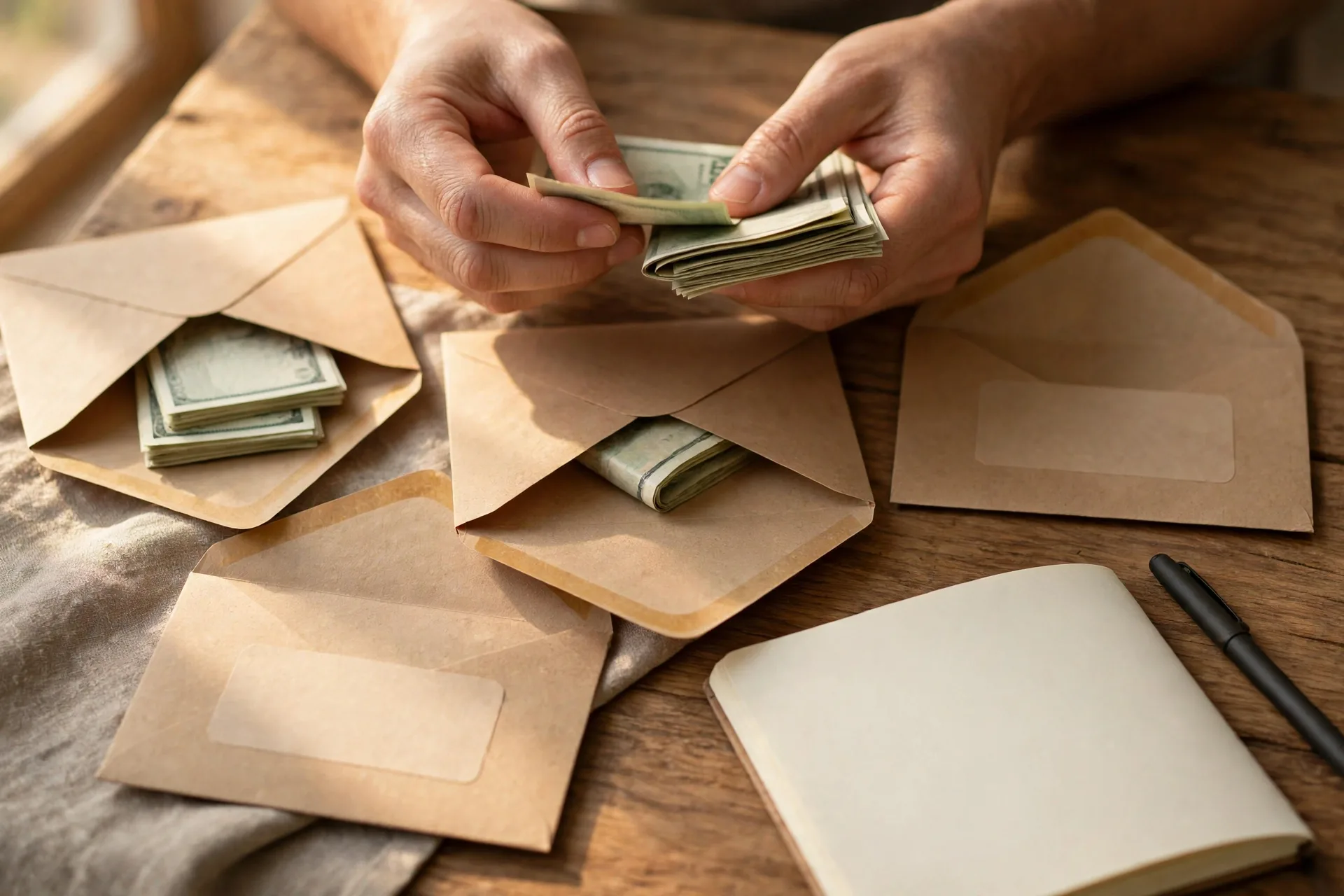
To budget with cash only in 2026, follow 7 steps in order: list take-home pay, list fixed bills, set envelope limits, withdraw cash on payday, pay fixed bills first, spend only from envelopes, and count cash once a week until the next payday. The first setup takes about 30 minutes. Each payday after that takes about 15 minutes.
- List take-home pay for the month, and use the lowest recent month if pay changes.
- List every fixed bill with its amount and due date, from real bills, not memory.
- Set envelope limits from the last 2 to 3 months of spending, trimmed by about 10 percent.
- Withdraw cash on payday: the envelope total plus cash for bills, in small bills.
- Pay fixed bills first, with money orders, in-person payments, or a prepaid card.
- Spend only from the matching envelope, and when an envelope is empty, that category is done until payday.
- Count cash once a week, write the balance on each envelope, and move money only for a clear reason.
Match each bill to a payday by its due date, so a bill due on the 3rd gets paid from the check that arrives before the 3rd. The paycheck budgeting method shows how to split bills across paychecks when one check cannot carry the whole month. A zero-based budget gives every dollar a job until income minus assignments equals zero, and a cash-only budget follows that same rule with physical cash.
A Worked Cash-Only Month on $3,200 Take-Home Pay
A worked cash-only month on $3,200 of take-home pay assigns $1,825 to fixed bills, $910 to 5 cash envelopes, and $465 to savings, sinking funds, and debt payoff, and the 3 groups add up to exactly $3,200 with no dollar left unassigned. The amounts below are an example for a single adult with shared housing, not a benchmark for every household.
| What the money pays for | Monthly amount | How it is paid |
|---|---|---|
| Rent | $1,150 | 2 money orders |
| Electric | $120 | In person or money order |
| Water | $45 | In person or money order |
| Internet | $65 | Prepaid card |
| Phone | $55 | In person at carrier store |
| Car insurance | $110 | Money order |
| Car payment | $280 | Money order or in person |
| Groceries envelope | $480 | Cash |
| Gas and transport envelope | $180 | Cash |
| Dining out envelope | $100 | Cash |
| Household and personal envelope | $90 | Cash |
| Fun money envelope | $60 | Cash |
| Clothing and gifts sinking fund | $75 | Cash in a labeled envelope |
| Emergency fund | $200 | Cash in a locked box |
| Extra debt payment | $150 | Money order |
| Buffer for surprises | $40 | Cash |
| Total | $3,200 | Every dollar assigned |
Fixed bills take $1,825, or 57 percent of pay. Cash envelopes take $910, or 28 percent of pay. Savings, sinking funds, and debt payoff take $465, or 15 percent of pay. Buy money orders the same day you withdraw, since they need cash at the counter.
Scale the same method to any income: fixed bills first, then envelopes, then savings. A household on $1,800 of take-home pay can use the same 3 groups with smaller amounts, and how to budget on a low income shows a full $1,800 example that adds up to the last dollar.
How Do You Pay Fixed Bills With Cash in 2026?
You pay fixed bills with cash in 2026 through 5 methods: in-person payment at the biller, a USPS money order, a prepaid debit card, a cash payment at a retail payment center, or cash handed to a landlord or biller with a written receipt. Each method fits a different bill, so most cash-only households use 2 or 3 of them in one month.
| Method | How it works | Typical fee | Best for | Proof to keep |
|---|---|---|---|---|
| In-person payment | Pay cash at the utility, phone, or lender office | $0 in most cases | Utilities, phone, local lenders | Stamped receipt from the office |
| USPS money order | Buy at the post office, mail it or hand it over | $2.65 up to $500, $3.75 for $500.01 to $1,000 (Source: USPS (2026)) | Rent, car payment, insurance | Receipt stub with the serial number |
| Prepaid debit card | Load cash at a store, pay online or by phone | Load fees vary by card | Internet, subscriptions, online bills | Card receipt and payment confirmation |
| Retail payment center | Pay cash at a grocery or check-cashing store | $1 to $3 per payment at most counters | Bills with a payment barcode | Printed payment receipt |
| Cash by hand | Hand cash to the landlord with a signed receipt | $0 | Rent to a private landlord | Signed and dated receipt, both copies kept |
A USPS money order has a $1,000 limit per order, so a $1,150 rent payment needs 2 orders: one for $1,000 at a $3.75 fee and one for $150 at a $2.65 fee, or $6.40 in fees for the month. Keep the receipt stub for every money order, and write the bill name and month on it. Pay each bill at least 3 days before its due date, because a money order sent by mail needs transit time. A money order can be traced and replaced if it is lost, which cash handed over by hand cannot.

Envelopes are one part of the system: read Cash Envelope System: Does It Still Work in 2026? for the envelope-only method.
How to Budget With Cash Only and No Bank Account
To budget with cash only and no bank account, cash each paycheck at the issuing bank or a check-cashing store, pay bills with money orders, load a prepaid card for online payments, and keep a written ledger of every dollar. In 2023, 4.2 percent of US households, about 5.6 million households, had no bank or credit union account, and two-thirds of those households, 66.2 percent, relied entirely on cash (Source: FDIC (2023)). Read the full results in the FDIC survey of unbanked households.
Cash a paycheck in the cheapest place first. The bank that issued the check often cashes it free for the payee, so ask there before paying a fee. A check-cashing store charges a percentage of the check, so compare 2 or 3 stores and pick the lowest rate.
A prepaid debit card covers the digital gaps: load only the amount needed for online bills, and check the fee list first. Keep a paper ledger: write each payday amount at the top, list each bill and envelope below it, and tick each line off when it is paid. A ledger is the bank statement of a cash-only budget: without it, a missing $40 stays a mystery.
Cash Envelope Categories for a Cash-Only Budget
The best cash envelope categories for a cash-only budget are groceries, gas and transport, dining out, household and personal care, and fun money, because these 5 categories change every month and cause most overspending, while fixed bills stay out of envelopes and get paid first. Start with 3 envelopes, not 5, and add the rest after one full month.
| Envelope | Monthly amount | Weekly amount | Rule |
|---|---|---|---|
| Groceries | $480 | $120 | Shop with a list, cook at home most nights |
| Gas and transport | $180 | $45 | Fill the tank on the same weekday each week |
| Dining out | $100 | $25 | When it is empty, eat at home until payday |
| Household and personal | $90 | $22 | Basics only, no stocking up in one trip |
| Fun money | $60 | $15 | Guilt-free spending with a hard ceiling |
| Total in envelopes | $910 | $227 | 28 percent of $3,200 take-home pay |
Write the category and the amount on each envelope, and write the remaining balance on it after each big purchase. Borrow from one envelope only once, with a written note of the amount and the date. Move leftover envelope cash to savings at month end.
Cash-Only Budget vs Card Spending: Which Controls Spending Better?
A cash-only budget controls spending better than cards for variable costs, because cash shows the remaining balance in your hand, while cards hide the total until the statement arrives, and cards still win for bills, online shopping, fraud protection, and records, so the choice depends on where your spending goes off plan. Research on the cashless effect has found more than once that people spend more when they pay by card than when they pay with cash, because a card payment feels less real than counting out bills.
| Feature | Cash-only budget | Card spending |
|---|---|---|
| Spending limit | Visible cash in the envelope | A balance you must check |
| Overspending stop | Cash runs out, spending stops | Card keeps working past the limit |
| Fees | Money order and load fees, a few dollars a month | Interest, late fees, and overdraft fees if the balance slips |
| Fraud protection | None, lost cash is gone | Chargebacks and fraud limits |
| Rewards | None | Cashback and points |
| Records | Paper ledger, written by hand | Automatic statements |
| Online shopping | Needs a prepaid card | Works directly |
| Best for | Groceries, dining out, fun money | Bills, subscriptions, online orders |
Cash wins where spending is a behavior problem, and cards win where the payment is fixed, online, or needs a paper trail.
How Do You Keep Cash Safe at Home and on the Go?
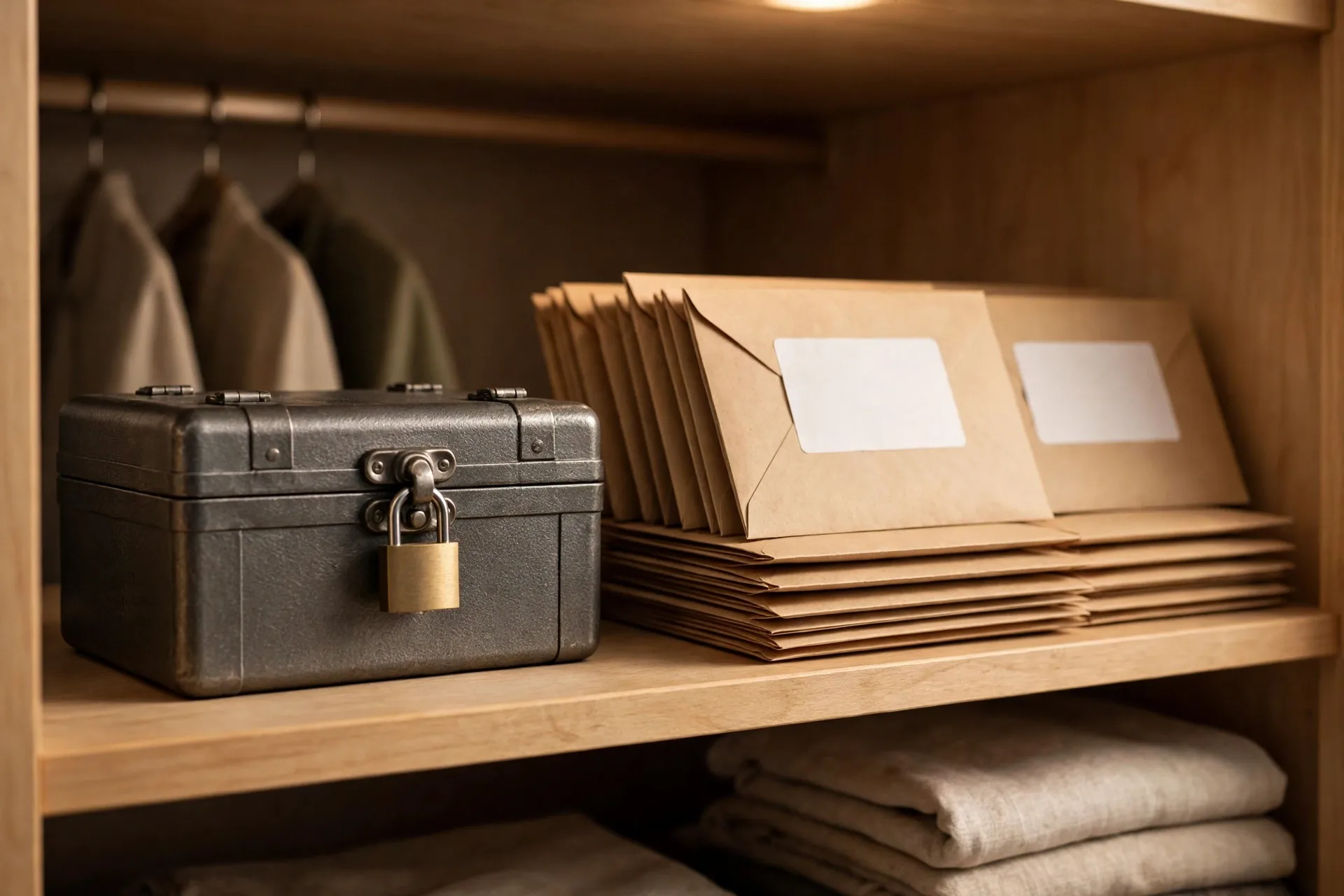
To keep cash safe, hold only one week of spending cash in a wallet, store the rest in a locked box at home, never carry the full month of cash, and keep receipts for every money order, and count the box once a week so a shortfall shows up fast. Cash has no fraud protection, so prevention is the whole plan.
Follow 6 safety rules. Carry only the week ahead: a wallet with $227 hurts less to lose than one with $910 for the month. Keep the cash box locked and out of sight. Split storage: keep rent money and the emergency fund in separate places. Never tell people outside the household how much cash is at home. Pay rent and large bills by money order as soon as the cash is withdrawn.
If cash is lost or stolen, there is no claim to file and no refund to wait for, so carry less, lock the box, and pay large bills at once. If the home is shared with people you do not fully trust with cash, use a small safe with a code.
The Weekly 10-Minute Cash Check
A weekly 10-minute cash check means counting each envelope, writing the remaining amount on it, comparing spending to the plan, and moving money between envelopes before the next week starts, and the check takes 10 minutes when it runs on the same weekday each week. Run the check on the same weekday each week, with a phone reminder set for it. Savvy Cash Flow covers the same weekly review pattern in its beginner budget guides.
- Count each envelope (3 minutes). Count the cash, write the balance on it, and note any envelope under $20.
- Compare spending to the plan (3 minutes). Check which categories run ahead of pace and which run behind.
- Fix one thing (2 minutes). Plan the next 3 meals from the pantry if groceries run over.
- Check the next bills (2 minutes). List bills due before the next payday and confirm the money order cash is set aside.
In my first cash-only month, I counted the grocery envelope on day 23 and found $18 left for 8 days. Cooking from the pantry for that last week fixed my grocery limit for month two. A weekly check catches that gap on day 7, while it is still small.
Cash Only or Hybrid: When to Use Which?
Use a full cash-only budget when overspending is the main problem or you have no bank account, and use a hybrid when bills, subscriptions, and online shopping make a full cash life hard to run, and the hybrid keeps cash envelopes on the categories where you overspend most while bills and savings stay digital. Pick the setup that fits your life, not the setup that sounds purest.
Choose a full cash-only budget if you overspend with cards every month, you have no bank account, or most of your shopping is in person. Choose a hybrid if most bills arrive online, you pay subscriptions each month, or you want fraud protection on big purchases. Test either setup for 3 full months, because month one is calibration, not a final grade.
7 Mistakes That Break a Cash-Only Budget
The 7 mistakes that break a cash-only budget are starting with too many envelopes, borrowing between envelopes, skipping the weekly count, forgetting yearly bills, carrying the full month of cash, paying bills late, and quitting after one bad month, and each mistake has a fix in the list below.
- Starting with 10 envelopes on day one. Start with 3 envelopes and add one a month.
- Borrowing between envelopes. Treat each envelope as a hard limit, and stop spending in a category when it runs dry.
- Skipping the weekly count. Count cash on the same weekday each week.
- Forgetting yearly bills. Add a sinking fund line for car insurance, registration, gifts, and holidays.
- Carrying the full month of cash. Carry one week at a time and keep the rest locked at home.
- Paying bills late. Pay each bill at least 3 days early.
- Quitting after one bad month. Month one sets the real numbers, so adjust the limits and run it again.
Conclusion
How to budget with cash only in 2026 comes down to 3 habits: pay fixed bills first with cash or money orders, spend variable costs only from labeled envelopes, and count cash once a week, and start with 3 envelopes, run one full month, and adjust the limits from real spending. Pick your 3 starter envelopes this week, withdraw the cash on your next payday, and give the plan 3 honest months. For more plain money guides in the same style, visit Savvy Cash Flow.
This article is for general information only and is not financial advice.
Frequently Asked Questions
Is cash-only budgeting still practical in 2026?
Yes, cash-only budgeting is still practical in 2026 for daily spending, because shops, markets, and most billers still take cash, and cash was 14% of US consumer payments in 2025 (Source: Federal Reserve (2026)). Online shopping, subscriptions, and bill payments need a prepaid card or a money order, so a cash-only budget plans for those cases from the start.
How much cash should I withdraw each payday?
Withdraw the envelope total plus the cash needed for bills paid in person, and leave fixed bills paid by money order in cash at the counter. On a $3,200 month, that is $910 for envelopes plus cash for in-person bills, and the rest gets paid by money order the same day.
How do I pay rent with cash?
Pay rent with cash through a USPS money order, which costs $2.65 for amounts up to $500 and $3.75 for $500.01 to $1,000 (Source: USPS (2026)). A rent payment above $1,000 needs 2 money orders, since one order caps at $1,000, and you should keep the receipt stub and hand the order over with a signed receipt.
Can I budget with cash only if I have no bank account?
Yes, you can budget with cash only and no bank account by cashing each paycheck at the issuing bank, paying bills with money orders, and loading a prepaid card for online payments. In 2023, 4.2 percent of US households had no bank account (Source: FDIC (2023)), so the path is common, and a written ledger replaces the bank statement.
What happens if I lose my cash envelopes?
Lost cash is gone, since cash has no fraud protection and no refund process, so prevention is the only fix. Carry only one week of cash at a time, keep the rest in a locked box at home, and pay large bills by money order right after payday, so a lost wallet never holds a full month of money.
Is a cash-only budget better than a card budget?
A cash-only budget is better than a card budget for variable spending like groceries and dining out, because cash shows the limit in your hand and stops spending when it runs out. Cards are better for fixed bills, online orders, fraud protection, and automatic records, so many households run cash envelopes for problem categories and cards for the rest.