


A biweekly budget template for beginners is a simple plan that matches your spending to the 26 paychecks you get each year when you are paid every two weeks. It assigns each bill, grocery trip, and savings transfer to a set payday, so money is ready before each due date.
This guide shows why a monthly budget fails on biweekly pay, then walks through a six-step setup, a copy-paste template with exact formulas, and a bill-split method. You also get a third-paycheck plan, rules for variable income and couples on staggered schedules, a debt trick that adds a 13th payment each year, a list of mistakes to skip, and a 30-minute first-Friday plan. The template works in Google Sheets or Excel and fits a $1,850 paycheck example you can copy and change to your own numbers.
Key Takeaways
- A biweekly budget plans money by payday, not by calendar month, across 26 paychecks a year.
- On a $2,000 check, ten months bring $4,000 and two bring $6,000: plan for the $333 gap.
- Split rent in half across two checks and assign each bill to the paycheck before its due date.
- Split each third paycheck 50 percent to savings or debt, 25 percent to sinking funds, and 25 percent to fun.
- Budget variable pay off your lowest recent check and send every surplus to savings or debt.
What Is a Biweekly Budget Template for Beginners?
A biweekly budget template for beginners is a reusable plan that splits your money by payday instead of by calendar month. It lists each paycheck, assigns bills to the check before each due date, sets grocery and fun money per pay period, and moves savings on every payday.
A biweekly budget template is a tool that turns each paycheck into its own small budget, with five parts: a list of the 26 paydays, a take-home pay line for each check, a bill list, spending limits, and a savings line that moves on payday.
The template fits anyone paid every two weeks: hourly workers, retail and warehouse staff, nurses, teachers, and office workers. A side gig fits too, as a separate income line.
Why Does a Monthly Budget Fail on Biweekly Pay?
A monthly budget fails on biweekly pay because the calendar month and the pay cycle run on different clocks. Ten months bring two paychecks and two bring three, so a flat monthly total hides a $333 gap in most months. Bills fall on fixed dates while paydays drift.
Take a $2,000 take-home check: 26 paychecks earn $52,000 a year, or $4,333 per average month. But ten months only bring two checks, which is $4,000 in cash, so a $333 gap opens in most months. The other two months bring three checks, or $6,000.
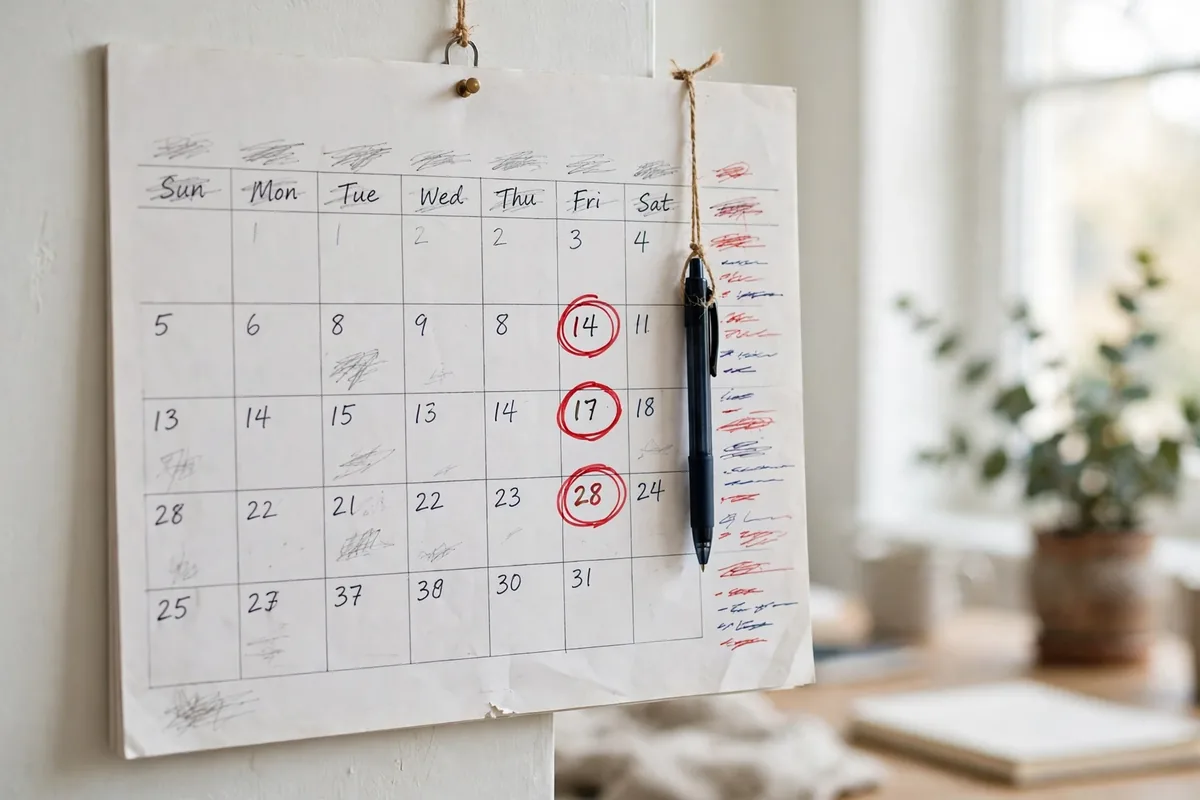
Paydays also drift through the month. A Friday payday lands on the 2nd one month and the 16th the next, so a bill due on the 1st can fall before payday in one month and after it in the next.
The stakes are real. Only 63 percent of adults would cover a $400 emergency expense with cash or its equivalent, according to the Federal Reserve report on household savings (Source: Federal Reserve (2026)). A budget with a $333 gap each month makes that buffer hard to build. Biweekly pay is also common: 43 percent of US private employers pay every two weeks (Source: Bureau of Labor Statistics (2023)).
When I first moved my own budget to payday blocks, the second week of the month felt calmer at once. Rent no longer competed with groceries because each cost had its own check.
More Budgeting & Saving guides pair with this template.
How to Set Up Your Biweekly Budget Template in 6 Steps
You set up a biweekly budget template in six steps: list paydays, write take-home pay, list bills with due dates, split bills across checks, set per-paycheck spending limits, and move savings on payday. Setup takes about 30 minutes, and the template then repeats with small edits.
- List all 26 paydays for the year from your pay calendar.
- Write your take-home pay per check.
- List every bill with its amount and due date.
- Assign each bill to the paycheck before its due date.
- Set grocery, gas, and fun limits per paycheck.
- Schedule a savings transfer for every payday.
The Copy-Paste Biweekly Budget Template
The copy-paste biweekly budget template below uses a $1,850 take-home check and a $1,350 rent split across two paychecks. Each check covers its own bills, groceries, savings, and buffer, and both total exactly $1,850. Copy the tables into Google Sheets or Excel, then swap in your own numbers.
At Savvy Cash Flow, we test every template with a real paycheck example. Paycheck 1 carries the big fixed bills, and Paycheck 2 carries the smaller bills and a larger buffer.
Paycheck 1
| Item | Amount |
|---|---|
| Rent (half) | $675 |
| Electric | $120 |
| Internet | $80 |
| Phone | $75 |
| Car insurance | $110 |
| Groceries | $240 |
| Gas | $100 |
| Savings | $100 |
| Extra debt payment | $150 |
| Fun money | $50 |
| Buffer | $150 |
| Total | $1,850 |
Paycheck 2
| Item | Amount |
|---|---|
| Rent (half) | $675 |
| Water | $60 |
| Subscriptions | $45 |
| Groceries | $240 |
| Gas | $100 |
| Savings | $100 |
| Extra debt payment | $150 |
| Household | $90 |
| Dining out | $80 |
| Fun money | $60 |
| Buffer | $250 |
| Total | $1,850 |
The buffer line is the part most beginners skip. It holds $150 on the first check and $250 on the second for surprise costs; roll unused buffer into savings next payday.
Biweekly Budget Template Formulas for Google Sheets and Excel
Five formulas run a biweekly budget template in Google Sheets or Excel. They build the payday list, turn a paycheck into a monthly average, split rent and yearly costs across 26 checks, and show what is left on each check. Type them once.
| What it does | Formula | Example |
|---|---|---|
| Next payday | =A2+14 | Jan 2 + 14 days = Jan 16 |
| Monthly average pay | =paycheck x 26 / 12 | $1,850 x 26 / 12 = $4,008.33 |
| Rent per check (reserve method) | =rent x 12 / 26 | $1,350 x 12 / 26 = $623.08 |
| Yearly cost per check | =annual cost / 26 | $600 car insurance / 26 = $23.08 |
| Left on this check | =paycheck – bills – 2 x weekly spend – savings | $1,850 – $1,240 – $340 – $100 = $170 |
Rent works two ways: the template splits $675 from each check in a month, while the reserve method sets aside $623.08 from every check. Pick one and use it all year.
The yearly-cost formula turns lumpy bills into small per-check amounts: a $600 yearly car insurance bill becomes $23.08 per check. Save it in a sinking fund.
Add these formulas to a free budget template for Google Sheets.

How Do You Split Bills Between Two Paychecks?
You split bills between two paychecks by due date, not by size. Each bill goes to the paycheck that lands before its due date, rent splits in half across the two checks, and groceries and gas get a set amount on each check. If one check ends up light, move a due date.
The due-date rule is the whole method: a bill due on the 5th goes to the paycheck before the 5th, and a bill due on the 20th goes to the paycheck before the 20th. Size does not matter.
Rent is the one bill you split: put $675 on each check so no single payday carries the full $1,350. Give each check its own $240 grocery line and $100 gas line instead of one monthly pool.
Check the split against the 50/30/20 budget rule. The 50/30/20 budget rule is a plan that puts 50 percent of take-home pay to needs, 30 percent to wants, and 20 percent to savings and debt payoff. On a $3,700 month, that is $1,850 for needs, $1,110 for wants, and $740 for savings and debt. If needs run past 50 percent, trim wants first.
If a bill lands on the wrong check, ask the biller to move the due date, which most lenders and utilities allow once or twice a year. Or shift a small flexible bill, like a subscription, to the other check. You can also hold at least $70 back from the light check as a bridge. Track grocery and gas with a weekly budget planner.
Try the paycheck budgeting method to plan each payday.
What Should You Do With Your Third Paycheck?
Your third paycheck is the extra check that lands in two months each year. Treat it as a bonus, not regular income, and split it 50 percent to savings or debt, 25 percent to sinking funds, and 25 percent to fun. Two third checks a year add up to about one extra month of pay.
On a $1,850 check, the split gives $925 to savings or debt, $462.50 to sinking funds, and $462.50 to spend freely. Two third checks a year total $3,700, close to one full month of take-home pay.
A sinking fund is a savings pot that holds money for a known future cost, like car insurance or holiday gifts. Fund them from the third paycheck and they stop breaking the regular budget.
Do not fold the third check into regular spending. If it funds savings and sinking funds, the tight months get easier each year.

How Do You Budget Biweekly Pay When Your Income Changes?
You budget biweekly pay with variable income by planning off your lowest recent check, not your average. Use the smallest take-home pay from the last three months as your base, treat overtime and tips as extra, and send surplus to savings or debt. A bigger check never raises spending limits.
List take-home pay for the last six checks and take the smallest number as your base. If your checks ran $1,700, $1,850, $1,720, $1,900, $1,680, and $1,860, your base is $1,680, and every bill and transfer must fit inside it.
Overtime follows one rule: only count it after it lands in your account. Plan the budget without it, then send it to savings or debt when it arrives. Tips follow the same rule.
When a check comes in bigger than your base, do not raise spending limits. Send the extra to the buffer first, then to savings or debt.

How Do Couples Budget on Two Different Biweekly Pay Schedules?
Couples on two different biweekly schedules budget from one shared bill calendar with four paydays a month. List all four checks, assign each bill to the nearest payday before its due date, and pay shared bills from one joint account. Each partner keeps a small personal amount per check.
Staggered paydays are a strength: four checks a month mean money lands about once a week, so no single week carries all the bills. Put all four paydays on one shared calendar and assign each bill to the nearest payday before its due date.
Run shared bills through one joint bill account. Each partner moves a set amount in on each payday, and the amounts can match income shares: if one partner earns 60 percent of the household pay, that partner funds 60 percent of the bills. Each partner keeps a small personal amount per check.
Hold a short money check-in once a week to review the next payday and the bills due before it.
The Biweekly Debt Trick: How 26 Half-Payments Pay Off Debt Faster
The biweekly debt trick works because 26 half-payments a year add up to 13 monthly payments instead of 12. Pay half your monthly minimum from each paycheck and the extra payment cuts your balance faster. On a $5,000 card at 24 percent APR, the trick saves about seven months and about $475 in interest.
Annual Percentage Rate (APR) is the yearly cost of borrowing shown as a percent. A card at 24 percent APR charges about 2 percent interest each month. Paying $150 once a month sends $1,800 a year to the card, while $75 from each of 26 paychecks sends $1,950. The $150 gap is one full extra monthly payment.
| Plan | Payment | Time to pay off | Total paid | Interest paid |
|---|---|---|---|---|
| $150 per month | $150/month | About 56 months | About $8,325 | About $3,325 |
| $75 per paycheck | $75 x 26 checks | About 48 months | About $7,850 | About $2,850 |
| You save | $150 extra a year | About 7 months | About $475 less | About $475 less |
These numbers are an illustration based on a fixed 24 percent APR and no new charges. Either way, 26 half-payments beat 12 full payments because the extra payment cuts the balance interest is charged on.
To use the trick, set up an automatic payment of half your monthly minimum for the day after each payday. If your lender only takes monthly payments, hold each half-payment in a savings spot and pay the full amount on the due date.
7 Biweekly Budget Mistakes to Avoid
The seven biweekly budget mistakes to avoid are budgeting by calendar month, leaving no buffer, spending the third check as regular income, forgetting yearly bills, copying last month without checking due dates, treating savings as optional, and paying full rent from one check.
- Budgeting by calendar month, which hides the $333 gap. Budget per paycheck instead.
- Leaving no buffer: keep $100 to $250 on each check for surprise costs.
- Spending the third check as regular income: use the 50/25/25 split instead.
- Forgetting yearly bills like car registration and renewals: fund them with a sinking fund.
- Copying last month without checking due dates: paydays drift, so check them on each payday.
- Treating savings as optional: move savings on payday, before spending starts.
- Paying full rent from one check: split rent in half across both checks.
Your First Friday: A 30-Minute Setup Plan
Your first Friday setup takes about 30 minutes: list paydays, write your take-home pay, list bills with due dates, split bills across checks, set spending limits, and schedule savings. Then follow a short 7-day checklist to check each step. By the second payday, the template runs on its own.
Pick the next Friday payday and block 30 minutes. Work in order and do not aim for a perfect plan. This is the same plan the Savvy Cash Flow team uses to test each new template.
| Day | Task | Time |
|---|---|---|
| Day 1 (Friday) | List paydays, pay, bills, and due dates | 15 min |
| Day 2 (Saturday) | Split bills across checks, set limits | 10 min |
| Day 3 (Sunday) | Set up the payday savings transfer | 5 min |
| Day 4 (Monday) | Move a due date if needed | 10 min |
| Day 5 (Tuesday) | Plan grocery and gas money | 10 min |
| Day 6 (Wednesday) | Check buffer and third-paycheck dates | 5 min |
| Day 7 (Thursday) | Review the plan, fix one weak spot | 10 min |
After week one, the routine takes five minutes per payday.

Conclusion
A biweekly budget template for beginners is a simple plan that matches your money to your 26 paychecks. It assigns each bill to a payday, splits rent in half, plans for two third paychecks a year, and moves savings on every check. Start this Friday and let the template do the rest.
The change is small and the payoff is steady: a $2,000 check stops hiding a $333 gap, rent stops eating one payday, and two third checks a year turn into savings.
Copy the template, swap in your own numbers, and run it for one full pay cycle. Then adjust the tight lines. More guides and templates wait at Savvy Cash Flow.
Frequently Asked Questions
How many paychecks do you get in a year if you are paid biweekly?
You get 26 paychecks a year when you are paid biweekly. A biweekly schedule pays every two weeks, which adds up to 26 pay periods in a 52-week year. Ten months bring two paychecks and two months bring three paychecks, which is why those two months feel like a bonus.
Is a biweekly budget better than a monthly budget?
Yes, a biweekly budget is better than a monthly budget when you are paid every two weeks. It matches spending to actual paydays, so bills get funded before their due dates instead of from a monthly pool. A monthly budget works fine for monthly pay, but it hides the $333 gap biweekly earners face in most months.
What should I do with my third paycheck?
Split your third paycheck 50 percent to savings or debt, 25 percent to sinking funds, and 25 percent to guilt-free spending. This split builds savings fast without banning fun money. With a $1,850 check, that means $925 to savings or debt, $462.50 to sinking funds, and $462.50 to spend freely.
How do I split rent between two paychecks?
Split rent in half and take one half from each paycheck in the month. For $1,350 rent, set aside $675 from the first check and $675 from the second check before the due date. If you want the same amount from every check, use the reserve method and set aside $623.08 per check instead.
Can I use a biweekly budget template if my paycheck amount changes?
Yes, you can use a biweekly budget template with a changing paycheck. Budget off the lowest take-home pay from your last three months, then treat overtime, tips, and bigger checks as extra money for savings or debt. Update the template on payday and the plan still holds.
What is the difference between biweekly and semimonthly pay?
Biweekly pay arrives every two weeks, which gives you 26 paychecks a year and two months with three checks. Semimonthly pay arrives twice a month on set dates, which gives you 24 paychecks a year and no third checks. The table below shows how the two schedules compare side by side.
| Biweekly pay | Semimonthly pay | |
|---|---|---|
| Paychecks per year | 26 | 24 |
| Payday pattern | Every two weeks, same weekday | Twice a month, set dates |
| Third-paycheck months | 2 per year | None |
| Monthly average (on $2,000 check) | $4,333 | $4,000 |