

Introduction
How to save money on utilities every month starts with cutting waste in 4 places: electricity, water, gas, and internet. Set the thermostat to 68 degrees in winter and 78 degrees in summer, switch the 5 bulbs to light-emitting diode (LED) bulbs, lower the water heater to 120 degrees, and call your provider yearly to ask for a lower rate.
Utility bills cover electricity, water, gas, sewer, trash, and internet service. The average United States electric bill was $144 a month in 2024 (Source: U.S. Energy Information Administration, 2024). Heating and cooling take about half of home energy use, so the thermostat is the first place to look. This guide works through each bill in order: what utility bills include, how much you can save, and the exact changes that cut each cost.
Key Takeaways
- Set the thermostat to 68 degrees in winter and 78 degrees in summer, and shift it 7 to 10 degrees for 8 hours when you sleep or leave the house.
- Switch the 5 most-used bulbs to LED bulbs, unplug devices that draw standby power, and run laundry and the dishwasher during off-peak hours.
- Lower the water heater to 120 degrees, fix leaks fast, and fit low-flow showerheads to cut water and gas use at the same time.
- Call your internet and phone providers once a year and ask for the retention rate, because a 15-minute call can save $20 to $50 a month.
- Start with the free changes, then buy the upgrades with the fastest payback, and check the Low Income Home Energy Assistance Program (LIHEAP) and utility rebates if bills stay high.
What Are Utility Bills and Where Does the Money Go?
A utility bill is a monthly statement that charges a household for the basic services that keep a home running, and the 4 biggest utility bills are electricity, water, gas, and internet. A utility bill lists a fixed service charge plus a usage charge, so you pay a set fee plus a price for each unit you use.
| Utility | Typical monthly cost | What drives the cost |
|---|---|---|
| Electricity | $144 | Heating, cooling, water heating, appliances |
| Water and sewer | $50 to $70 | Showers, toilets, laundry, leaks |
| Natural gas | $63 | Heating, water heating, cooking |
| Internet | $60 to $80 | Plan speed, equipment rental fees |
| Total | About $317 to $357 | Typical United States averages, 2024 to 2026 |
Two charges appear on almost every utility bill: a fixed service charge and a usage charge. The fixed charge pays for the meter, the lines, and the account. The usage charge rises with every kilowatt-hour (kWh), gallon, or therm you use, so cutting usage cuts this charge directly.
How Much Can You Save on Utilities Every Month?
A household that makes the free changes in this guide can save $65 to $130 a month, or $780 to $1,560 a year, and a household that adds 2 or 3 cheap upgrades can save more. The exact total depends on home size, climate, and current rates, and the table below shows where the dollars come from.
| Change | Monthly saving | Yearly saving |
|---|---|---|
| Thermostat setback 7 to 10 degrees, 8 hours a day | $10 to $20 | $120 to $240 |
| LED bulbs in the 5 most-used fixtures | $4 | $45 |
| Water heater set to 120 degrees | $4 | $45 |
| Cold-water laundry | $17 | $200 |
| Unplug standby devices | $8 to $17 | $100 to $200 |
| Negotiate internet and phone | $20 to $50 | $240 to $600 |
| Fix leaks and fit low-flow fixtures | $5 to $15 | $60 to $180 |
| Total for the free and cheap changes | $68 to $127 | $810 to $1,510 |
Savings stack, so the total beats any single change on its own. A $100 monthly saving is $1,200 a year. Start with the free changes, add the cheap upgrades, and put the monthly saving into a savings account on payday. You can find more monthly savings systems in the Frugal Living guides on Savvy Cash Flow.
How Do You Cut Your Electric Bill?
You cut your electric bill by switching the 5 most-used bulbs to LED bulbs, unplugging devices that draw standby power, and running the washer, dryer, and dishwasher during off-peak hours. These 3 changes cost little or nothing, and they cut the 3 biggest sources of electric waste in most homes.

LED bulbs use up to 90 percent less energy than incandescent bulbs and last about 15 times longer. The average household saves about $225 a year by using LED lighting (Source: U.S. Department of Energy, 2026). Swap the 5 most-used fixtures first: kitchen, living room, bedroom, bathroom, and porch.
Standby power is the electricity that devices draw while they are off but still plugged in. Standby power adds 5 percent to 10 percent to a monthly electric bill (Source: U.S. Department of Energy, 2026). TVs, game consoles, chargers, and microwaves all draw standby power, so plug the entertainment setup into one power strip and flip the switch off when you leave the room. Unplugging devices can save $100 or more a year.
Time-of-use rates are electricity prices that change by the hour, with low prices overnight and high prices at peak demand. Shifting loads to off-peak hours is one of the energy conservation methods that cut bills without new equipment. Check your utility website or call to ask about a time-of-use plan, then run the dishwasher, washer, and dryer overnight. When I checked my own bills, I noticed the electric bill spiked in weeks I ran the dryer every day, so I switched to 2 full loads a week and air-dried the rest.
How to Save Money on Utilities Every Month With a Smarter Thermostat
You save money on utilities every month with a smarter thermostat by setting 68 degrees in winter and 78 degrees in summer, then shifting the setting 7 to 10 degrees for 8 hours while you sleep or work. A smart thermostat makes that shift automatic, and it saves about $50 a year (Source: EPA ENERGY STAR, 2026).
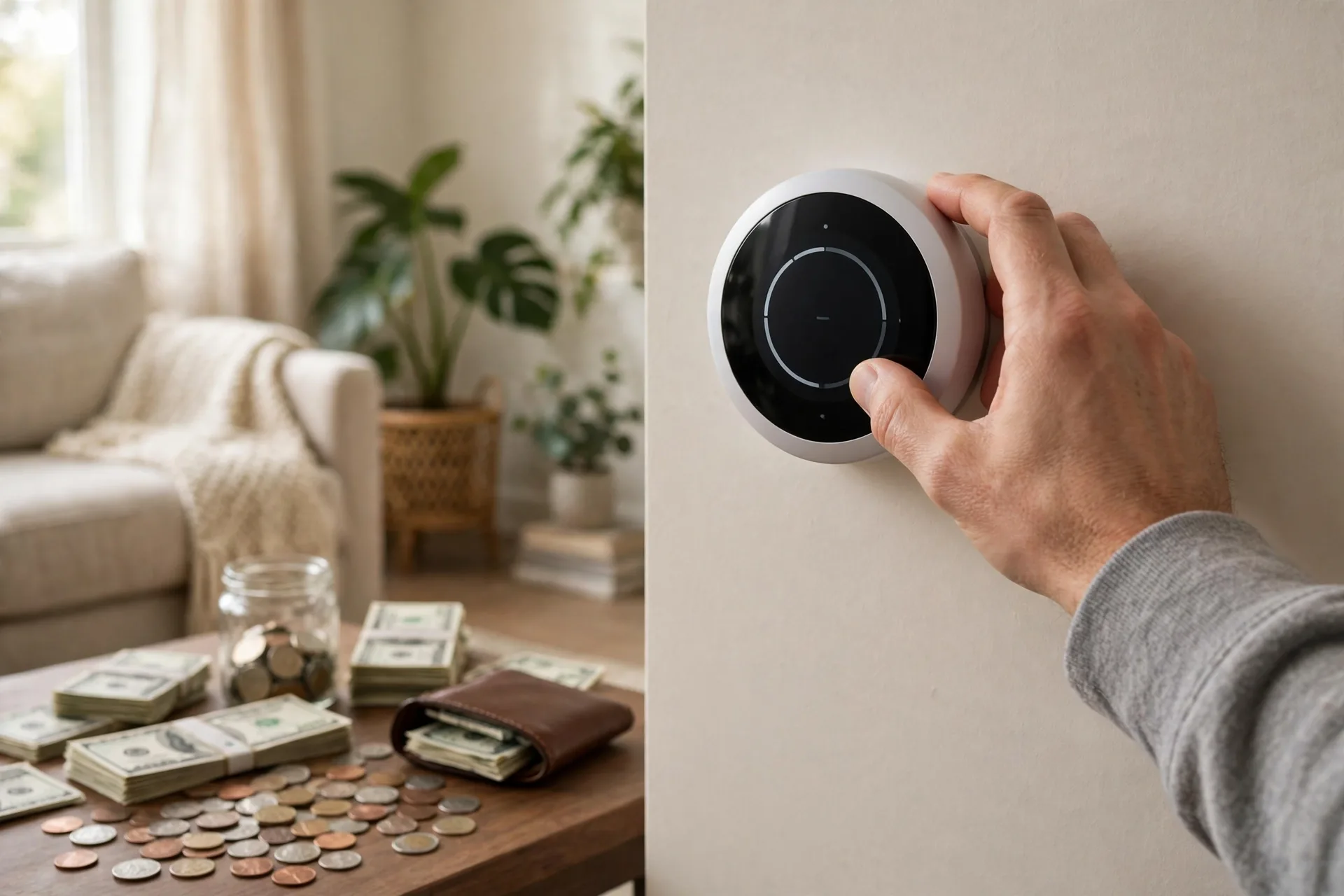
Heating and cooling take about half of home energy use (Source: U.S. Department of Energy, 2026). The thermostat is the single biggest lever on the utility bill, because every degree you shift saves about 1 percent to 3 percent on heating costs. A 7 to 10 degree shift for 8 hours a day cuts heating and cooling costs by up to 10 percent a year (Source: U.S. Department of Energy, 2026).
A smart thermostat costs $100 to $130 and pays for itself in about 2 years at $50 a year in savings. Change the heating, ventilation, and air conditioning (HVAC) filter every 1 to 3 months, because a dirty filter forces the system to work harder. Run a ceiling fan and raise the thermostat 2 to 4 degrees in summer.
How Do You Lower Your Water Bill?
You lower your water bill by fixing every leak, fitting low-flow showerheads and faucet aerators, and cutting hot water use, because hot water costs you twice: once for the water and once for the energy that heats it. A dripping faucet wastes more than 3,000 gallons a year (Source: U.S. Environmental Protection Agency, 2026).
Start with leaks, because they waste water 24 hours a day. A running toilet is usually a worn flapper valve, a part that costs $5 and takes 10 minutes to swap. Test a toilet with food coloring: put a few drops in the tank and wait 30 minutes without flushing. Check every faucet and toilet tank once a month.
WaterSense is a label from the U.S. Environmental Protection Agency that marks fixtures that use at least 20 percent less water. A WaterSense showerhead uses at most 2.0 gallons per minute instead of the standard 2.5, and it saves about 2,700 gallons a year for a family of 4 (Source: U.S. Environmental Protection Agency, 2026). Each minute you cut from a shower saves about 2.5 gallons.
Lower the water heater to 120 degrees. Most water heaters ship set to 140 degrees. Each 10-degree drop saves 3 percent to 5 percent on energy bills (Source: U.S. Department of Energy, 2026). Wash laundry in cold water with full loads, because about 90 percent of washer energy goes to heating the water, and cold-water washing saves about $200 a year (Source: ColdWaterSaves, 2026). Run the dishwasher only when full and skip heat-dry: a full load uses about 5 gallons, while hand-washing the same pile uses 27 gallons or more.
How Do You Cut Heating and Gas Costs?
You cut heating and gas costs by sealing air leaks, adding insulation where it is thin, and keeping the heating system clean, because heated air that escapes through gaps is money spent on rooms you never use. Sealing air leaks cuts energy bills by 5 percent to 30 percent a year (Source: U.S. Department of Energy, 2026).

Find drafts by holding your hand near windows, doors, and outlets on outside walls on a cold day. Caulk around window frames, add weatherstripping to exterior doors, and lay a draft snake at the base of a loose door. Insulation matters most in the attic, where most heat escapes in winter and enters in summer. Sealing a home and adding insulation in attics, floors, and basement rim joists saves an average of 15 percent on heating and cooling costs (Source: U.S. Environmental Protection Agency, 2026).
Keep the heating system clean. Change the furnace filter every 1 to 3 months and keep vents clear of furniture. Leaky ductwork loses up to 60 percent of heated air before it reaches the rooms you want warm (Source: U.S. Department of Energy, 2026). Seal visible duct joints with metal-foil tape. A water heater blanket on a tank that is 5 or more years old saves 7 percent to 16 percent a year on water heating (Source: U.S. Department of Energy, 2026).
How Do You Save on Internet and Phone Bills?
You save on internet and phone bills by calling the retention department once a year, buying your own modem and router, and dropping to a speed tier that matches your real use. Most households pay for more speed than they use, and a 15-minute call can cut $20 to $50 a month.

Call the retention department, not general customer service, and have a competitor price in hand before you dial. Ask what loyalty rate they can offer, and ask for a supervisor if the first answer is no. Providers keep lower rates for customers who ask, because keeping a customer costs less than finding a new one.
Read our guide to negotiating bills for word-for-word scripts that save hundreds a year.
Renting a modem and router from your internet service provider (ISP) costs $10 to $15 a month, or $120 to $180 a year. Buying a compatible set costs $80 to $120 once, and it pays for itself in under a year. Audit your speed plan next: log into your router and check peak use. A household on a gigabit plan with peak use under 200 Mbps can drop a tier and save $20 to $40 a month. Check your phone plan the same way and drop data you never use.
LED Bulbs vs a Smart Thermostat: Which Upgrade Pays Back First?
LED bulbs pay back first, because a $3 to $8 bulb saves about $45 a year across the 5 most-used fixtures and pays for itself in weeks, while a $100 to $130 smart thermostat saves about $50 a year and pays back in about 2 years. Buy the bulbs first, then the thermostat, and let the bulb savings fund the thermostat.
| Upgrade | Upfront cost | Yearly saving | Payback time |
|---|---|---|---|
| LED bulbs (5 most-used fixtures) | $15 to $40 | $45 | Weeks to months |
| Smart thermostat | $100 to $130 | $50 | About 2 years |
| Low-flow showerhead | $20 to $40 | $70 | Under 1 year |
| Weatherstripping (whole home) | $25 to $75 | $50 to $200 | Under 1 year |
| Water heater blanket | $25 to $35 | $20 to $45 | Under 1 year |
Run the payback math before you buy any upgrade: divide the upfront cost by the yearly saving, and the result is the payback time in years. A $15,000 window replacement that saves $200 a year takes 75 years to pay back, so buy new windows for comfort or home value, not for energy savings alone.
How Do Renters Save on Utilities Without Changing the Home?
Renters save on utilities without changing the home by using removable fixes: draft snakes, window film, LED bulbs, smart power strips, and low-flow showerheads that swap back at move-out. Most of these cost under $30 each, and none of them need landlord approval.
Keep the original bulbs and showerhead in a box, and swap them back when you move out. Window film and thermal curtains cut drafts without touching the window frame, and a rug on a bare floor adds warmth in winter. A smart power strip cuts standby power with one switch. Run full loads and wash in cold water.
Ask your landlord about the bigger fixes, and frame the request as maintenance, not comfort. Old appliances, missing insulation, and leaky windows cost the landlord too, because damp and drafts damage the property. Ask about a smart thermostat, a newer fridge, or a water heater check at lease renewal. Check the lease to see which utilities the rent already covers, and ask the utility company about a free home energy audit and budget billing.
What Assistance Programs and Rebates Cut Utility Bills?
Assistance programs and rebates cut utility bills through the Low Income Home Energy Assistance Program (LIHEAP) for heating and cooling help, utility rebates for efficient appliances and smart thermostats, and federal tax credits of 30 percent for qualifying energy upgrades. Check your utility website and your state energy office first, because most programs are local.
The Low Income Home Energy Assistance Program (LIHEAP) is a federally funded program that helps low-income households pay heating and cooling bills. LIHEAP serves about 5.4 to 5.9 million households a year, and eligibility rests on income relative to the federal poverty level. Apply through your state social services office. Most utilities also run rebates for efficient appliances, smart thermostats, and LED bulbs.
Federal tax credits cover 30 percent of the cost of qualifying upgrades, including insulation, air sealing, heat pumps, water heaters, solar panels, and energy-efficient windows and doors. Annual caps apply: $600 for most single improvements and $2,000 for heat pumps. In 2023, 3.4 million families saved $8.4 billion through federal energy efficiency credits (Source: U.S. Department of the Treasury, 2023).
Budget billing is a plan that charges the same amount each month based on past average use. Budget billing does not cut the annual total, but it evens out seasonal spikes, so a $300 winter bill becomes a steady $150 a month. Many utilities also offer a free or low-cost home energy audit that finds the biggest waste in your home.
Your 30-Day Utility Savings Plan
Your 30-day utility savings plan cuts the bill in 4 weekly steps: measure the baseline in week 1, make the free changes in week 2, fit the cheap upgrades in week 3, and negotiate and automate in week 4. Each week takes 1 to 2 hours, and the savings start on the next bill.

- Week 1: Write down the last 3 bills and note the usage number on each one.
- Week 2: Set the thermostat schedule, lower the water heater to 120 degrees, and unplug standby devices.
- Week 3: Swap 5 bulbs to LED bulbs, fit a low-flow showerhead, and seal the worst drafts.
- Week 4: Call the internet and phone providers, ask for the retention rate, and repeat the call next year.
- Move the monthly saving to a savings account on payday.
Track the next bill against the baseline you wrote down in week 1. If a bill jumps without a rate change, check for a leak or a broken appliance first, because a silent leak wastes more water in a week than a month of shorter showers saves. The same week-by-week method works for food, and our guide to save money on groceries every month shows the grocery version.
Frequently Asked Questions
How much can I save on utilities every month?
You can save $65 to $130 a month, or $780 to $1,560 a year, by making the free changes in this guide and adding 2 or 3 cheap upgrades. The thermostat setback saves $10 to $20 a month, negotiating internet and phone saves $20 to $50 a month, and cold-water laundry saves about $17 a month.
What uses the most electricity in a home?
Heating and cooling use the most electricity in a home, at about half of total home energy use (Source: U.S. Department of Energy, 2026). Appliances, lighting, and electronics come next. A 7 to 10 degree thermostat setback for 8 hours cuts heating and cooling costs by up to 10 percent a year.
Does unplugging devices really save money?
Yes, unplugging devices saves money, because standby power adds 5 percent to 10 percent to a monthly electric bill (Source: U.S. Department of Energy, 2026). TVs, game consoles, chargers, and microwaves draw power while they are off. Unplugging them or switching off one power strip can save $100 or more a year, and it costs nothing to start.
What thermostat setting saves the most money?
Set 68 degrees in winter and 78 degrees in summer, with a 7 to 10 degree shift for 8 hours while you sleep or work. Each degree you shift saves about 1 percent to 3 percent on heating costs. A smart thermostat makes the shift automatic and saves about $50 a year (Source: EPA ENERGY STAR, 2026).
Can renters save on utilities?
Yes, renters can save on utilities with removable fixes that need no landlord approval. Draft snakes, window film, LED bulbs, smart power strips, and low-flow showerheads each cost under $30, and they swap back at move-out. Renters can also ask the utility for a free energy audit and join budget billing.
Is it cheaper to wash clothes in cold water?
Yes, washing clothes in cold water is cheaper, because about 90 percent of washer energy goes to heating the water. Cold-water washing saves about $200 a year (Source: ColdWaterSaves, 2026). Modern detergents clean well in cold water, and cold water is gentler on clothes. Use hot water only for heavily soiled loads.
Conclusion
How to save money on utilities every month comes down to 4 moves: set the thermostat to 68 degrees in winter and 78 degrees in summer, switch the 5 most-used bulbs to LED bulbs, lower the water heater to 120 degrees, and call your internet and phone providers once a year to ask for a lower rate. Those 4 moves save $65 to $130 a month for most households.
Start this week with the free changes, then buy the upgrades with the fastest payback, and check LIHEAP and utility rebates if bills stay high. Savvy Cash Flow covers the same save-first method across the whole budget, so pair this plan with our guide to cut monthly expenses without stress and move every dollar you save into a savings account on payday. A lower utility bill repeats every month.