

Last updated: October 2026
Written by Emma for Savvy Cash Flow.
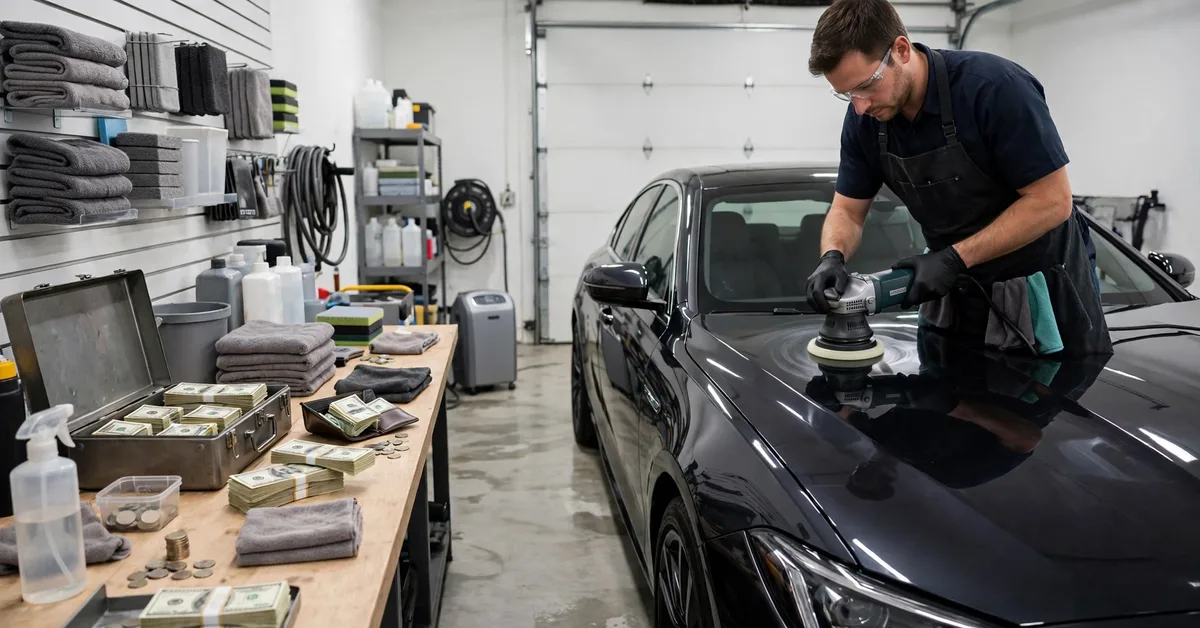
Yes, a car detailing business is profitable when prices cover time, travel, supplies, and fixed costs, and when repeat clients fill a tight local route. A solo mobile car detailing business can earn a strong hourly rate from low startup costs, while a shop-based car detailing business needs higher volume to cover rent and staff costs.
A car detailing business is a paid service that cleans, restores, and protects vehicle interiors and exteriors for owners who want a car that looks and feels new. This guide covers costs, earnings, models, services, pricing, first clients, licenses, mistakes, and a 90-day plan. A car detailing business also needs clear rules for damage photos, cancellations, and tax records, and this guide gives those rules in plain steps.
Key Takeaways
- A car detailing business is profitable when each job price covers work time, drive time, supplies, and fixed costs.
- A mobile car detailing business starts for $2,000 to $15,000, while a fixed shop starts for $50,000 to $150,000 or more.
- A solo mobile car detailing business earns most from repeat maintenance clients in one tight area.
- A full detail prices at $150 to $300 in the planning ranges in this guide, and premium coatings price far higher.
- Drive time, underpricing, and free add-on work cut car detailing business profit fastest.
- A written price list, a cancellation rule, and a 25 percent tax set-aside protect car detailing business profit.
Table of Contents
- What Is a Car Detailing Business?
- Is a Car Detailing Business Profitable?
- How Much Does It Cost to Start a Car Detailing Business?
- Mobile Detailing vs Shop Detailing: Which Model Pays More?
- How Much Can a Car Detailing Business Earn?
- What Services Pay the Most in a Car Detailing Business?
- How Do You Price Car Detailing Services?
- How Do You Get Your First 10 Clients?
- What Licenses and Insurance Does a Car Detailing Business Need?
- What Mistakes Cut Car Detailing Profits?
- Your First 90 Days: A Simple Launch Plan
- Conclusion
- FAQs
What Is a Car Detailing Business?
A car detailing business is a service business that cleans, restores, and protects vehicles through interior cleaning, exterior washing, paint correction, and protective coatings, and the car detailing business charges per vehicle, per package, or per maintenance plan.
A car detailing business differs from a car wash in depth and time. A car wash cleans surface dirt in minutes, while a car detailing business spends 1 to 8 hours on one vehicle, based on the package. A basic detail covers wash, vacuum, glass, tires, and wipe-down surfaces. A full detail adds shampooing, stain removal, wax or sealant, and trim care. A premium detail adds paint correction or a ceramic coating, and premium jobs take a full day or more.
Buyers include busy owners, car lovers, sellers, and fleets. Browse the Business Ideas & Side Hustles guides to compare car detailing with other low-cost service businesses on Savvy Cash Flow.
Is a Car Detailing Business Profitable?
Yes, a car detailing business is profitable for a solo mobile operator who prices each job above true costs and keeps a full repeat schedule, and a car detailing business turns unprofitable when drive time stays unpaid, prices stay too low, or a shop lease outruns bookings.
A car detailing business earns profit from labor skill, not from stock. Supplies cost $10 to $30 per basic job in the planning ranges in this guide, while labor time forms the main cost. A mobile car detailing business avoids shop rent, so a mobile car detailing business keeps a higher share of each job price. A shop-based car detailing business pays rent, utilities, and staff wages from every job, so a shop-based car detailing business needs higher prices or higher volume.
Industry scale supports demand for car detailing work. The United States car wash and auto detailing industry recorded about $14.6 billion in revenue (Source: IBISWorld, 2023), and about 57,900 businesses operated in the industry (Source: IBISWorld, 2024). Employee pay differs from owner profit: full-time workers who clean vehicles and equipment had median weekly earnings of $751 (Source: U.S. Bureau of Labor Statistics, 2025), and that figure covers employee pay, not owner earnings.
How Much Does It Cost to Start a Car Detailing Business?
A car detailing business costs $2,000 to $15,000 to start as a mobile operation and $50,000 to $150,000 or more to start as a fixed shop, and the mobile start range covers equipment, supplies, insurance, licenses, and launch marketing.
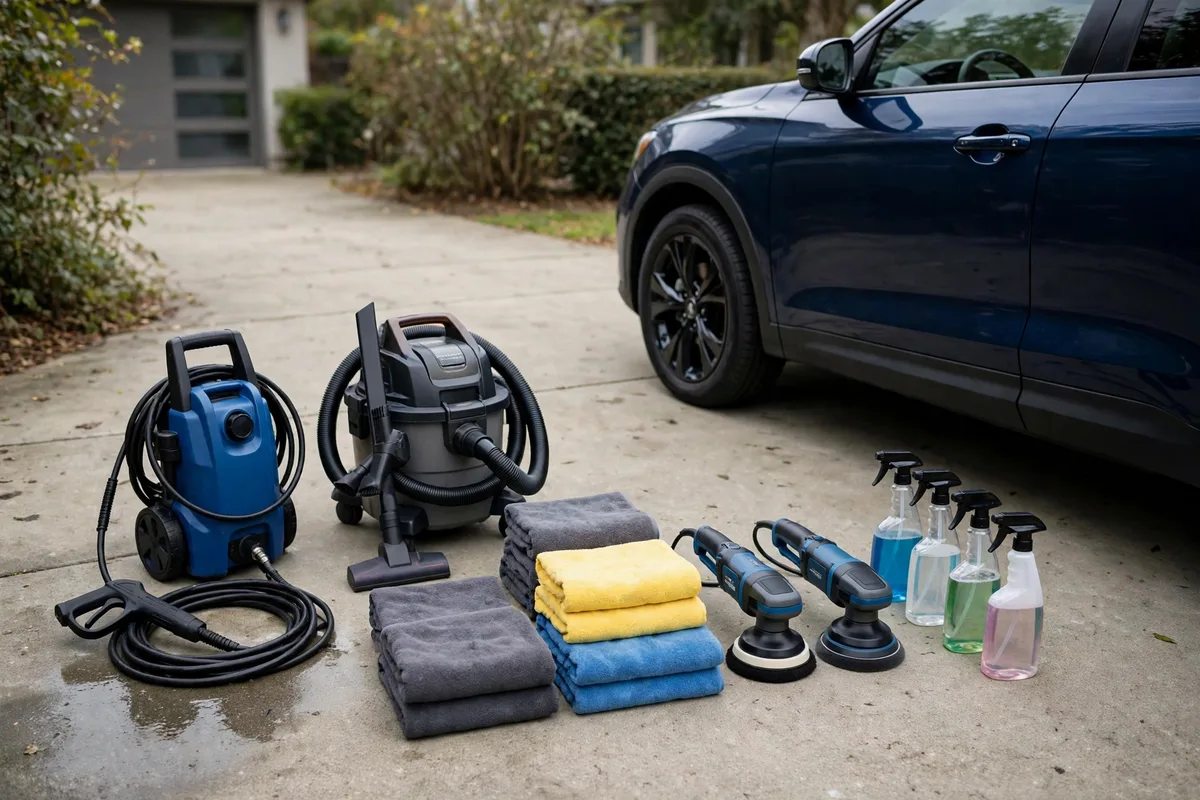
A beginner starts mobile to test demand before signing a lease. A mobile car detailing business needs a pressure washer, a vacuum, a polisher, towels, brushes, chemicals, and a way to carry water and power to each job. A shop-based car detailing business needs the same tools plus a deposit, rent, utilities, signage, and shop fit-out work.
| Startup cost item | Mobile range | Fixed shop range |
|---|---|---|
| Equipment and supplies | $2,000 to $5,000 | $8,000 to $15,000 |
| Vehicle or rig setup | $2,000 to $8,000 | Not needed |
| Premises and build-out | $0 | $40,000 to $150,000 |
| Insurance for year 1 | $500 to $3,000 | $2,000 to $5,000 |
| Licenses, permits, marketing | $350 to $1,000 | $1,000 to $4,000 |
| Total startup cost | $2,000 to $15,000 | $50,000 to $150,000 or more |
A beginner buys core tools first. A polisher, a steam cleaner, and an extractor join the kit after interior and paint jobs arrive, and a coating kit joins after training.
Mobile Detailing vs Shop Detailing: Which Model Pays More?
Mobile detailing pays more per job for a solo operator in the early stage, because mobile detailing avoids rent, while shop detailing pays more at scale, because shop detailing supports premium coatings, paint correction, and team volume in a controlled space.
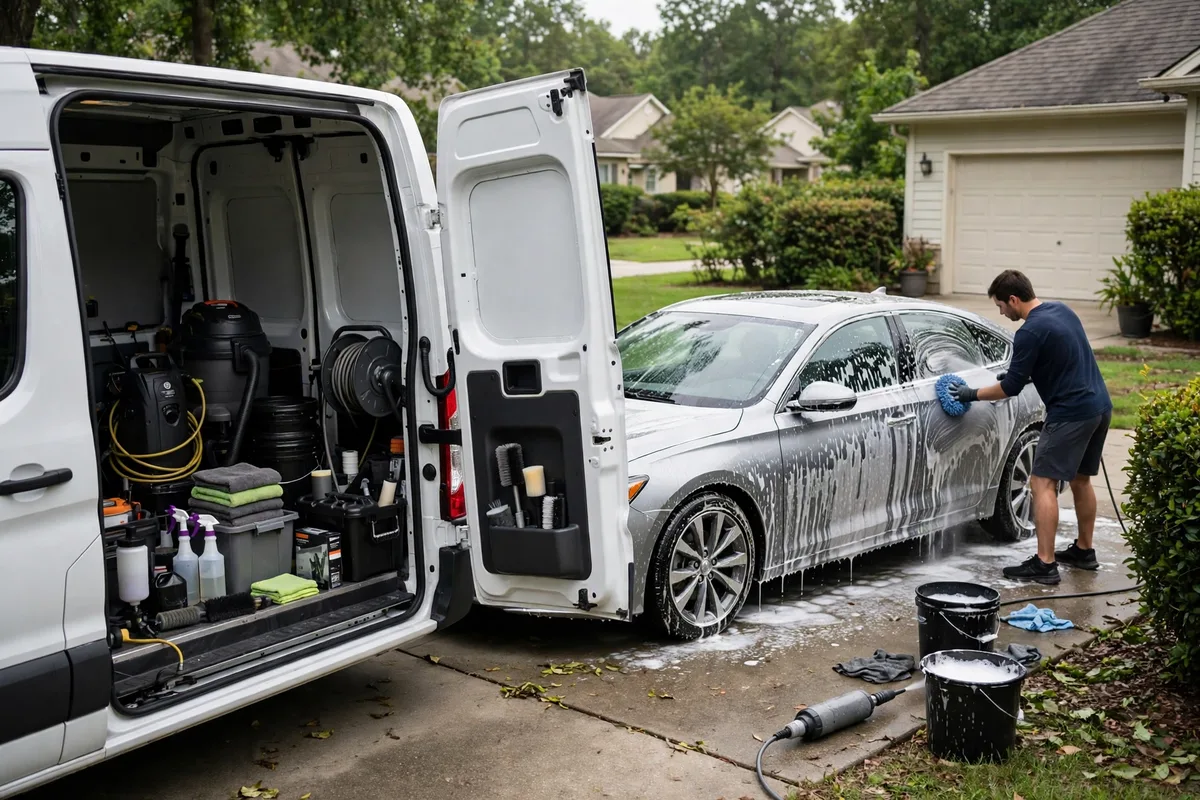
Mobile detailing fits a beginner who wants low fixed costs and fast launch. Mobile detailing serves clients at homes and offices, and mobile detailing wins bookings from convenience. Mobile detailing loses time to driving, weather, and water and power limits at each site. Shop detailing fits an operator with steady bookings who wants controlled light, weather cover, and room for multi-day coating jobs.
| Factor | Mobile detailing | Shop detailing |
|---|---|---|
| Fixed monthly cost | Low, $500 to $1,000 | High, $3,000 to $5,000 or more |
| Startup cost | $2,000 to $15,000 | $50,000 to $150,000 or more |
| Weather risk | High | Low |
| Premium coating work | Harder, dust and light limits apply | Easier, controlled bay and lighting |
| Best stage | Start and solo growth | Scale with team and premium work |
A hybrid path works for many owners: start mobile, then add a shop bay for coatings once repeat clients fill the schedule.
How Much Can a Car Detailing Business Earn?
A solo mobile car detailing business can earn $2,000 per month part time and $5,600 per month before income tax in the full-time worked example in this guide, and a car detailing business earns more when jobs cluster in one area and clients rebook each month.
The part-time worked example uses 2 cars per week at a $250 average job price, which equals $500 per week and $2,000 per month in gross bookings. The full-time worked example uses 10 jobs per week at $200 per job, which equals $2,000 per week and $8,000 per month in gross bookings. Monthly costs of $2,400 in that full-time example leave $5,600 per month before income tax. A shop example uses $12,000 per month in gross bookings with $8,400 in monthly costs, which leaves $3,600 per month before income tax. Shop volume must rise above mobile volume to beat mobile profit, because shop fixed costs eat the first jobs each month.
A practical observation from my own trial pricing work: I priced one full detail at $150 and a second full detail at $200, and the $200 job took the same 3 hours as the $150 job, so the higher price paid more per hour with no extra work time. Price testing beats price guessing, because one price rise lifts every future job.

What Services Pay the Most in a Car Detailing Business?
Ceramic coatings, paint correction, and fleet contracts pay the most in a car detailing business, because ceramic coatings and paint correction sell skill and time at premium prices, and fleet contracts sell repeat volume on a set schedule.
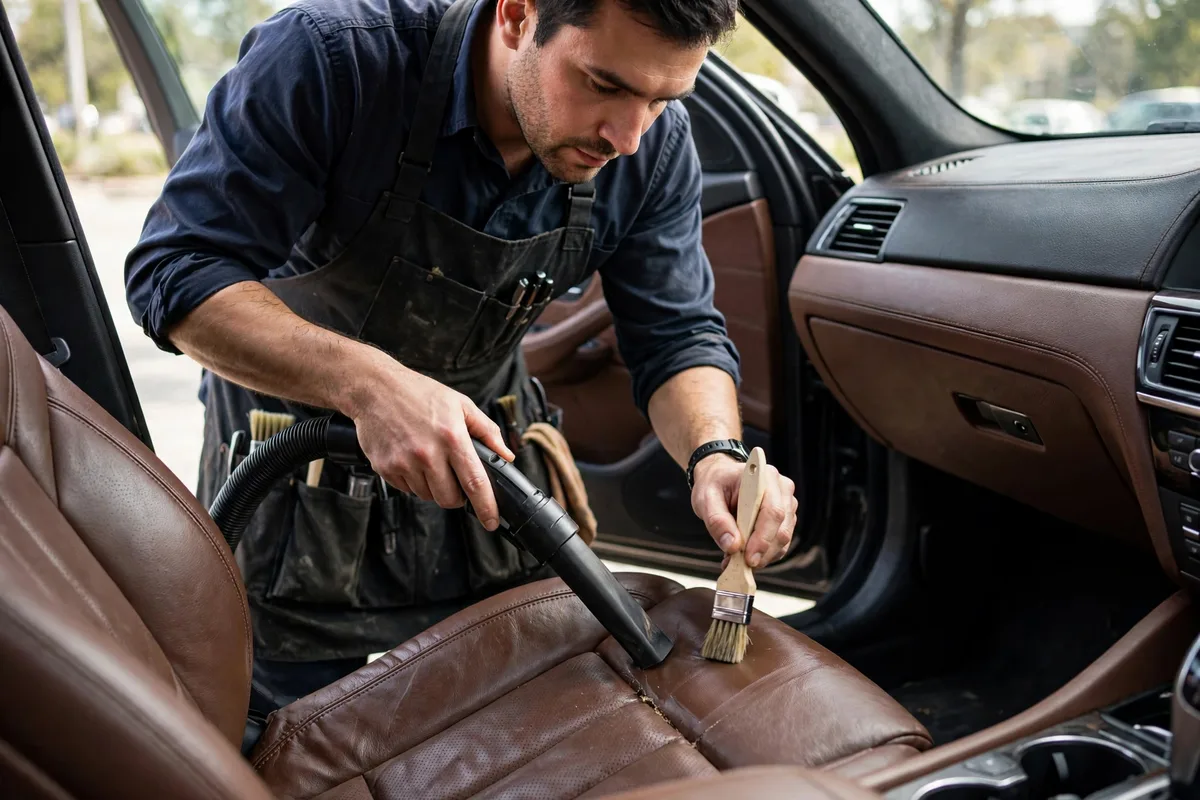
A basic wash and vacuum package prices at $50 to $100 in the planning ranges in this guide. A full interior and exterior detail prices at $150 to $300. An interior-only deep clean prices at $100 to $200. A paint correction job prices at $300 to $1,000, based on paint condition and stages. A ceramic coating job prices at $500 to $2,000 or more, based on coating grade and prep work.
A maintenance plan turns one-time buyers into monthly income at $80 to $120 per visit. A fleet deal with 5 to 20 vehicles per month gives predictable bookings, even when retail demand dips. Add premium services only after training, because a bad coating job costs more in rework and reputation than the job price.
How Do You Price Car Detailing Services?
To price car detailing services, add work time cost, drive time cost, supplies cost, fixed cost share, and profit margin, then set a package price that covers the full total, and a car detailing business prices packages, not hours, so clients see one clear price per job.
Follow 5 pricing steps for each package:
- Time each job type on 3 real cars and record hours.
- Add drive time and setup time to work time.
- Add supplies cost per job from actual product use.
- Add a fixed cost share for insurance, software, and marketing.
- Add a profit margin of 40 to 60 percent for a solo operator.
A $200 job that takes 3 hours plus 1 hour of driving pays $50 per hour before costs, while the same $200 job with 2 hours of driving pays $40 per hour before costs. Drive time decides hourly income, because drive time pays $0 unless the price covers drive time. A travel fee beyond a set radius and a minimum job price protect hourly income.
Read how a related low-cost service prices starter work in Dog Walking Business: Startup Costs and Earnings.
How Do You Get Your First 10 Clients?
To get the first 10 car detailing clients, offer 3 trial details at an intro price to neighbours and local groups, collect before and after photos with permission, ask each trial client for a review, and turn trial clients into monthly packages with a fixed rebooking date.
Savvy Cash Flow readers can use 4 channels in week 1: message 20 personal contacts with one offer, one price, and one start date; post in 2 neighbourhood groups with photos and prices; leave flyers at car washes, tire shops, and offices with staff permission; and set up a Google Business Profile with services, area, and photos. A Google Business Profile drives local search bookings, because local buyers search for a detailer near home or work.
Ask for a review on delivery day, while the clean car sits in front of the client. Offer one free add-on for each referral that books a paid job, capped at 2 per client per month.

What Licenses and Insurance Does a Car Detailing Business Need?
A car detailing business needs a city business license where the city requires one, general liability insurance, garage keepers cover for vehicles in the detailer’s care, commercial auto cover for a work vehicle, and local wastewater rules checked before the first paid job.
A Limited Liability Company (LLC) is a legal form that separates personal assets from business debts in most states. A sole proprietorship is a form with no legal separation between owner and business. A beginner can start as a sole proprietorship and form a Limited Liability Company (LLC) after clients arrive and income grows.
An Employer Identification Number (EIN) is a free federal tax number from the Internal Revenue Service (IRS). Banks ask for an Employer Identification Number (EIN) for a business account, so apply through the IRS online EIN application before opening a business account. Wastewater rules matter for detailing work: wash water can carry soap, oil, and grease, and many places ban wash water discharge into storm drains, so check city and county rules for each work site.
Insurance covers 3 risks: general liability cover for injury and property damage, garage keepers cover for damage to a client vehicle while the vehicle sits in the detailer’s care, and commercial auto cover for a work vehicle crash.
What Mistakes Cut Car Detailing Profits?
The mistakes that cut car detailing profits are spread-out routes, underpricing, free add-on work, no cancellation rule, and skipped damage photos, and each mistake costs time, cash, or trust even when job count looks high.
Spread-out routes burn unpaid drive time, so cap the service area at 2 neighbourhoods until 10 weekly clients fill that area. Underpricing traps a detailer at a full schedule with low pay: a $100 price with $2,000 monthly costs needs 20 jobs per month to cover costs, while a $200 price needs 10 jobs.
Free add-on work traps profit, because each free add-on adds time with $0 pay. A written add-on price list stops free work at the booking stage. No cancellation rule leaks booked revenue: a client who cancels at noon leaves a 1 p.m. slot empty, and no new client fills a midday slot in one hour. A 50 percent same-day cancellation fee and a full fee for a no-show protect the schedule. Photograph each vehicle before work starts and note existing marks on the job sheet, because skipped damage photos cause disputes.

Your First 90 Days: A Simple Launch Plan
A simple 90-day launch plan for a car detailing business sets prices and insurance in days 1 to 30, wins 10 weekly clients in days 31 to 60, and fills one tight route with monthly packages in days 61 to 90.
Follow the plan in order:
- Days 1 to 30: pick one service area, set 3 package prices, buy insurance, register the business name, and build a booking page.
- Days 1 to 30: complete 3 trial details at an intro price and collect photos and reviews.
- Days 31 to 60: message 20 contacts, post in 2 local groups each week, and flyer car-related local firms.
- Days 31 to 60: convert trial clients into monthly packages and target 10 weekly clients by day 60.
- Days 61 to 90: drop out-of-area clients or raise out-of-area prices, and add one premium service after training.
- Days 61 to 90: review job times, costs, and profit per job, then raise the weakest price by 10 percent.
A car detailing business grows on repeat routes, not on one-time jobs spread across town. The business ideas you can start with $1,000 guide shows the same low-cost start pattern, and How to Start a Freelancing Business From Zero follows similar pricing rules.
Conclusion
A car detailing business is profitable when a solo operator starts mobile, prices each job above true costs, keeps routes tight, and converts one-time buyers into monthly clients. Start with core tools, prove demand in one area, raise prices after reviews arrive, and add a shop only when bookings cover shop costs.
FAQs
Is a car detailing business profitable for a beginner?
Yes, a car detailing business is profitable for a beginner who starts mobile, prices full details at $150 to $300, and keeps fixed costs low. A beginner earns profit fastest from repeat clients in one area, because repeat routes cut drive time and marketing cost per job.
How much money do I need to start a car detailing business?
A mobile car detailing business needs $2,000 to $15,000 to start, covering equipment, supplies, insurance, licenses, and launch marketing. A fixed shop needs $50,000 to $150,000 or more, because rent, build-out, utilities, and signage join the startup bill for a shop launch.
Is mobile detailing more profitable than a shop?
Yes, mobile detailing is more profitable per job for a solo operator, because mobile detailing avoids shop rent. Shop detailing wins at scale, because shop detailing supports premium coatings, paint correction, and team volume in a controlled space with steady bookings.
How much can a car detailing business make per month?
A solo mobile car detailing business can make $2,000 per month part time and $5,600 per month before income tax in the $8,000 gross worked example in this guide. Actual income depends on job count, job price, drive time, and monthly costs in the local area.
Do I need a license to detail cars?
A car detailing business needs a city business license where the city requires one, plus insurance and local wastewater rules checked before paid work. License rules vary by city and state, so check city clerk rules and county rules before the first paid job.
How long does it take to break even on a car detailing business?
A mobile car detailing business can break even in 1 to 4 months when bookings fill fast and startup costs stay under $10,000. A shop-based car detailing business takes longer, because rent and build-out costs need far more jobs to cover the startup bill.
This article gives general information only, not tax advice or legal advice for a specific person.
Explore more money and business guides on Savvy Cash Flow.