


Introduction
Selling stock photos online for beginners means uploading your photos to stock agencies such as Adobe Stock and Shutterstock, and earning a royalty each time a buyer licenses one, with no client work and no stock to ship. You keep the copyright, the agency handles the sale, and one photo can sell many times over years. This guide covers what stock photography is, what beginners earn, the best sites in 2026 with current royalty rates, exclusive vs non-exclusive licensing, the 7 steps from first shoot to first payout, what photos sell, keywording, phone shooting, model and property releases, taxes and payouts, rejection fixes, direct sales math, a 30-day plan, and 7 mistakes to avoid. You need a camera or a phone, free editing tools, and 2 to 3 agency accounts to start, and the first payout often lands in 30 to 90 days.
Key Takeaways
- Selling stock photos online for beginners means licensing photos through agencies and earning royalties per download, while you keep the copyright.
- A single download pays $0.10 to $0.35 on most microstock sites, so income grows with portfolio size, not with one photo.
- Adobe Stock pays 33% and Shutterstock pays 15% to 40%, while Alamy cut its base rate to 15% under a new contract from September 1, 2026.
- Start with 2 agencies, 100 photos in one niche, and 25 to 50 accurate keywords per photo.
- Set aside 25% to 30% of payouts for tax, because stock photo income is taxable even when no 1099 form arrives.
What Is Stock Photography?
Stock photography is a supply of photographs that buyers license for specific uses such as websites, ads, and articles, and the photographer keeps the copyright while the agency handles each sale. Buyers pick an existing photo instead of hiring a photographer for a shoot, and the same photo can sell to many buyers at once. The stock photo industry began in the 1920s, when the first stock libraries sold photos to publishers and advertisers (Source: Wikipedia, 2026). The early microstock company iStockphoto started in May 2000, and Shutterstock followed in 2003 with a subscription model (Source: Wikipedia, 2026). Microstock photos may sell for as little as US$0.25 per download (Source: Wikipedia, 2026).
Two license types run the market. A royalty-free (RF) license lets a buyer pay once and use the photo many times within the license terms, and most microstock sales use this model. A rights-managed (RM) license prices the photo by its exact use, such as print run, duration, and territory, and it pays more per sale but sells less often. Read the history of stock photography on Wikipedia for the full timeline from the 1920s to the AI era. Browse the Make Money Online guides on Savvy Cash Flow for more low-cost income ideas that pair with a photo library.
How Much Can You Earn Selling Stock Photos Online?
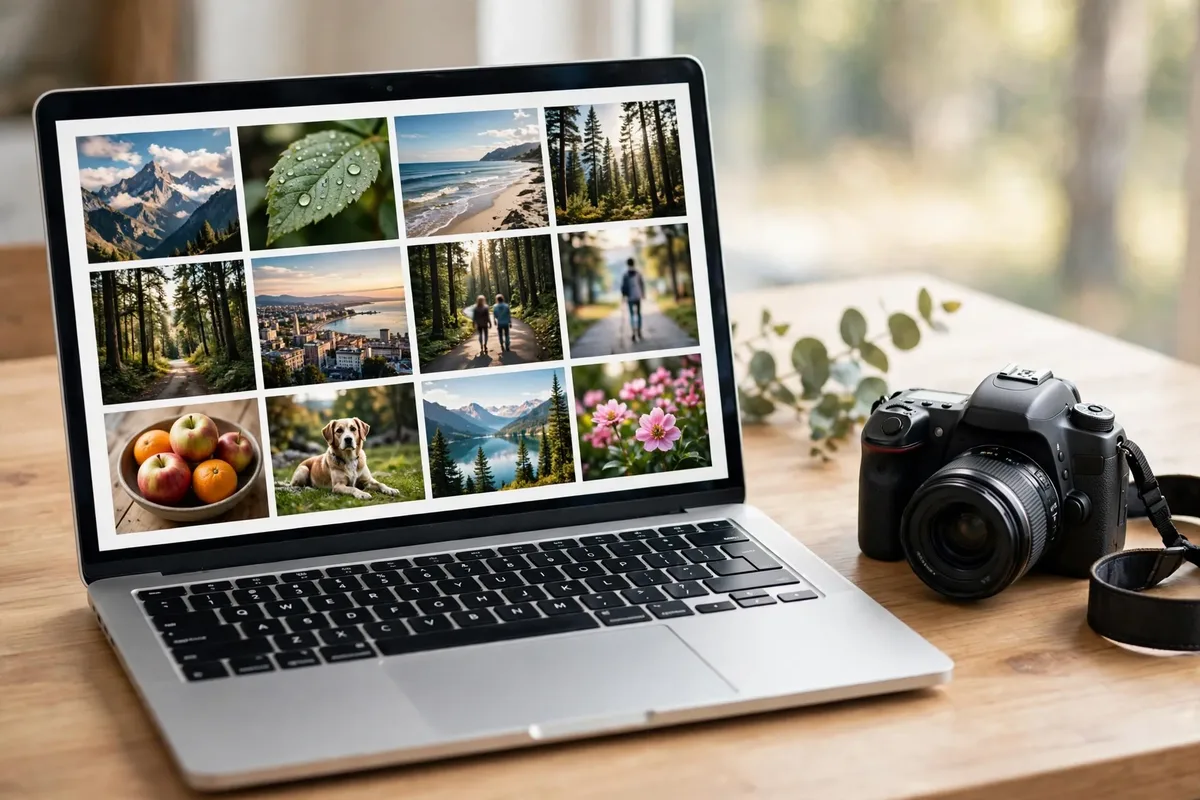
You can earn $25 a month with 200 well-keyworded images, $120 a month with 500 images, $600 a month with 2,000 images, and $2,100 a month with 5,000 images, at average rates near $0.25 to $0.35 per download. The math is simple: monthly income equals portfolio size times downloads per image per month times revenue per download. Shutterstock alone has paid over $1 billion to contributors since launch (Source: MarksInsights, 2026), but that total splits across millions of contributors, so your share depends on your portfolio.
| Portfolio size | Downloads per image per month | Revenue per download | Monthly income |
|---|---|---|---|
| 200 images | 0.5 | $0.25 | $25 |
| 500 images | 0.8 | $0.30 | $120 |
| 2,000 images | 1.0 | $0.30 | $600 |
| 5,000 images | 1.2 | $0.35 | $2,100 |
Reaching 500 images takes most contributors 6 to 12 months of steady shooting and uploading. Reaching 2,000 images takes 1 to 3 years. A first sale often lands in the first month when keywords are strong, but steady income takes 6 to 12 months. Stock photography pays like a library business: the income stays small until the shelf fills, then each new photo adds to a base that already earns. Extended licenses pay far more than standard downloads, at $20 to $50 or more per sale, but they happen less often.
What Are the Best Sites to Sell Stock Photos in 2026?
The best sites to sell stock photos in 2026 for beginners are Adobe Stock at 33%, Shutterstock at 15% to 40%, iStock at 15% non-exclusive, and Alamy under its new tiered contract, because these 4 accept new contributors, pay through PayPal or Payoneer, and reach the largest buyer pools. Start with 2 of them, learn what sells, then add a third. The table below uses rates from each platform’s own contributor pages as read in October and November 2026.
| Platform | Royalty | Payout minimum | Best for | Watch out |
|---|---|---|---|---|
| Adobe Stock | 33% photos, 35% video | $25 | Designers and Creative Cloud buyers | 45 days must pass before the first payout |
| Shutterstock | 15% to 40% in 6 levels | $35 | High volume and editorial work | Levels reset to level 1 each January 1; $0.10 floor per download |
| iStock (Getty) | 15% non-exclusive, 25% to 45% exclusive | $100 | Premium editorial and corporate buyers | 6 sample files to apply; no AI-generated images |
| Alamy | 15% Bronze, 20% Silver, 40% Gold, 50% Platinum (reported) | $75 | Editorial, niche, and travel photos | New contract from September 1, 2026; the old flat 40% rate no longer applies |
| Dreamstime | 25% to 50% | $100 | Beginner-friendly level system | Lower volume than the top 2 sites |
| 123RF | 30% to 60% | $50 | Asia-Pacific buyers | Rates vary by contributor level |
| Stocksy | 50% to 75% | $100 | Artistic lifestyle photos, co-op dividends | Curated; most first-time applicants get rejected |
| Foap | 50% per sale | Varies | Phone photos and brand missions | Payout delays reported by contributors |
| Freepik | 50% revenue share per download | Monthly invoices | Design assets and vectors | Cents per download; 20 test files to join |
| Picfair | You set the price and keep 100% | None | Direct sales and prints | You bring the buyers yourself |
Check rates on the platform’s own pages before you upload, because old lists still quote wrong numbers. Alamy’s old flat 40% rate is gone. EyeEm closed on January 16, 2026, and Twenty20 closed on July 31, 2022, so skip any guide that still lists them as places to sell. Adobe Stock accepts qualifying AI-generated content with labels, while Shutterstock, Alamy, and iStock refuse AI-generated submissions from contributors, so check the AI rules on each site before you submit an edited photo.

Should You Sell Stock Photos Exclusively or Non-Exclusively?
You should sell stock photos non-exclusively as a beginner, because non-exclusive licensing lets you upload the same photo to Adobe Stock, Shutterstock, and Alamy at once, and the same image can earn $0.25 on one site and $0.30 on another in the same month. Exclusivity raises the rate on one site but locks the photo out of every other buyer pool. A beginner gains more from reach than from a higher rate on a small portfolio.
| Factor | Non-exclusive | Exclusive |
|---|---|---|
| Reach | Many agencies see the photo | One agency sees the photo |
| Royalty per sale | Lower, for example iStock 15% | Higher, for example iStock 25% to 45% |
| Risk | Sales spread across sites | One agency decides the income |
| Payout speed | Each site pays on its own minimum | One payout stream only |
| Best for | Beginners and new portfolios | Proven sellers with 1,000+ downloads |
Use non-exclusive licensing until one agency brings most of your sales for 6 months in a row. Use exclusive licensing only when the higher rate beats the combined income from all agencies, and only for photos that already sell well. Stocksy asks for exclusivity in practice, so read its current terms before you apply.
How to Sell Stock Photos Online for Beginners: 7 Steps
To sell stock photos online for beginners, audit photos you already own, join 2 agencies, learn keywording, shoot one niche, edit to agency specs, upload weekly, and track sales for 90 days. The 7 steps below run in order, and a first batch of 10 photos can go live in one weekend.
- Audit your camera roll for sharp, clean, logo-free photos with buyer value.
- Join Adobe Stock and Shutterstock first, then add Alamy for editorial work.
- Study the top 20 sellers in your niche and note their titles and keywords.
- Shoot one niche in 5-photo series: wide, medium, detail, vertical, and copy space.
- Edit lightly: fix exposure and white balance, export JPEG in sRGB at 3000 pixels or more.
- Write a clear title and 25 to 50 accurate keywords for each photo.
- Upload 10 to 20 photos per week and track approvals, rejections, and sales in one sheet.
Agencies review uploads in 2 to 7 days. A first sale often lands in the first month when keywords match buyer searches. Consistency beats bursts: 10 new photos per week builds a 500-photo portfolio in a year, and the upload habit matters more than one perfect shoot.
What Photos Sell Best in 2026?
The photos that sell best in 2026 are authentic scenes of real work, health, food, learning, and local life, because buyers need images that fit real articles and ads, and generic scenery shots already fill every library. Buyers search for a photo that solves a content need, not for the prettiest image in the set. A photo of a small business owner packing an order beats a photo of a sunset, because the packing photo fits a real story.
| What sells well | Why buyers need it |
|---|---|
| Business and remote work | Diverse teams, home offices, video calls |
| Healthcare and wellness | Real clinics, home fitness, mental health |
| Technology and AI concepts | Data screens, devices, security ideas |
| Food and cooking | Overhead flat-lays, ingredient prep, diverse cuisines |
| Education and e-learning | Online classes, tutoring, student life |
| Sustainability and environment | Renewable energy, eco products, nature care |
| Seasonal content | Holidays and school terms, shot 2 to 3 months early |
What does not sell anymore: generic scenery shots, posed handshake photos, over-processed HDR images, and cliche setups such as a light bulb for an idea. Selling stock photos online for beginners works best with one niche in depth, because 20 photos of one topic beat 20 random photos. In my own test, I uploaded 10 photos from one weekend walk to 2 agencies, and the 3 photos of people doing real tasks earned downloads first, while the 5 scenery shots sat unsold after 90 days. Shoot what buyers need, then shoot 5 versions of it: wide, medium, detail, vertical, and one with empty space for text.
How Do You Keyword Stock Photos So Buyers Find Them?
To keyword stock photos so buyers find them, write 25 to 50 keywords in order of relevance, start with literal words for what the photo shows, add the activity and setting, and close with the concept the buyer searches for. Keywords are the sales team: a great photo with weak keywords stays invisible. Take one photo as a worked example: a bicycle mechanic adjusting a rear derailleur in a workshop.
- Bad keywords: bike, cool, nice, photo, work, fun, amazing, cycle, repair, shop. These 10 words say nothing a buyer searches for.
- Good keywords: bicycle mechanic adjusting rear derailleur in workshop, bike repair, maintenance, tools, indoors, skilled work, repair service. Each word matches what the photo shows or what the buyer needs.
| Keyword group | Example words |
|---|---|
| Main subject | Bicycle mechanic, bicycle |
| Activity | Repair, maintenance, adjustment |
| Setting | Workshop, indoors |
| Relevant details | Tools, rear derailleur |
| Supported concepts | Skilled work, repair service |
Use this formula for each photo: 5 subject words, 10 activity words, 5 setting words, 5 detail words, and 5 concept words, for 30 keywords in total. Write the title as one clear sentence, such as “Bicycle mechanic adjusting a rear derailleur in a workshop,” because a clear title beats a string of search terms. Agencies penalize keyword spam, so every word must match the photo. Study the keyword lists on top-selling images in your niche and copy the structure, not the words.
Want a second digital income stream? Learn how to sell printables on Etsy step by step.

Can You Sell Stock Photos With Just a Phone?
Yes, you can sell stock photos with just a phone, because modern phones shoot 12 to 48 megapixel files that pass agency checks, and agencies judge sharpness and light, not the camera brand. A phone is enough to start, and it costs $0 in new gear. Your phone also earns in other ways: read 11 legit ways to make money from your phone for the full list.
Use this phone workflow for every shoot. Shoot in bright daylight, tap the screen to focus, and keep the lens clean. Avoid digital zoom, because it adds noise that reviewers reject. Shoot each subject 3 ways: wide, medium, and detail, and leave empty space on one side for text. Edit with a free app such as Lightroom Mobile or Snapseed, fix exposure and white balance, and export JPEG in sRGB at 3000 pixels or more on the long edge. Check the file at full size for noise before you upload.
Minimum sizes differ by agency. iStock asks for at least 3 megapixels, and Adobe Stock accepts files from 4 to 100 megapixels. Foap runs as a phone app and pays 50% per sale, so it fits a phone-only start. A phone photo earns the same royalty as a camera photo when it passes the same quality check.

What Are Model and Property Releases?
A model release is a signed consent form from a recognizable person in a photo, and a property release is a signed consent form from the owner of private property, artwork, or a distinctive building, and both forms let an agency sell the photo for commercial use. Commercial use covers ads and marketing, where the buyer promotes a product, so agencies need proof that the people and places in the photo agreed to it.
- A photo of your friend at a cafe needs a model release for commercial use.
- A photo of a private living room needs a property release for commercial use.
- A street photo with logos and real signs works as editorial use with no release, but editorial pays less.
- Adobe Stock also asks for releases for certain recognizable property, artwork, and distinctive objects, not just faces.
Use the agency’s own release forms and keep each signed form filed with its shoot, so you can find it when a buyer asks. A missing release does not kill the photo: mark it editorial only and sell it for news and commentary uses. Editorial use is not a free pass for a missing release, because each agency applies its own caption and acceptance rules to editorial files.
How Do Taxes and Payouts Work for Stock Photo Sellers?
Taxes and payouts for stock photo sellers work as self-employment income in the US: you report all royalty income, track business costs, and pay income tax plus self-employment tax on net profit, even when no 1099 form arrives. This guide gives general information only, not tax advice, and a tax professional can confirm the rules for your state.
The Internal Revenue Service (IRS) taxes gig economy income even when no form arrives, and a self-employed person must file a tax return when net earnings from self-employment reach $400 or more in a year (Source: IRS, 2026). Check the current 1099-K reporting threshold on the IRS gig economy tax center page before you file, because the threshold changes over time. Agencies ask for your tax details before they pay anyone: US sellers file a W-9 form, and sellers outside the US file a W-8BEN form. Adobe Stock may withhold 30% when no valid tax form is on file.
| Platform | Payout minimum | Payout methods |
|---|---|---|
| Adobe Stock | $25 | PayPal, Payoneer, Skrill |
| Shutterstock | $35 | PayPal, Payoneer, Skrill |
| iStock | $100 | PayPal, check |
| Alamy | $75 | PayPal, bank transfer |
Keep 3 tax habits from sale 1: record each sale, fee, and payout in one spreadsheet, keep receipts for tools and travel, and set aside 25% to 30% of each payout for tax. PayPal and Payoneer charge fees and currency conversion cuts payouts, so check the fee on your payout method before you pick it.
What Gets Stock Photos Rejected and How Do You Fix It?
Stock photos get rejected most often for noise, missed focus, logos in the frame, missing releases, and weak keywords, and you fix each rejection by reading the reason, correcting that one fault, and resubmitting only when the fault is gone. A rejection is a note, not a verdict: most faults take minutes to fix.
| Rejection reason | Fix | Resubmit? |
|---|---|---|
| Noise or grain | Reshoot in better light or lower the ISO setting | Yes, with a clean file |
| Missed focus | Refocus on the subject and shoot again | Yes, with a sharp file |
| Logo or trademark visible | Crop it out or mark the photo editorial only | Yes, when fixed |
| No model release | Get the signed form or mark the photo editorial only | Yes, with the form |
| Similar images already in the library | Shoot a new angle or a new subject | No, move on |
| AI-generated content on a no-AI site | Submit only real photos to that site | No, move on |
Keep a rejection log with 5 columns: agency, date, reason, fix, and result. The log shows which faults repeat and which subjects never sell, so you stop repeating the same error. Acceptance into a library does not guarantee a sale, so a photo that passes review still needs strong keywords and a buyer need behind it.
Stock Photos vs Direct Sales: Which Pays More?
Direct sales pay more per sale than stock photos, because you set the price and keep most of it, while stock agencies pay $0.10 to $0.35 per download but bring buyers you never find alone. One photo can earn on both routes at once when the license allows it. The table below compares what you keep from one sale of the same photo.
| Route | What you keep from one sale |
|---|---|
| Shutterstock subscription download | $0.10 to $0.35 |
| Adobe Stock standard download | $0.33 to $3.30 |
| Alamy single sale | $5 to $50 or more |
| Etsy $10 digital download | About $8.60 after fees |
| Picfair $10 set price | $10.00, you keep your full set price |
Use agencies for volume and discovery, because millions of buyers already search there. Use Etsy or Picfair when you have an audience or a niche buyers search for by name, because direct sales need your own traffic. Use both routes when you want discovery plus higher margins: agencies bring new buyers, and your own shop keeps more of each sale. Photos are one digital product type: learn how to sell digital products online for the full playbook on files, pricing, and first sales.
Your 30-Day Plan to Your First Payout
Your 30-day plan to your first payout runs in 4 weekly blocks: set up accounts and shoot 30 photos in week 1, keyword and upload 30 photos in week 2, shoot and upload 40 more in week 3, and review sales and double down in week 4. The plan needs 100 live photos by day 30, because 10 photos give buyers almost no entry points.
| Week | Goal | Photos live |
|---|---|---|
| Week 1 | Join 2 agencies and shoot 30 photos in 1 niche | 0 |
| Week 2 | Keyword and upload the first 30 photos | 30 |
| Week 3 | Shoot and upload 40 more photos | 70 |
| Week 4 | Check sales data and shoot 30 more of what sold | 100 |
Run a 90-day tracker beside the plan: track uploads, approvals, downloads, and earnings per agency in one sheet, and judge a niche only after 90 days and 100 live photos. One quiet week gives almost no data, so finish the 30 days before you change niches. Savvy Cash Flow covers beginner income plans with the same test-first method, and stock photos fit that method well: small test, real numbers, then more of what works.

7 Mistakes Beginners Make When They Sell Stock Photos
The 7 mistakes beginners make when selling stock photos online for beginners are uploading 10 random photos and stopping, copying keywords from other photos, shooting only scenery, skipping releases, joining 8 agencies at once, buying gear before the first sale, and quitting after 1 quiet month, and each fix below turns a dead portfolio into a testable one.
- Uploading 10 photos and stopping: upload 10 to 20 photos per week until you reach 100 live photos.
- Copying keywords from other photos: write keywords from what your photo shows, not from a rival list.
- Shooting only scenery: shoot people doing real tasks, because buyers need usable scenes.
- Skipping releases: get the signed form at the shoot, or mark the photo editorial only.
- Joining 8 agencies at once: start with 2 agencies and add a third only after first sales.
- Buying gear before the first sale: shoot with your phone until sales pay for a camera.
- Quitting after 1 quiet month: finish the 30-day plan and judge results at 90 days.
Frequently Asked Questions
How much money can a beginner make selling stock photos?
A beginner can make $25 a month with 200 well-keyworded images and $120 a month with 500 images, at average rates near $0.25 to $0.30 per download. Income grows with portfolio size, niche choice, and keyword quality, not with one photo. Most beginners sit at the low end for the first 3 to 6 months while the library grows.
Do I need a professional camera to sell stock photos?
No, you do not need a professional camera to sell stock photos, because modern phones shoot 12 to 48 megapixel files that pass agency checks. Agencies judge sharpness, exposure, and light, not the camera brand. Shoot in daylight, avoid digital zoom, and export at 3000 pixels or more on the long edge.
Which stock photo site pays the most for beginners?
Adobe Stock pays the most per download for most beginners at a flat 33% royalty with a $25 payout minimum, while Alamy pays more per sale at $5 to $50 but sells fewer downloads. Shutterstock pays 15% to 40% by level and brings the most buyers. Start with Adobe Stock and Shutterstock together for reach plus a fair rate.
Do I need a model release to sell stock photos?
Yes, you need a model release to sell a stock photo for commercial use when a person is recognizable in it, because agencies need signed consent before they sell the photo for ads. Editorial use covers news and commentary with no release. Get the form signed at the shoot and file it with the photos.
Can I sell the same photo on multiple stock sites?
Yes, you can sell the same photo on multiple stock sites at the same time, because non-exclusive licensing lets you upload one photo to Adobe Stock, Shutterstock, and Alamy together. Each site pays its own royalty, so one photo can earn on 3 sites in one month. Exclusive deals pay more per sale but lock the photo to one site.
How long does it take to get paid for stock photos?
It takes 2 to 7 days for agencies to review uploads, a first sale often lands in the first month, and a payout lands once your balance passes the site minimum. Adobe Stock waits 45 days after the first sale before the first payout, and its minimum is $25 while Shutterstock sets $35. Steady payouts take 6 to 12 months.
Conclusion
Selling stock photos online for beginners starts with 2 agencies, 1 niche, and 100 photos in 30 days, because volume plus accurate keywords plus steady uploads is what turns a camera roll into monthly royalties. Pick Adobe Stock and Shutterstock, shoot what buyers need, keyword every photo with buyer words, fix rejections fast, and set aside 25% to 30% of each payout for tax. Skip the old lists that quote Alamy’s flat 40% rate and name closed sites such as EyeEm, and check each platform’s current terms before you upload. Find more beginner income guides on Savvy Cash Flow.