


Introduction
Zero-based budgeting for beginners is a plan that gives every dollar of take-home pay a job before the month starts, so income minus planned spending equals zero. You list your pay, assign each dollar to a bill, a savings goal, or a spending line, and track the plan until the month ends. The word zero scares some people, and it should not. Zero means the plan is full, not that your bank balance is empty.
This guide covers what the method is, the seven steps to start, a $3,500 worked example, sinking funds, irregular income, couples budgets, debt payoff math, a first-week timeline, a subscription audit, a check against the 50/30/20 budget rule, exit signs, and common mistakes. You need no paid app, and the plan takes about one hour to set up the first time.
Key Takeaways
- Zero-based budgeting assigns every dollar of take-home pay to a job.
- Setup takes about one hour, and upkeep takes about 15 minutes a week.
- A buffer line of $50 to $100 absorbs small surprises without breaking the plan.
- Sinking funds turn large irregular costs into small monthly lines.
- The plan works for couples, irregular income, and debt payoff, and you can switch to a simpler method once the habit sticks.
What Is Zero-Based Budgeting?
Zero-based budgeting is a budgeting method that gives every dollar of take-home pay a job before the month starts, so income minus planned spending equals zero. You plan with the pay you will receive, not with last month’s guess. Each dollar goes to a bill, a debt payment, a savings goal, or a spending line. When the plan is done, no dollar sits without a job.
Peter Pyhrr built the first version of this method at Texas Instruments in the 1970s, and companies used it to justify each cost from zero instead of copying last year’s budget (Source: Wikipedia (2026)). Households now use the same idea at a smaller scale.
In its 2025 household survey, the Federal Reserve found that 27% of US adults would have trouble covering a $400 emergency expense (Source: Federal Reserve (2025)). A zero-based plan puts savings and a buffer into the plan before fun money gets a line.
A zero-based plan says “groceries get $420, dining out gets $150, and the total is $570,” while a loose limit just says “spend less on food.” For more plans in this style, browse the Budgeting and Saving guides on this site.
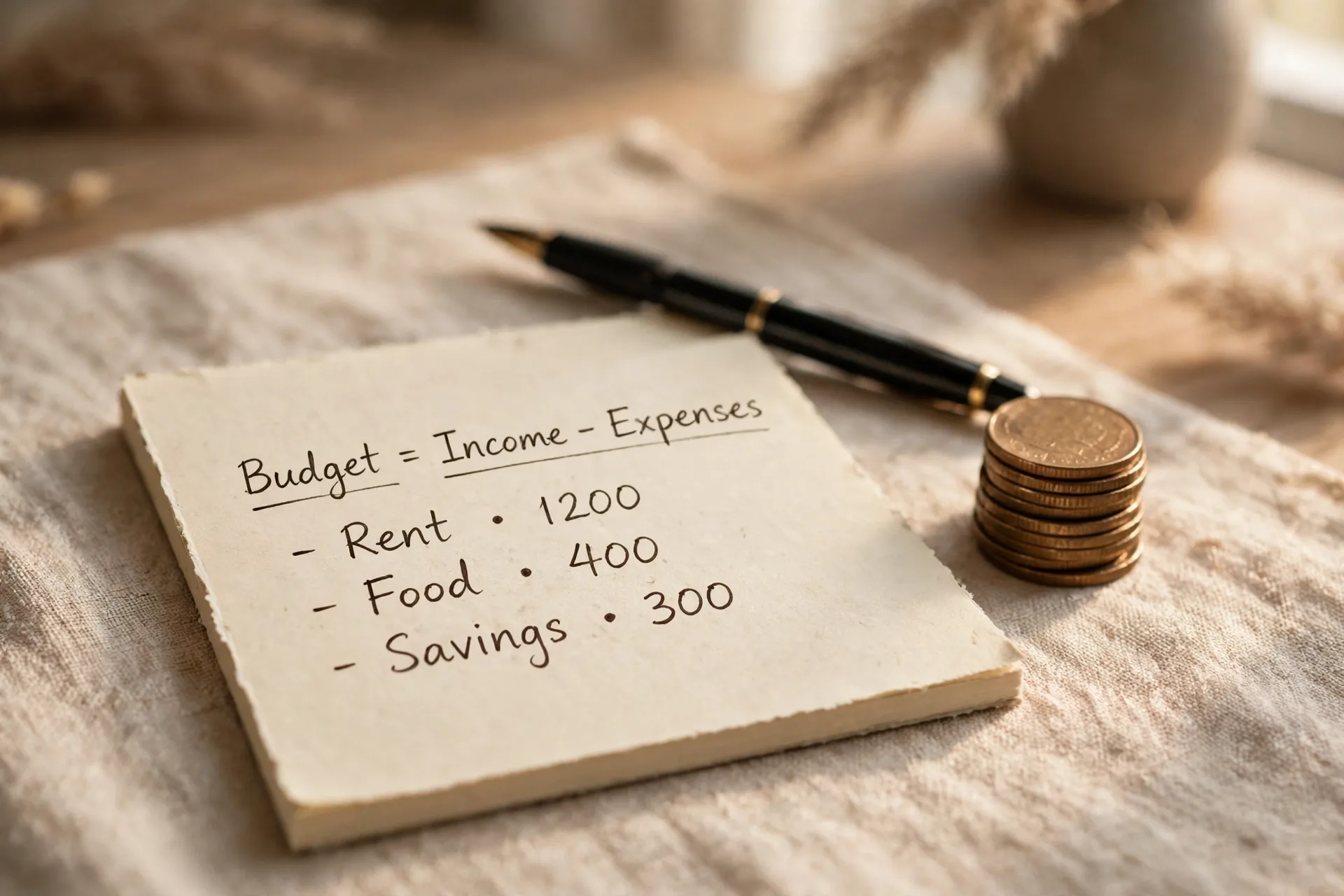
How to Start Zero-Based Budgeting for Beginners in 7 Steps
You start a zero-based budget in seven steps: list take-home pay, list fixed bills, list variable costs, set savings and debt goals, give fun money a line, make the total equal your pay, and track the plan each week. The steps take about one hour the first time. Do them in order.
- List your take-home pay. Write down the pay that lands in your bank account after tax, using the lowest normal month if your pay changes.
- List fixed bills first. Rent, utilities, phone, internet, insurance, and minimum debt payments go here, at the exact amounts from last month.
- List variable costs next. Groceries, transport, dining out, and personal spending go here, at the average of the last three months, rounded to the nearest $10.
- Set savings and debt goals. Put an emergency fund line, a sinking fund line, and an extra debt payment line into the plan before fun money gets a line.
- Give fun money a line. Set a dining out line, a personal line, or both. A plan with no fun money fails fast.
- Make the total equal your pay. Add every line. If the total is less than your pay, assign the rest to savings or debt. If the total is more, cut fun money before bills. The plan is done when income minus planned spending equals zero.
- Track the plan each week. Check each line every Sunday night for 15 minutes. A plan you check each week lasts.
I tested this method on my own budget for one month. The first week felt slow, and by week three the nightly check took less than five minutes. The weekly check caught a $35 streaming charge I had forgotten, and I moved that money to groceries the same night.

Zero-Based Budget Example With Real Numbers
A $3,500 take-home pay splits into 14 lines in this example: $2,260 for bills and minimum debt, $600 for savings and extra debt payoff, $440 for food and fun, and a $100 buffer, and the lines add up to exactly $3,500. Rent takes the largest share, and savings plus extra debt payoff take $600 before any fun money appears.
| Category | Amount |
|---|---|
| Rent | $1,200 |
| Utilities | $180 |
| Groceries | $420 |
| Transport | $200 |
| Phone and internet | $110 |
| Insurance | $150 |
| Minimum debt payment | $200 |
| Extra credit card payment | $200 |
| Emergency fund | $250 |
| Sinking funds | $150 |
| Dining out | $150 |
| Subscriptions | $60 |
| Personal and fun | $130 |
| Buffer | $100 |
| Total | $3,500 |
Income is $3,500 and planned spending is $3,500, so income minus planned spending equals zero. The buffer covers small surprises, and unspent buffer money moves to the emergency fund at month end.
The 50/30/20 budget rule splits pay into needs, wants, and savings, and this example lands near that split: needs take about 65%, wants take about 12%, and savings plus extra debt payoff take about 23%.
Change the numbers to fit your own pay, and keep the buffer at $50 to $100.

How to Build Sinking Funds for Irregular Costs
A sinking fund is a savings line that collects a small fixed amount each month for a large cost you know is coming, so a $600 car repair becomes six $100 lines instead of one crisis. You name the cost, find the total, divide by the months left, and save that amount each month in a separate savings account.
Start with three funds: car repairs, holidays, and home costs. A $600 car repair fund needs $50 a month for 12 months, a $900 holiday fund needs $75 a month, and a $300 home repair fund needs $25 a month. The three funds together cost $150 a month.
A sinking fund works best in a High-Yield Savings Account (HYSA), which is a savings account that pays a higher interest rate than a standard savings account. Keep each fund in its own labeled sub-account if your bank allows it, and move the money on payday with an automatic transfer.
Review each fund every three months. If a fund hits its target early, stop the monthly line and send the money to the next goal. If a cost grows, raise the monthly line by the gap divided by the months left.

How to Handle Irregular Income?
You handle irregular income by budgeting with your lowest normal month, building a one-month buffer, and treating extra pay as money to assign after the base plan is set. The base plan covers bills, food, and savings from the lowest pay you expect. Extra pay goes to the emergency fund, to debt, or to a sinking fund.
Build a buffer account with one month of costs. If your lowest month brings $3,000 and your plan needs $3,000, the buffer covers a $2,600 month without a cut. Build it with $200 a month, or with each extra paycheck until it equals one month of costs.
The paycheck budgeting method pairs well with this plan if you get paid on an uneven schedule. Assign each paycheck to the bills due before the next paycheck lands, and check the plan when each paycheck lands.
Freelance pay needs one extra rule: hold 25% to 30% of each payment for tax in a separate account, and budget only with the pay left after that hold.
Zero-Based Budget for Couples
A couples zero-based budget is one shared plan that lists both incomes, pays shared bills first, gives each person a personal line of the same size, and gets a yes from both partners before the month starts. The shared plan removes the most common money fight.
Add both take-home pays on separate lines. Pay shared bills next: rent, utilities, groceries, insurance, and shared debt. Set shared savings next: emergency fund, sinking funds, and extra debt payoff. Give each person a personal line of the same amount, such as $130 each.
Hold a 30-minute money date each week with the plan open on the table. Review what each person spent, and agree on the next week. A plan both partners agree on survives.
Use three accounts if your bank allows it: one shared account for bills, one shared savings account, and one personal account each. Move each personal line to the personal account on payday, and the zero-based plan still adds up to zero across all four accounts.

Debt Payoff Math: Extra $200 a Month
An extra $200 a month on a $4,000 credit card balance at 24% Annual Percentage Rate (APR) cuts the payoff time from about 7 years to about 16 months, and it cuts the interest paid from about $4,100 to about $800. APR is the yearly cost of borrowing shown as a rate. The math below uses one clear set of assumptions.
Assume a $4,000 balance at 24% APR, which is 2% interest per month, and no new charges on the card. Paying only the $100 minimum each month takes about 81 months, or about 6 years and 9 months. You pay about $8,100 in total, and about $4,100 of that is interest, because the first $80 of each $100 payment covers interest alone.
Pay $300 a month instead, which is the $100 minimum plus $200 extra, and the same balance clears in about 16 months. You pay about $4,800 in total, and about $800 of that is interest. The extra $200 a month saves about 65 months of payments and about $3,300 in interest. Put the extra payment line into the plan before fun money gets a line.
New to budgets? Read What Is a Budget? before your first plan.
First-Month Timeline: Your First 7 Days
Your first seven days follow a simple order: gather numbers on day 1, set bills and savings on day 2, build the full plan on day 3, open the accounts on day 4, automate transfers on day 5, make the first weekly check on day 6, and fix the gaps on day 7.
| Day | Task | Time |
|---|---|---|
| Day 1 | Gather pay slips, bank statements, and bill amounts for the last three months | 30 minutes |
| Day 2 | List fixed bills, savings goals, and the extra debt payment | 20 minutes |
| Day 3 | Build the full plan so income minus planned spending equals zero | 20 minutes |
| Day 4 | Open a HYSA and a buffer account if you lack them | 15 minutes |
| Day 5 | Set automatic transfers for savings, sinking funds, and the extra debt payment | 15 minutes |
| Day 6 | Check each line against real spending for the first week | 15 minutes |
| Day 7 | Move money between lines to fix the gaps, then lock the plan | 15 minutes |
Day 3 is the only hard day, because it forces the trade-offs. If the lines add up to more than your pay, cut dining out first, then subscriptions, then the personal line. Day 7 matters just as much, because a plan you fix after week one lasts into month two.
Subscription Audit: Find Money to Reassign
A subscription audit is a line-by-line check of every recurring charge in your bank app, and it finds $30 to $80 a month to reassign to savings or debt in most first audits. Open your bank app, list every charge that repeats each month, and mark each one as keep, cut, or share. Cancel the cuts the same day, and move the saved amount to a savings or debt line.
List all subscriptions from the last 90 days of bank statements, not from memory, and note the cost of each one. Cancel any service you used zero times last month. Share any service your household can split, such as a family streaming plan. Downgrade any plan you use less than twice a week. Add the saved total to the extra debt payment or the emergency fund line.
A typical first audit looks like this: cancel a $15 fitness app you never opened, cancel a $12 music add-on, share a $20 streaming plan to save $10, and downgrade a $25 cloud plan to save $10. The total saved is $47 a month, which is $564 a year, and that money now funds a sinking fund line.
Zero-Based Budgeting vs 50/30/20
Zero-based budgeting and the 50/30/20 budget rule both control spending, and they differ in detail: zero-based budgeting names a job for each dollar, while the 50/30/20 rule groups pay into three broad shares of 50% for needs, 30% for wants, and 20% for savings. The 50/30/20 budget rule splits take-home pay into needs, wants, and savings in fixed shares, while zero-based budgeting assigns each dollar to a named line until nothing is left unassigned.
| Feature | Zero-Based Budgeting | 50/30/20 Rule |
|---|---|---|
| Setup time | About 1 hour first time | About 15 minutes |
| Weekly upkeep | About 15 minutes | About 5 minutes |
| Detail level | Each dollar has a named line | Three broad shares only |
| Best for | Debt payoff and tight months | Steady pay and simple tracking |
| Flexibility | High, lines move each week | Low, shares stay fixed |
| Risk | Plan fatigue from detail | Overspending inside a broad share |
Pick zero-based budgeting if you carry card debt or if your pay changes. Pick the 50/30/20 rule if your pay is steady and your debt is low. The best method is the one you still check in month three.
When to Switch to a Simpler Method?
You switch away from zero-based budgeting when three signs line up: your debt is gone or nearly gone, your savings run on autopilot for three months, and the weekly check feels like a chore you skip. The method did its job at that point. A simpler plan can now hold the habit with less work.
Move to the 50/30/20 rule if your pay is steady and your costs stay stable. Move to a pay-yourself-first plan if your savings already leave the bank on payday. Keep the sinking funds and the buffer line in either case, because those two lines prevent the surprises that push people back to card debt.
Do not switch in the middle of a tight month or during a debt payoff push. Switch at the start of a calm month, keep the same savings amounts, and check the new plan each week for the first month. If spending drifts up by more than $100 in that month, return to the zero-based plan for one more month.
Common Mistakes to Avoid
The most common zero-based budgeting mistakes are forgetting irregular costs, setting fun money to zero, skipping the weekly check, and treating the buffer as spare cash. Each mistake has a plain fix, and most new budgeters make at least one of them in month one.
- Forgetting irregular costs. Car repairs, gifts, and annual fees break plans with no sinking funds. Fix it with a sinking fund line for each cost you know is coming.
- Setting fun money to zero. A plan with no fun money lasts about two weeks. Fix it with a personal line of $50 to $130.
- Skipping the weekly check. A plan you never check is a wish list. Fix it with a 15-minute Sunday check.
- Treating the buffer as spare cash. The buffer covers surprises, not extra shopping. Move unspent buffer money to savings at month end.
- Budgeting with gross pay. Gross pay is pay before tax, and it never lands in your account. Fix it by planning only with take-home pay.
- Cutting every line at once. Deep cuts in week one lead to a blowout in week three. Fix it by cutting one or two lines at a time.

FAQs
Is zero-based budgeting good for beginners?
Yes, zero-based budgeting is good for beginners because the steps are simple and the math is plain. You list your pay, give each dollar a job, and check the plan each week. The method needs no paid app and no past skill. Start with the seven steps in this guide, and keep the first plan simple.
How much should I keep as a buffer in a zero-based budget?
Keep $50 to $100 as a buffer in a zero-based budget if your pay is steady, and keep $200 if your pay changes each month. The buffer covers small surprises such as a pharmacy trip or a parking ticket. Move unspent buffer money to savings at month end, and rebuild the buffer at the start of the next month.
What happens to money left over at the end of the month?
Money left over at the end of the month gets a new job before the next month starts. Send it to your emergency fund, to a sinking fund, or to an extra debt payment. Unassigned money drifts into random spending. A zero-based plan ends each month at zero, and the leftover money starts the next month with a clear job.
Can I use zero-based budgeting with irregular income?
Yes, you can use zero-based budgeting with irregular income by planning with your lowest normal month. Build the base plan from that low month, and treat extra pay as money to assign after the plan is set. A one-month buffer covers a slow month, and holding 25% to 30% of freelance pay for tax keeps the plan safe.
Does zero-based budgeting work for couples?
Yes, zero-based budgeting works for couples when both partners build one shared plan together. List both incomes, pay shared bills first, set shared savings next, and give each person a personal line of the same size. Hold a 30-minute money date each week to review spending and agree on changes before the next week starts.
How is zero-based budgeting different from the 50/30/20 rule?
Zero-based budgeting gives each dollar a named line, while the 50/30/20 rule groups take-home pay into three shares: 50% for needs, 30% for wants, and 20% for savings. Zero-based budgeting takes more time each week, and it suits debt payoff and tight months. The 50/30/20 rule is faster, and it suits steady pay and simple tracking.
Conclusion
Zero-based budgeting for beginners works because it turns a vague goal into a named line for each dollar. Start with the seven steps, build the $3,500 example with your own numbers, add sinking funds, and run the subscription audit in week one. Check the plan each Sunday for 15 minutes. Couples should build one shared plan, and irregular earners should plan with the lowest month and keep a buffer. When the debt is gone and savings run on autopilot, switch to a simpler method without guilt. This guide from Savvy Cash Flow gives you the full plan, and more guides from Savvy Cash Flow cover the next steps. Pick your start date, set aside one hour, and give every dollar a job.