

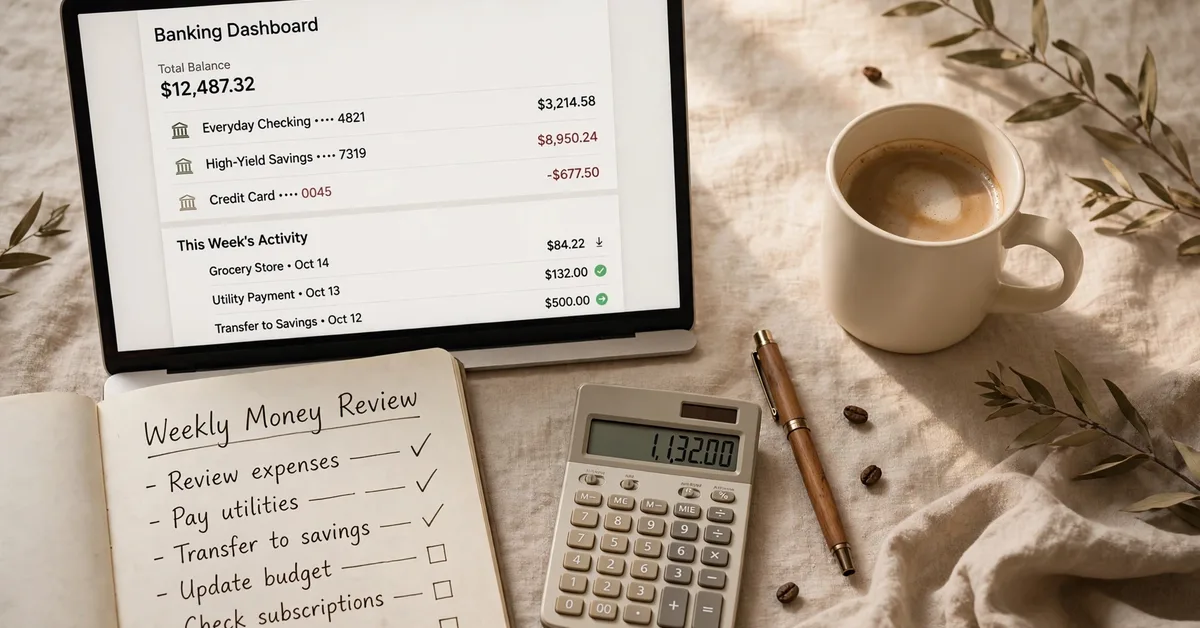
Your bank account has a funny way of surprising you. One week you feel comfortably ahead, and the next you are staring at a balance that makes no sense. The problem is rarely your income. It is the quiet gap between paydays, when nobody is watching the numbers. A weekly money review fixes that in just ten minutes. It shows you where your money went this week, catches sneaky charges before they snowball, and keeps your spending on track. Spare ten minutes once a week, and money surprises stop for good.
Key Takeaways
- A weekly money review is a 10-minute check-in, done once a week, to review your balances, spending, and savings progress.
- The five steps: glance at balances, review this week’s spending, scan for subscriptions and sneaky charges, update savings and upcoming bills, and set one money focus for next week.
- Do your review on the same day and time every week (Sunday evening works best) so it becomes automatic.
- Pair the weekly money review with a monthly money reset to catch both weekly leaks and bigger monthly drift.
- Ten minutes a week catches real problems early: forgotten subscriptions, overspending categories, and bills that quietly went up.
What Is a Weekly Money Review?

A weekly money review is a short, repeatable finance check-in you do once a week to look at your balances, spending, and savings progress. It takes about ten minutes and follows the same steps every time: glance at your accounts, review what you spent, scan for unwanted charges, check your savings goals, and set one focus for the week ahead.
Think of it as a quick pit stop for your wallet. You are not building a full budget or doing a deep audit. You are asking five questions: How much do I have? Where did it go? Is anything leaking? Are my savings growing? What is my focus next week?
The routine is deliberately tiny. Big money systems fail because they ask too much. A simple system you still do in December beats a perfect one you abandoned in February.
Why Does a Weekly Money Review Beat Checking Monthly?
A weekly money review beats monthly check-ins because money problems compound fast. A forgotten $15 subscription costs you $15 if you catch it this week, but $180 if you do not notice it for a year. Checking weekly means you catch leaks, overspending, and billing errors while they are still small and easy to fix.
Most people underestimate their spending by 20 percent or more, and that drift happens week by week. If your dining-out budget is $300 a month and you spend $180 in week one, a monthly check-in tells you after the damage is done. A weekly money review tells you on day seven, when you still have three weeks to adjust.
Monthly reviews also feel heavy because you face 30 days of transactions at once, which is why most people skip them. A weekly review covers just seven days: easy to remember, easy to scan, hard to argue with.
How Do You Do the 10-Minute Weekly Money Review?
Set a timer for ten minutes and work through these five steps in order. Each step builds on the last, so do not skip ahead. You only need your phone (banking app and notes app) and ten quiet minutes.
Step 1: Glance at Your Balances (2 Minutes)
Open your banking app and write down four numbers: your checking balance, your savings balance, your total credit card debt, and any “safe to spend” figure your app shows. Then compare them to last week. Did savings go up? Did credit card debt go down? The trend matters more than any single number. Do not judge the numbers; you are gathering facts, not grading yourself.
Step 2: Review This Week’s Spending (3 Minutes)

Pull up this week’s spending summary and look at the big categories: groceries, dining out, shopping, gas, and subscriptions. Do not audit individual purchases. Look for the one or two categories that ran hot. If dining out was double what you expected, you found your leak for the week.
A simple framework makes this step fast. The 50/30/20 rule gives you instant context: roughly 50 percent of take-home pay for needs, 30 percent for wants, 20 percent for savings and debt payoff. If your weekly spending is way over 30 percent on wants, pull back next week.
Step 3: Scan for Subscriptions and Sneaky Charges (2 Minutes)

Scroll through the last seven days of transactions and look for recurring charges and anything you do not recognize. Streaming services, apps, memberships, and free trials that quietly converted to paid plans all live here. Ask about each unexpected charge: “Did I agree to this, and did I use it?” If either answer is no, cancel or dispute it right now. The average household wastes over $130 a year on unused subscriptions, so this two-minute scan often pays for the whole routine.
Step 4: Update Your Savings and Upcoming Bills (2 Minutes)
Check each savings goal: emergency fund, vacation, car repairs, whatever you are building. How much did you add this week? Update the numbers, even if progress was small. A stagnant goal tells you your automatic transfer needs attention.

If your emergency fund is not growing, fix it now. A high-yield savings account can earn 4 to 5 percent while your money waits, and our guide to building an emergency fund from scratch has the full plan.
Then glance at the bills due in the next seven days: rent, utilities, insurance, credit card minimums. Knowing what is coming means no surprise overdrafts and no late fees.

Step 5: Set One Money Focus for Next Week (1 Minute)
Pick exactly one money focus for the coming week. Not five. One. Examples: bring lunch to work three days, move $50 into savings on payday, or call your internet provider to ask for a lower rate. Write it in your notes app where you will see it.
When Is the Best Time for Your Weekly Money Check-In?

The best time for your weekly money check-in is a fixed slot you can keep: Sunday evening works best for most people. It is quiet, the week is fresh in your mind, and you can plan the week ahead with real numbers instead of guesses. Pick one day and one time, and put a recurring reminder on your phone so you never have to decide when to do it.
Consistency beats perfection. If you miss a Sunday, do the ten-minute version on Monday instead of skipping the week. Tie the review to something you already do, like your evening tea or your favorite show’s opening credits, and it becomes a habit instead of a chore.
What Tools Make Your Weekly Money Checkup Easier?
Your weekly money checkup only needs three things: your banking app, a notes app for your four numbers and one weekly focus, and optionally a budgeting app that categorizes spending for you. The routine is designed to work with tools you already have, so there is no setup project standing between you and your first review.
A good budgeting app makes Step 2 much faster by connecting to your accounts and sorting your spending automatically. If you want help choosing, our roundup of the best budgeting apps for 2026 matches seven top apps to different budgeting styles, including free options that work well for a weekly money review.
Prefer a hands-on approach? A simple spreadsheet or paper notebook works fine, as long as you open it every week. If your accounts are scattered, take a weekend to organize your money first.
How Do You Make the Weekly Review a Habit That Sticks?
Make the weekly money review stick by attaching it to something you already do, like Sunday dinner cleanup or your morning coffee. Set a phone reminder for the first month until the day feels automatic. Keep a streak count in your notes app, because nobody wants to break a 12-week streak over ten minutes.
Make the ten minutes pleasant. Pour a good drink, put on music, and treat it as your weekly “money date.” Track one small win each week, like “canceled one unused subscription.” Wins compound into motivation, and motivation compounds into a habit that runs for years.
Weekly Money Review FAQs
How long does a weekly money review really take?
About ten minutes once you know the routine. The first one might take twenty minutes because you are finding your numbers and learning the steps. By the third or fourth week, most people finish in under ten minutes because the steps are familiar and the numbers are already organized.
What if I do not have a budget yet?
You can do a weekly money review without a formal budget. Just track the four numbers from Step 1 and scan your spending by category in Step 2. After three or four weeks, you will have enough real data to build a budget that actually fits your life.
Should I do a weekly money review or a monthly money reset?
Do both. A weekly money review catches small, fast-moving problems like overspending and surprise charges. A monthly money reset handles the bigger picture: full-month spending trends, savings goal progress, and your one goal for the month ahead. The weekly review keeps you on track day to day; the monthly reset keeps your whole plan honest.
What should I do if my weekly review shows I overspent?
Do not panic. Overspending is information, not failure. Name the one category that caused the biggest gap, then set a realistic adjustment for next week, like cutting dining out from $150 to $100 instead of to zero.
Is a weekly money review worth it if I live paycheck to paycheck?
It is even more worth it. When money is tight, every dollar needs a job, and a weekly money review is how you give it one. Many people on tight budgets find an extra $50 to $100 a month in their first few reviews just by catching charges and spending they never noticed.
Start Your First Weekly Money Review Today
You do not need a perfect budget, a fancy app, or a free weekend. You need ten minutes, your banking app, and the five steps above. Do your first weekly money review today, even if today is a Tuesday, then set a recurring reminder for Sunday evening.
Ten minutes a week is a tiny price for always knowing exactly where your money stands. Run the steps, set your one focus for next week, and enjoy the calm that comes from being in control.
This article is for general information only and is not financial advice.