

Last updated: October 2026
Written by Emma for Savvy Cash Flow.
A dog walking business is a paid service that walks dogs for owners who work long hours or travel, and a beginner can start a dog walking business for $200 to $2,000, earn $20 to $35 per 30-minute walk, and build income from repeat weekday clients in one local area.
This guide covers what a dog walking business is, what it costs to start, which services pay best, how much a walker can earn, platform work compared with independent work, 7 start steps, licenses and insurance, first clients, taxes and records, profit mistakes, and a 90-day launch plan.
Readers also get a startup cost table, a pricing table, a platform compared with independent table, an earnings worked example, and answers to 6 common questions about dog walking business costs, income, and rules.
Key Takeaways
- A dog walking business starts for $200 to $2,000, with insurance as the main trust cost.
- A 30-minute walk prices at $20 to $35 in the planning ranges in this guide.
- Repeat weekday clients in one tight area drive profit most.
- Platform work costs 15 percent to 40 percent in commission, while independent work keeps full revenue.
- A cancellation rule, a key log, and a 25 percent tax set-aside protect profit.
Table of Contents
- What Is a Dog Walking Business?
- Startup Costs
- Services
- Earnings
- Platform vs Independent
- 7 Start Steps
- Licenses and Insurance
- First 10 Clients
- Taxes and Records
- Profit Mistakes
- 90-Day Launch Plan
- Conclusion
- FAQs
What Is a Dog Walking Business?
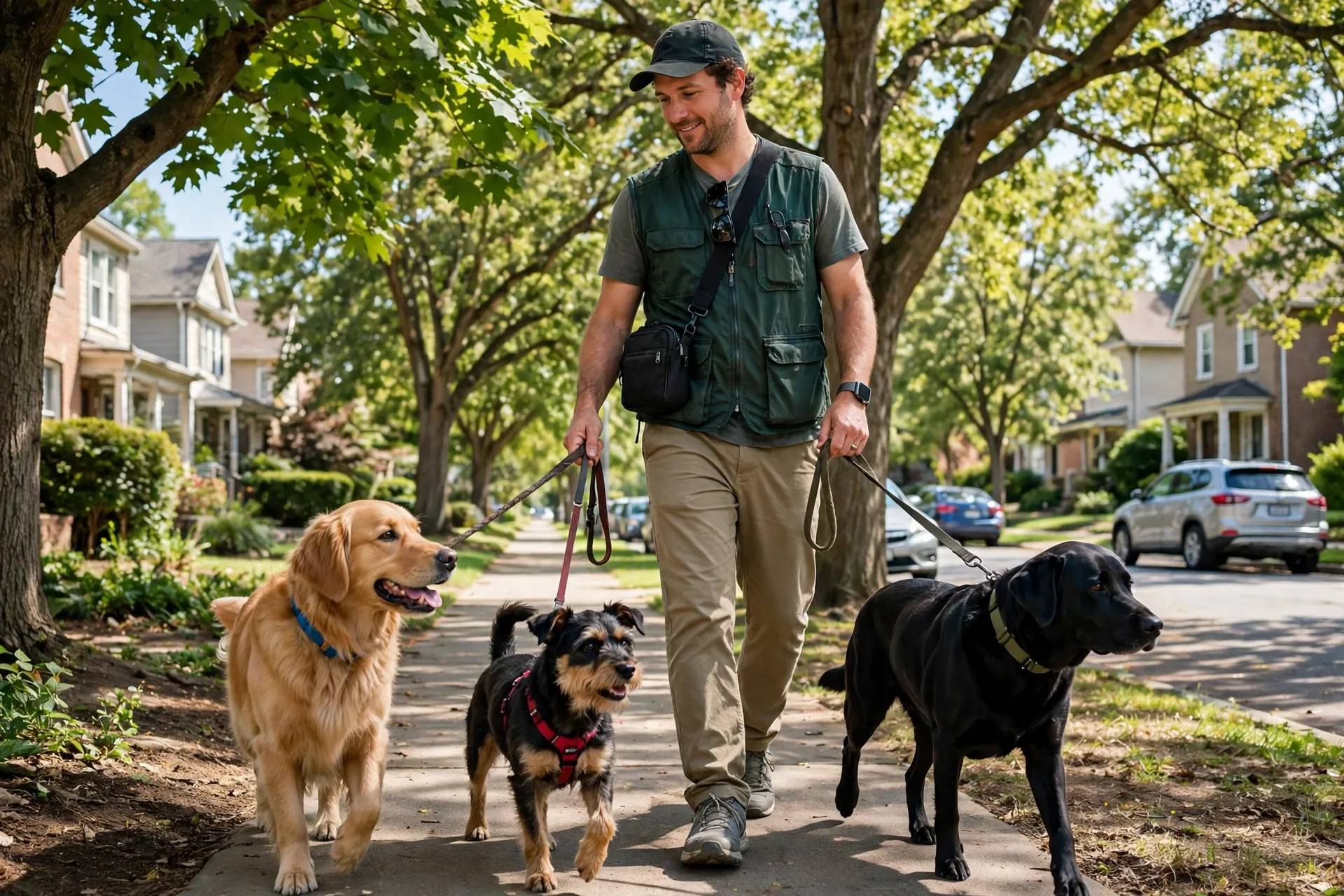
A dog walking business is a service that walks dogs for owners for a set fee, and the dog walking business collects dogs from homes, walks dogs on set routes, and returns dogs home with a short report for each owner.
A dog walking business is a local service business that sells time, care, and reliability. Owners pay for midday walks and exercise when owners work or travel. The walker controls the area, length, price, and schedule, and holds house keys and pet care notes, so trust forms the core product.
Professional dog walkers are paid by dog owners to walk dogs, and some walkers walk one dog at a time while other walkers walk small groups. Read how professional dog walking works.
How Much Does It Cost to Start a Dog Walking Business?
A dog walking business costs $200 to $2,000 to start, and the $200 start uses a platform profile with basic gear, while the $2,000 start adds a Limited Liability Company (LLC), a full year of insurance and bonding, booking software, a website, first aid training, and a marketing budget.
| Startup cost item | Low range | High range | What it covers |
|---|---|---|---|
| Insurance, bonding, and LLC filing | $80 | $600 | Liability cover, surety bond, state filing fee |
| Leashes, bags, and first aid gear | $60 | $350 | Slip leads, waste bags, treat pouch, first aid kit |
| Booking, scheduling, and GPS software | $0 | $300 | Calendar, client portal, GPS walk reports |
| Website and branding | $0 | $350 | Domain, one-page site, logo, business cards |
| Pet first aid certification | $0 | $120 | Online or in-person pet first aid and CPR course |
| Marketing and launch | $60 | $280 | Flyers, door hangers, local group posts, small ads |
| Total startup cost | $200 | $2,000 | Full start range for a dog walking business |

A dog walking business pays $45 to $570 per month for insurance, software, fuel, waste bags, treats, gear, and marketing. Fuel is the swing cost: a tight route costs $20 per month, while a spread-out route costs $250 per month.
Browse the Business Ideas & Side Hustles guides on Savvy Cash Flow to compare dog walking with other low-cost service businesses. Dog walking fits the low-cost pattern in 10 Business Ideas You Can Start With $1,000, where skill and time sell before stock. Keep $200 in reserve after launch spend.
What Services Can a Dog Walking Business Offer?
A dog walking business can offer solo walks, group walks, potty breaks, long walks, weekend walks, and pet sitting visits, and the dog walking business earns most from repeat weekday solo walks and group walks in one area, with prices set on the booking page.
Start with 2 or 3 core services, then add services after 10 repeat clients book each week.
| Service | Walk length | Planning price | Best buyer |
|---|---|---|---|
| Solo walk | 30 minutes | $20 to $35 | Shy dogs, reactive dogs, senior dogs |
| Group walk | 30 minutes | $15 to $25 per dog | Social dogs in one area |
| Long walk | 60 minutes | $35 to $50 | High-energy dogs, active owners |
| Potty break | 15 minutes | $12 to $18 | Puppies, senior dogs, midday breaks |
| Drop-in pet sitting visit | 20 to 30 minutes | $25 to $40 | Owners on short trips |
| Overnight pet sitting | Overnight | $50 to $75 | Owners on holidays |
How Much Can a Dog Walking Business Earn?
A dog walking business can earn $900 per month part time and $3,700 per month full time in the worked examples in this guide, and the dog walking business earns more when walks cluster in one area and clients book 5 days per week.
The part-time worked example uses 9 walks per week at $25 per walk: 3 walks per day on 3 days equals $225 per week, which equals $900 per month.
The full-time example uses 40 walks per week at $25 per walk, which equals $4,000 per month. Monthly costs of $300 leave $3,700 per month before tax.

A group walk with 3 dogs at $20 per dog pays $60 for one 30-minute slot, while a solo walk pays $25 for the same slot. Group walks need matched dogs and a safe route.
I timed two routes in my own trial walks: 4 clients on one street finished 40 minutes sooner than 4 clients spread across town, for the same pay. Route density decides hourly income, because drive time pays $0.
Platform Walking vs Independent Walking: Which Model Fits a Beginner?
Platform walking fits a beginner who wants fast first bookings with no website and no insurance purchase, while independent walking fits a beginner who wants full price control, full client ownership, and repeat income without commission, and the choice depends on cash, speed, and control needs.
The table compares the 2 models on cost, income, control, and growth. Many walkers start on a platform and move repeat clients to an independent booking method after 3 months of steady walks.
| Factor | Platform walking | Independent walking |
|---|---|---|
| Startup cost | $200 or less | $500 to $2,000 |
| Commission | 15 percent to 40 percent per booking | $0 commission, software and insurance costs apply |
| Client ownership | Platform owns the booking record | Walker owns the client list |
| First booking speed | Days | 1 to 4 weeks |
| Price control | Platform rules and fee structure apply | Walker sets each price |
| Trust signal | Platform reviews and platform cover | Own insurance, bond, reviews, and reports |
Rover takes 15 percent to 20 percent of each booking, and Wag takes around 40 percent, in the ranges reported by Startup Cost Guide (2026). A $25 walk on a 20 percent platform pays $20 to the walker, while the same walk as an independent booking pays $25 before costs.
Learn client outreach steps that also work for dog walking in How to Start a Freelancing Business From Zero.
How Do You Start a Dog Walking Business in 7 Steps?
To start a dog walking business, pick one service area, set prices, buy insurance and bonding, register the business, build a booking page, win 3 trial clients, and turn trial walks into weekly packages with a booking page and weekly billing from the first month.
Follow the 7 steps in order, because each step removes one blocker for the next step.
- Pick one service area with dense dog ownership.
- Set 3 prices: solo, group, and weekend add-on.
- Buy pet-care liability insurance and a surety bond before the first paid walk.
- Register the business name and check city license rules with the city clerk office.
- Build a one-page booking page with area, prices, and a contact form.
- Offer 3 trial walks at an intro price to neighbours and local groups.
- Convert trial walks into weekly packages with fixed days and billing.
What Licenses, Insurance, and Safety Rules Apply?
A dog walking business needs a city business license where the city requires one, pet-care liability insurance, a surety bond for key holding, and a written safety routine, and the dog walking business needs no national license in most cities.
A Limited Liability Company (LLC) is a legal form that separates personal assets from business debts in most states. A sole proprietorship is a form with no legal separation between owner and business. A beginner can start as a sole proprietorship and form a Limited Liability Company (LLC) after clients arrive.
An Employer Identification Number (EIN) is a free federal tax number from the Internal Revenue Service (IRS). Banks ask for an Employer Identification Number (EIN) for a business account, so apply on the Internal Revenue Service (IRS) website first.
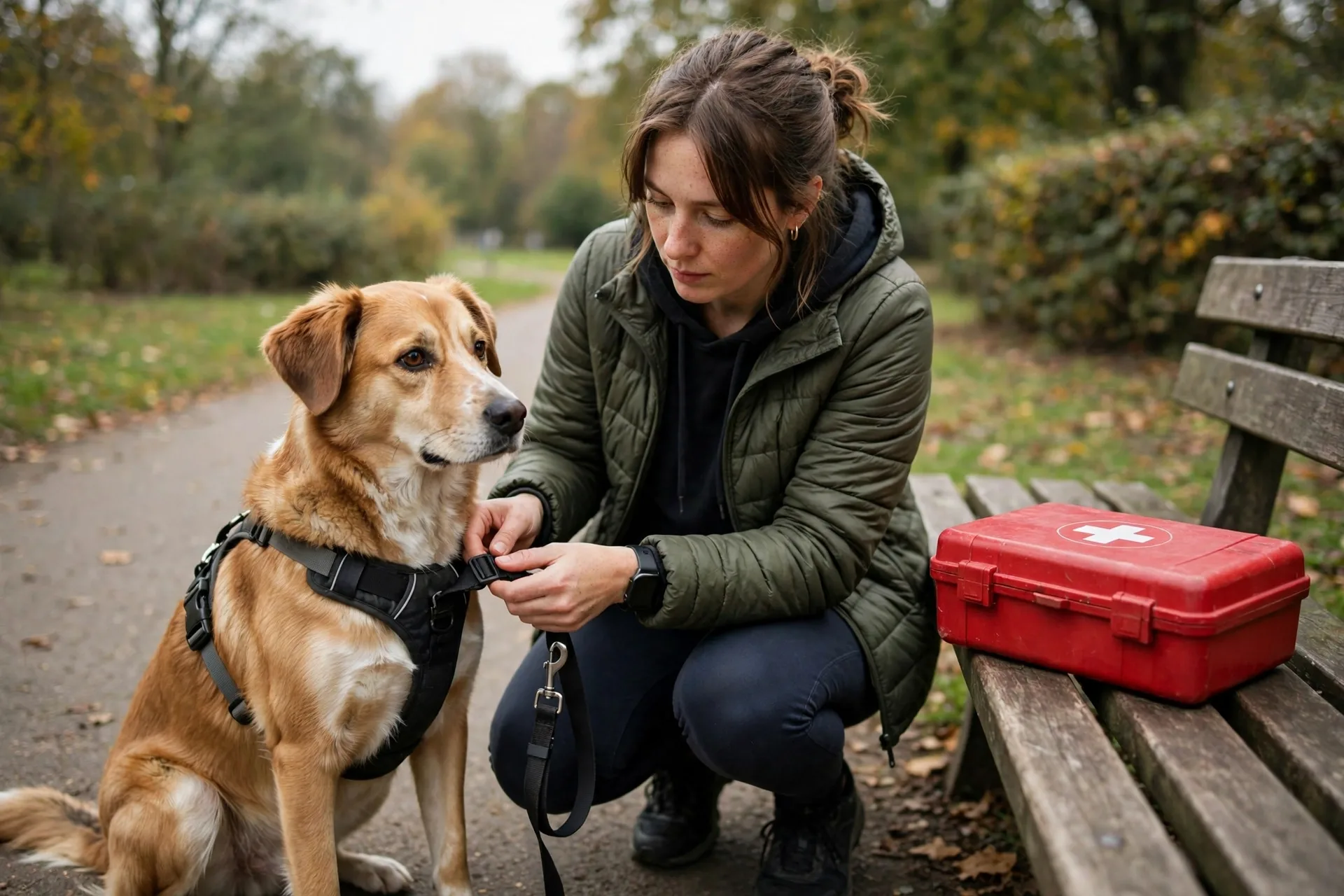
Insurance covers 3 risks: general liability cover for injury and property damage, care, custody, and control cover for injury, illness, or loss of a dog, and a surety bond for theft claims when a walker holds keys. Pet first aid training covers heat exhaustion, cut paws, and choking, and a Red Cross course costs about $25 online.
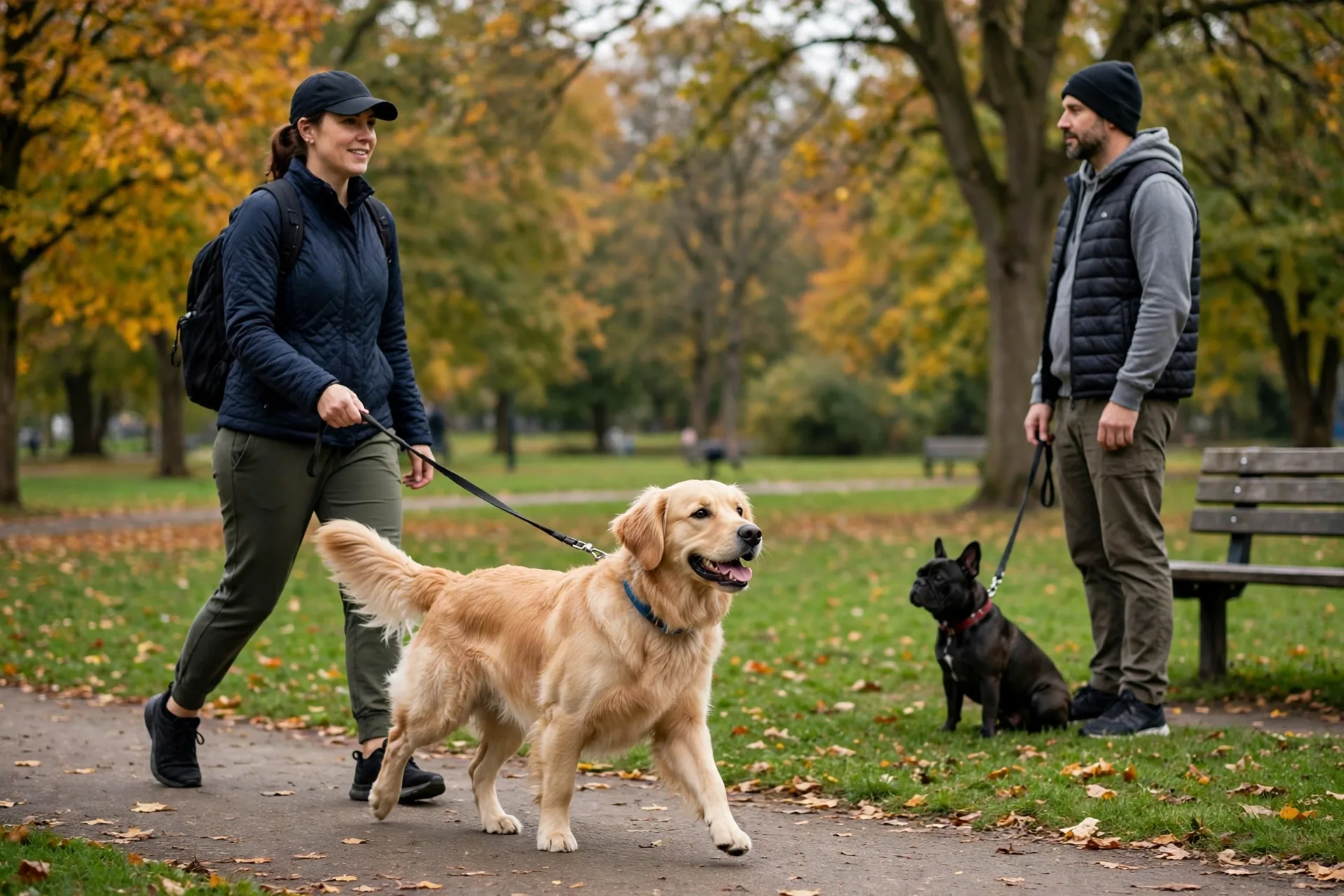
Safety rules need written form: a fixed-length leash rule, a maximum dog count, a weather cutoff, a lost-dog plan, and a key log with coded labels and no addresses on keys. Some cities limit group walks to 3 to 6 dogs.
How Do You Get Your First 10 Clients?
To get your first 10 dog walking clients, post one clear offer in 2 local groups, flyer 2 vet clinics and 2 pet shops, ask 20 named contacts for referrals, and turn each trial walk into a weekly package with a review request on delivery day.
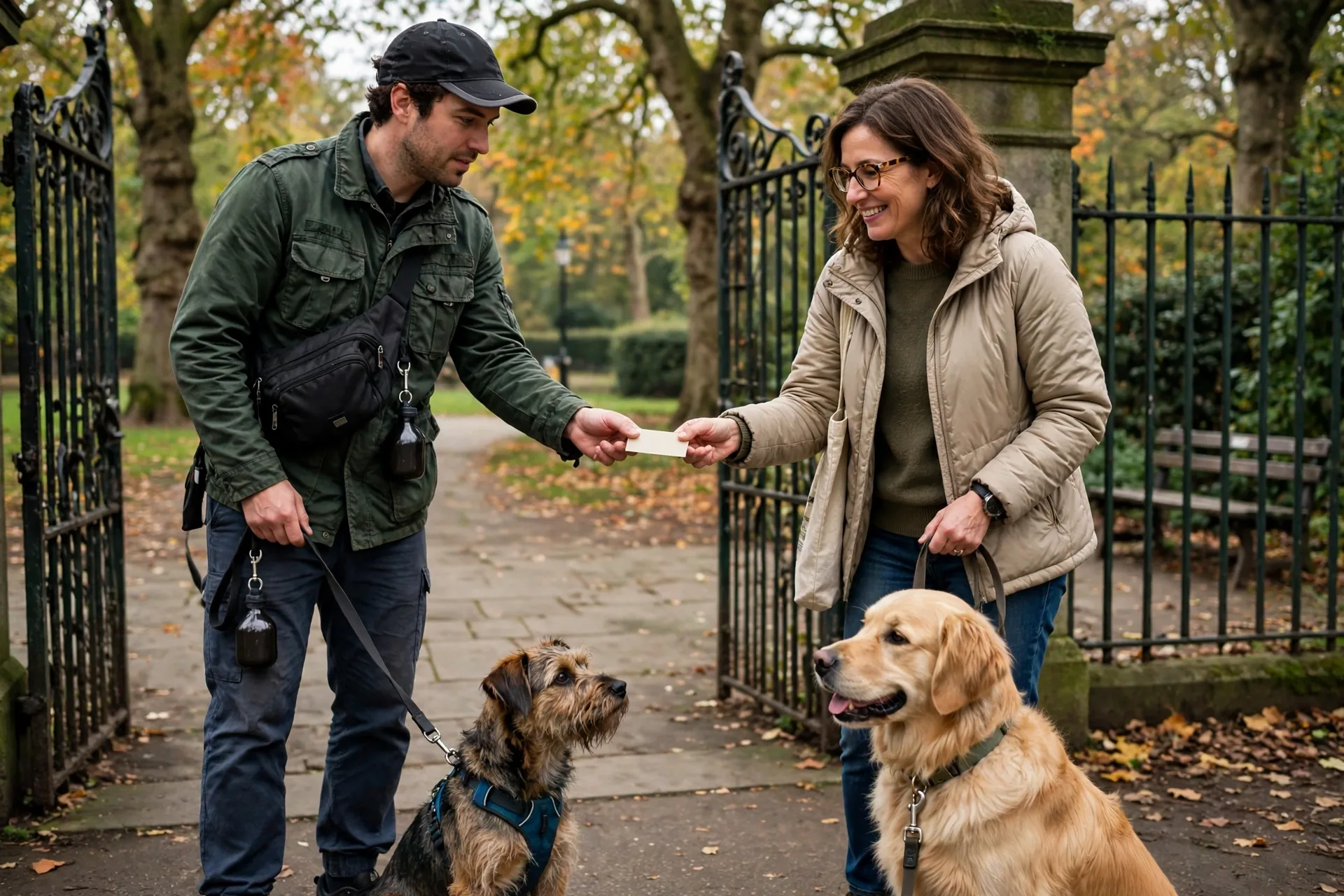
Savvy Cash Flow readers can use 4 channels in week 1: message 20 personal contacts with one offer, one price, and one start date; post in 2 neighbourhood groups; leave flyers at vet clinics and pet shops with staff permission; and list on Rover or Wag for early bookings.
Ask for a Google review after 3 successful walks. Offer one free walk for each referral that books a weekly package, capped at 2 per client per month.
How Do You Handle Taxes, Payments, and Records?
To handle taxes, payments, and records for a dog walking business, set aside 25 percent of each payment for taxes, bill weekly packages in advance, track income and miles in one sheet, and keep receipts in one folder for each tax year.
Self-employment tax is Social Security tax plus Medicare tax, at 15.3 percent of net earnings (Source: Internal Revenue Service (IRS), 2026). Income tax sits on top, so a 25 percent to 30 percent set-aside covers both taxes for most beginners. Filing is required when net earnings reach $400 or more (Source: Internal Revenue Service (IRS), 2026). Read the IRS self-employed tax center for quarterly tax rules, Schedule C, and Schedule SE.
Weekly billing in advance beats per-walk billing after the fact, because advance billing stops late payment gaps. A same-day cancellation fee of 50 percent stops revenue leaks, and a full fee applies for a no-show with no notice. Each payment needs a receipt with date, client name, service, and amount.
Record 5 facts for each walk: date, client name, dog name, walk type, and amount paid. Record miles for each route day, because the Internal Revenue Service (IRS) mileage deduction lowers taxable income. Record expenses in the same sheet. This article gives general information only, not tax advice for a specific person.
What Mistakes Cut Dog Walking Profits?
The mistakes that cut dog walking profits are spread-out routes, no cancellation fee, underpricing, free extra services, and no written service terms, and the dog walking business loses money on each mistake even when walk count looks high, and each mistake costs time, cash, or trust.
Spread-out routes burn unpaid drive time: clients 20 minutes apart turn a 30-minute paid walk into a 50-minute time block, so hourly income falls by 40 percent. Cap the service area at 2 neighbourhoods until 10 weekly clients fill that area.
No cancellation fee leaks 10 percent to 20 percent of booked revenue: a client who cancels at noon leaves a 1 p.m. slot empty, and no new client fills a midday slot in one hour. Fix leaks with a written fee rule on the booking page and in the welcome message.
Underpricing traps a walker at a full schedule with low pay: a $15 price with $300 monthly costs needs 20 walks per month to cover costs, while a $25 price needs 12 walks. Raise prices after 5 paid jobs and 3 reviews. Free add-ons trap profit too, because each free add-on adds time with $0 pay.
Your First 90 Days: A Simple Launch Plan
A simple 90-day launch plan for a dog walking business sets prices and insurance in days 1 to 30, wins 10 weekly clients in days 31 to 60, and fills one tight route with weekly packages in days 61 to 90.
Days 1 to 30 cover setup: pick the area, set 3 prices, buy insurance and bonding, register the name, build the booking page, and complete first aid training. Book 3 trial walks in days 21 to 30.
Days 31 to 60 cover client growth: message 20 contacts, post in 2 local groups each week, flyer vet clinics and pet shops, and list on one platform. Convert trial walks into weekly packages. Target 10 weekly clients by day 60.
Days 61 to 90 cover route tightening: drop out-of-area clients or raise out-of-area prices by $5 per walk. Add one group slot per day for matched dogs. Review prices, costs, and hours at day 90, and raise the solo price by $2 to $5 when the schedule fills for 2 straight weeks.

Conclusion
A dog walking business works best when the walker starts for $200 to $2,000, prices solo walks at $20 to $35, fills one tight local route with repeat weekday clients, and protects profit with insurance, a cancellation rule, and a tax set-aside.
Start with one service area, 3 prices, and 3 trial walks, and let referrals fill the route. More practical money guides live on Savvy Cash Flow.
Frequently Asked Questions
Can you start a dog walking business with $200?
Yes, you can start a dog walking business with $200 when you work through a platform, use gear you already own, and skip a website and standalone insurance at launch. The $200 covers leashes, waste bags, a treat pouch, and flyers. Platform cover handles liability.
How much do dog walkers earn per month?
Dog walkers earn $900 per month part time and $3,700 per month full time in the worked examples here, before tax. Part-time income uses 9 walks per week at $25 per walk, while full-time income uses 40 walks per week at $25 per walk. Group walks and pet sitting raise income past solo walks.
Do you need a license to walk dogs?
No, you need no national license to walk dogs in most cities, but some cities require a general business license and some parks require a commercial use permit. Check city clerk and park rules before the first paid walk. A business license costs $50 to $200.
Is dog walking profitable in winter?
Yes, dog walking stays profitable in winter when clients book repeat weekday walks and the walker uses weather gear, reflective vests, and shorter routes in storms. Winter demand holds for midday walks, because owners still work full days. Holiday pet sitting fills income gaps.
Should you use Rover or Wag or work independent?
Platform work fits beginners who want fast first bookings, while independent work fits walkers who want full price control and full client ownership. Rover takes 15 percent to 20 percent and Wag takes around 40 percent, so independent work keeps more income per walk.
How many dogs can you walk at once?
You can walk 1 to 4 dogs at once in most local rules, with solo walks for shy dogs and group walks of 2 to 4 dogs for social dogs. Some cities limit group walks to 3 to 6 dogs, so check city rules before selling group walks.
[…] Read how a related low-cost service prices starter work in Dog Walking Business: Startup Costs and Earnings. […]