


Last updated: October 2026
Written by Emma for Savvy Cash Flow.
Introduction
Compound interest explained in one line: compound interest is interest earned on the original amount plus interest earned in earlier periods, so each period adds interest to a larger balance than the period before it. A $1,000 deposit at 7% per year grows to $1,967.15 in 10 years with annual compounding, while the same deposit grows to $1,700.00 in 10 years with simple interest.
This guide defines compound interest, shows how compound interest works year by year, gives the compound interest formula with a worked example, compares compound interest with simple interest in real numbers, explains compounding frequency, gives 3 real examples with monthly contributions, covers the Rule of 72, shows when compound interest works against you on debt, lists 5 mistakes to avoid, and gives a 6-step plan to use compound interest. Six FAQs close the guide with direct answers.
Key Takeaways
- Compound interest is interest earned on the principal plus interest earned in earlier periods.
- A $1,000 deposit at 7% per year reaches $1,967.15 in 10 years with annual compounding.
- Monthly contributions change results more than a large one-time deposit in most beginner plans.
- A 25-year-old who invests $100 per month at 7% per year reaches $262,481 by age 65 in an illustrative example, while a 35-year-old who invests the same $100 per month reaches $121,997 by age 65.
- Time, rate, and regular contributions are the 3 levers that control compound interest results.
- Compound interest also raises debt balances, so high-interest debt needs a payoff plan before long-term investing.
Table of Contents
- What Is Compound Interest?
- How Does Compound Interest Work Year by Year?
- What Is the Compound Interest Formula?
- Compound Interest vs Simple Interest: What Do Real Numbers Show?
- How Often Does Compounding Happen?
- Real Example 1: What Does $100 Per Month Grow To?
- Real Example 2: Why Does Starting 10 Years Earlier Matter So Much?
- What Is the Rule of 72?
- When Does Compound Interest Work Against You?
- What Mistakes Lower Compound Interest Results?
- How Do You Use Compound Interest in Your Own Plan?
- Frequently Asked Questions
- Conclusion
What Is Compound Interest?
Compound interest is interest that an account or investment earns on the original principal and on interest added in earlier periods, so the balance that earns interest grows after each compounding period. Compound interest differs from simple interest, since simple interest earns interest on the original principal only.
Compound interest appears in savings accounts, certificates of deposit, investment accounts that reinvest dividends, and loans, and the Investing and Wealth category on Savvy Cash Flow covers more guides in this area. A savings account adds interest to the balance, and the next payment uses the new balance. An investment account that reinvests dividends buys more shares, and those shares earn returns later. A loan balance works in reverse, since unpaid interest joins the balance.
How Does Compound Interest Work Year by Year?
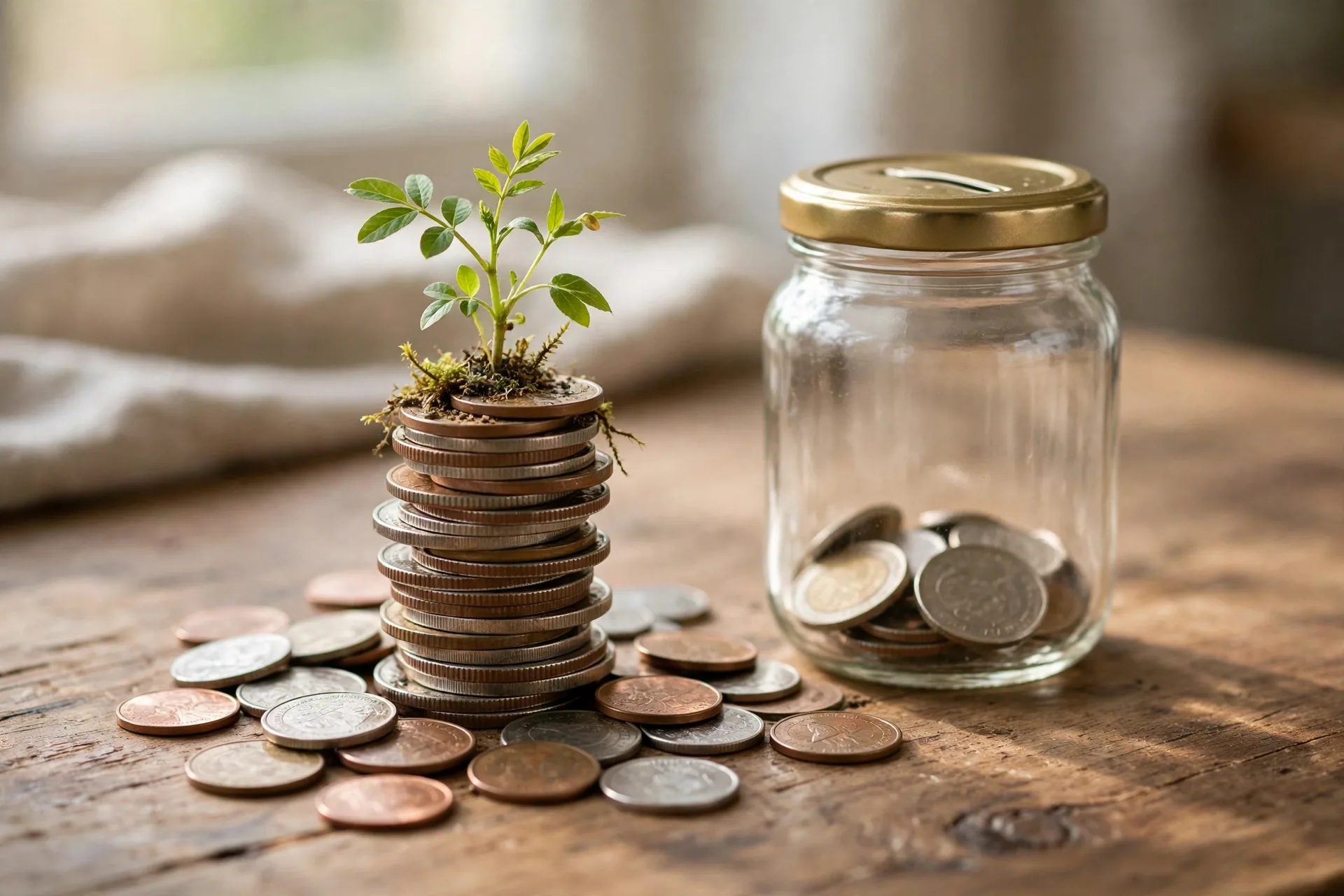
To see how compound interest works year by year, start with $1,000 at 7% per year, add $70.00 in year 1 for a $1,070.00 balance, add $74.90 in year 2 for a $1,144.90 balance, and keep adding 7% of the new balance each year until year 10 reaches $1,967.15. The interest amount rises each year even though the rate stays at 7% per year.
The table below shows each year for a $1,000 deposit at 7% per year with annual compounding.
| Year | Interest earned that year | Balance at year end |
|---|---|---|
| 1 | $70.00 | $1,070.00 |
| 2 | $74.90 | $1,144.90 |
| 3 | $80.14 | $1,225.04 |
| 4 | $85.75 | $1,310.80 |
| 5 | $91.76 | $1,402.55 |
| 6 | $98.18 | $1,500.73 |
| 7 | $105.05 | $1,605.78 |
| 8 | $112.40 | $1,718.19 |
| 9 | $120.27 | $1,838.46 |
| 10 | $128.69 | $1,967.15 |
Year 10 interest of $128.69 is $58.69 more than year 1 interest of $70.00, and the rate never changed. Early years look slow, and later years add larger dollar amounts because the base keeps growing.
Readers who want a full investing start can read our guide on how to start investing in index funds for a first-buy plan that pairs well with compound interest.
What Is the Compound Interest Formula?
The compound interest formula is A = P (1 + r/n) to the power of (n times t), where A is the final amount, P is the principal, r is the annual rate as a decimal, n is the number of compounding periods per year, and t is the number of years. The formula gives the final balance, and final balance minus principal gives total interest earned.
To use the compound interest formula, follow 4 steps:
- Write the principal P, the annual rate r, the compounding periods n, and the years t.
- Divide r by n to get the rate for one period.
- Raise (1 + r/n) to the power of (n times t).
- Multiply the result by P to get the final amount A.
A worked example uses $5,000 at 6% per year, compounded monthly, for 10 years. The monthly rate is 0.06 divided by 12, which is 0.005. The number of periods is 12 times 10, which is 120. The final amount is $5,000 times (1.005) to the power of 120, which is $9,096.98. Total interest earned is $9,096.98 minus $5,000, which is $4,096.98.
The Wikipedia guide to compound interest gives the same formula with the compounding frequency terms defined for annual, monthly, and daily compounding.

Compound Interest vs Simple Interest: What Do Real Numbers Show?
Compound interest beats simple interest by a wider margin as time grows, since compound interest earns interest on past interest while simple interest earns interest on the principal only. A $1,000 deposit at 5% per year reaches $1,276.28 in 5 years with annual compounding, while the same deposit reaches $1,250.00 in 5 years with simple interest.
The table below compares both methods.
| Deposit and time | Simple interest total | Compound interest total | Compound interest advantage |
|---|---|---|---|
| $1,000 for 5 years at 5% | $1,250.00 | $1,276.28 | $26.28 |
| $100 for 20 years at 7% | $240.00 | $386.97 | $146.97 |
| $10,000 for 30 years at 7% | $31,000.00 | $76,122.55 | $45,122.55 |
Simple interest adds $700.00 each year for 30 years, while compound interest adds a rising amount each year and reaches $76,122.55. The $45,122.55 advantage comes only from interest earning interest.
How Often Does Compounding Happen?
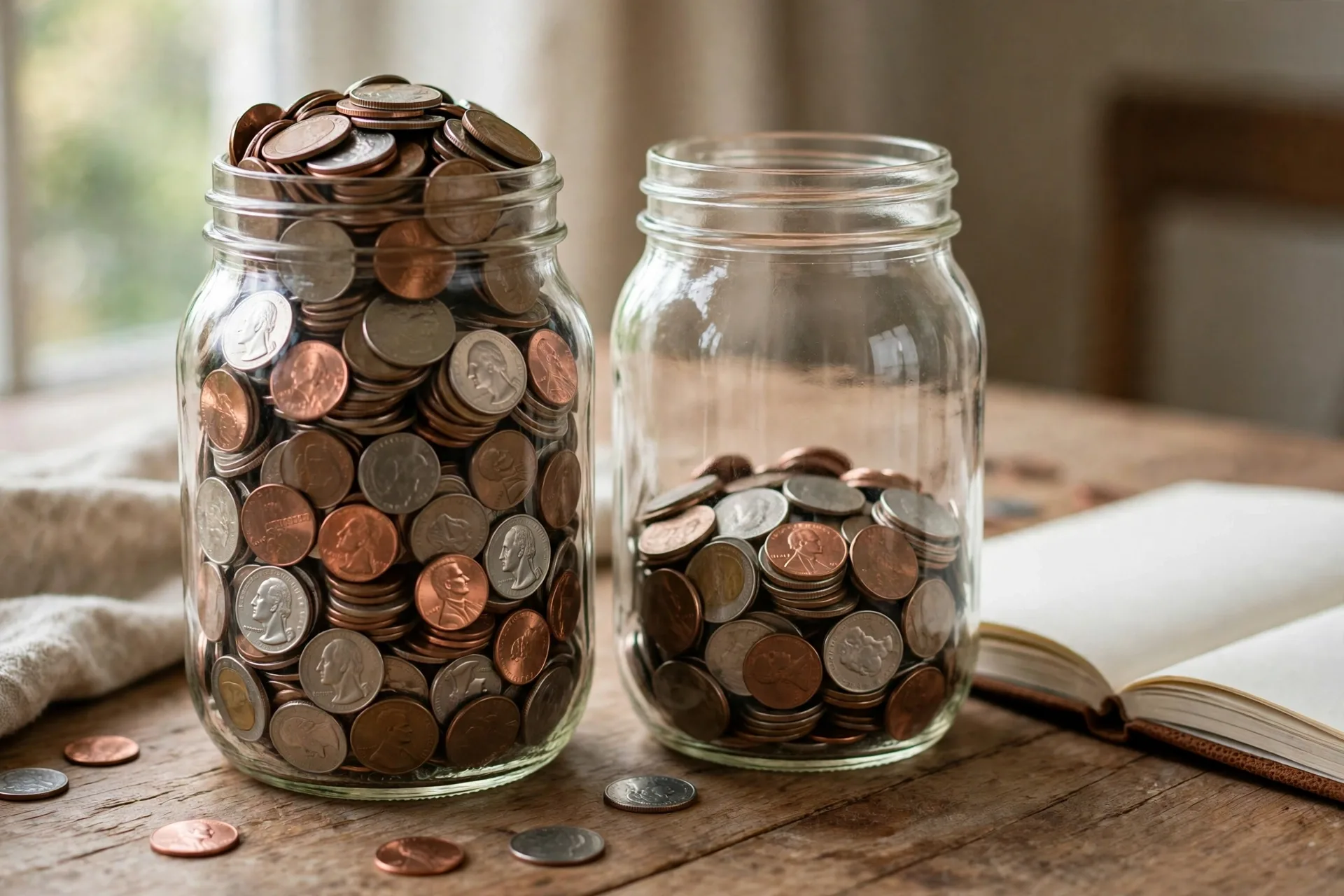
Compounding frequency is the number of times per year that interest joins the balance, and common frequencies are annual (1 time), semiannual (2 times), quarterly (4 times), monthly (12 times), and daily (365 times). More frequent compounding gives a slightly higher final balance at the same stated rate, since interest starts earning interest sooner.
The table below shows the effect of frequency on a $10,000 deposit at 2.3% per year for 1 year.
| Compounding frequency | Periods per year | Final balance after 1 year |
|---|---|---|
| Annual | 1 | $10,230.00 |
| Monthly | 12 | $10,232.35 |
| Daily | 365 | $10,232.66 |
Frequency matters less than rate and time in a 1-year example, since the gap between annual and daily compounding is only $2.66 on $10,000. Over 30 years the gap compounds again in later years. Annual Percentage Yield (APY) states the yearly return after compounding frequency is included, so compare APY across savings accounts.
Real Example 1: What Does $100 Per Month Grow To?
A $100 monthly contribution at 7% per year, compounded monthly, grows to $121,997 in 30 years, from $36,000 in contributions plus $85,997 in growth. The contribution total is $100 times 360 months, which is $36,000, and growth supplies more than double the contribution total.
This example uses an assumed 7% annual return, compounded monthly, with no fees, no taxes, and no missed months. Real returns vary year by year. Early years add mostly contributions, and later years add mostly growth.
The same $100 per month for 10 years at 7% per year reaches about $17,308, while the same $100 per month for 20 years reaches about $52,093. The 30-year total of $121,997 is 7 times the 10-year total, even though contributions only triple from $12,000 to $36,000.

Readers who want a monthly amount plan can read our guide on how much to invest per month for a percentage plan by income and age.
Real Example 2: Why Does Starting 10 Years Earlier Matter So Much?
Starting 10 years earlier matters so much because the extra 10 years give compound interest 120 more monthly periods, and a 25-year-old who invests $100 per month at 7% per year reaches $262,481 by age 65, while a 35-year-old who invests the same $100 per month reaches $121,997 by age 65. The 25-year-old contributes $48,000 and the 35-year-old contributes $36,000, so a $12,000 contribution gap turns into a $140,484 balance gap.
The table below shows both paths at 7% per year, compounded monthly, with no fees and no taxes.
| Start age | Monthly amount | Months to age 65 | Total contributions | Balance at age 65 |
|---|---|---|---|---|
| 25 | $100 | 480 | $48,000 | $262,481 |
| 35 | $100 | 360 | $36,000 | $121,997 |
A late start still beats no start: the 35-year-old turns $36,000 into $121,997. A 35-year-old who invests $200 per month at 7% per year reaches $243,994 by age 65. Start with the amount you can keep, then raise the amount when pay rises.

What Is the Rule of 72?
The Rule of 72 is a shortcut that estimates doubling time by dividing 72 by the annual rate, so money at 7% per year doubles in about 10.3 years, money at 6% per year doubles in 12 years, and money at 8% per year doubles in 9 years. The Rule of 72 gives an estimate, not an exact answer, and the exact doubling time at 7% per year is 10.24 years.
To use the Rule of 72, divide 72 by the rate as a whole number, not as a decimal. A 6% rate gives 72 divided by 6, which is 12 years. A 9% rate gives 72 divided by 9, which is 8 years. The shortcut works best for rates between 6% and 10% per year. Use the full formula for a plan that needs exact numbers.
The Rule of 72 also shows the cost of waiting. Money that doubles 4 times grows to 16 times the starting amount, since 2 times 2 times 2 times 2 equals 16. A 25-year-old with 40 years to age 65 gets about 4 doubling periods at 7% per year, while a 45-year-old with 20 years gets about 2 doubling periods at the same rate.
When Does Compound Interest Work Against You?
Compound interest works against you when unpaid interest joins a debt balance, since later interest charges use the larger balance and the debt grows faster than the original loan amount suggests. Credit card debt shows this pattern most clearly, since unpaid interest joins the balance each month and the next month charges interest on the new balance.
A $1,000 credit card balance at 24% per year, with no payments and no new purchases, grows far faster than a savings balance at 4% per year, since the rate is 6 times higher and compounding runs monthly. Paying only the minimum keeps the balance high, so interest charges stay high. A payoff plan that pays more than the interest charge each month cuts the balance, and each cut lowers the next interest charge.
From my own routine, I check my investment account on the first Saturday of each month, and I check any debt balance in the same review, so a rising debt balance never sits unnoticed for months. Readers who want a debt payoff comparison can read our guide on snowball vs avalanche for real numbers on both methods. Find more money guides on Savvy Cash Flow.

What Mistakes Lower Compound Interest Results?
The 5 mistakes that lower compound interest results are waiting for a large start, stopping contributions during a market drop, paying high fees, withdrawing growth early, and investing money needed soon. Each mistake cuts time, rate, or balance, and compound interest needs all 3 to work.
- Waiting for a large start. A $25 monthly start at age 25 beats a $0 plan that waits for a $5,000 start at age 30.
- Stopping contributions during a market drop. A drop lets the same dollars buy more shares, and stopping removes that gain.
- Paying high fees. A 1.00% fee on a $10,000 balance costs $100 per year, while a 0.03% fee costs $3 per year, and the fee gap compounds.
- Withdrawing growth early. A withdrawal cuts the balance that earns interest in every later period.
- Investing money needed soon. Money needed within 3 to 5 years belongs in savings, since a 20% market drop right before the need turns a plan into a problem.
How Do You Use Compound Interest in Your Own Plan?
To use compound interest in your own plan, set a monthly amount, open the right account, automate the transfer for payday, reinvest dividends, keep fees under 0.10% per year on broad funds, and review the plan once or twice a year. The plan needs 6 steps, and each step takes under 30 minutes except the account opening.
- Pick a monthly amount you can keep in a bad month, such as $50 or $100.
- Open a retirement account or a brokerage account that offers automatic investing.
- Set a recurring transfer for the day after payday.
- Turn on dividend reinvestment, so dividend cash buys more shares.
- Pick one broad low-cost fund with a fee under 0.10% per year.
- Review the plan once or twice a year, and raise the amount by $25 with each pay raise.
A plan that runs for 30 years beats a larger plan that stops in 3 years. Compound interest rewards a plan that stays in place, since each year adds interest to a larger balance than the year before it.
Frequently Asked Questions
What is compound interest in simple terms?
Compound interest is interest earned on the original amount plus interest earned in earlier periods. A $1,000 deposit at 7% per year earns $70.00 in year 1, then earns 7% on $1,070.00 in year 2, so the interest amount rises each year while the rate stays the same.
How much does $1,000 grow with compound interest in 10 years?
A $1,000 deposit at 7% per year, compounded annually, grows to $1,967.15 in 10 years. The same $1,000 at 5% per year grows to $1,628.89 in 10 years, and the same $1,000 at 10% per year grows to $2,593.74 in 10 years with annual compounding.
Is compound interest better than simple interest?
Yes, compound interest gives a higher final balance than simple interest at the same rate and time, since compound interest earns interest on past interest. The gap is small in 1 year and large in 30 years, as the $10,000 example at 7% per year shows with $76,122.55 versus $31,000.00.
How often is compound interest calculated?
Compound interest is calculated at the frequency stated in the account terms, and common frequencies are annual, quarterly, monthly, and daily. Monthly compounding is common for savings accounts and loans, while investment returns compound when dividends reinvest and share prices change over time.
Can compound interest make you rich?
No, compound interest alone does not guarantee wealth, since results depend on the amount contributed, the rate earned, the time invested, and the fees paid. Compound interest turns steady contributions over decades into large balances in illustrative examples, but real returns vary and no rate is guaranteed.
What is the best way to use compound interest?
The best way to use compound interest is to start early, contribute each month, automate the transfer, reinvest dividends, and keep fees low. A $100 monthly plan at 7% per year reaches $121,997 in 30 years in an illustrative example, and raising the amount with each pay raise lifts the final balance further.
Conclusion
Compound interest explained in full: compound interest turns time, rate, and regular contributions into growth, since each period adds interest to a larger balance than the period before it. A $1,000 deposit at 7% per year reaches $1,967.15 in 10 years, a $100 monthly plan at 7% per year reaches $121,997 in 30 years, and a 10-year head start adds $140,484 to the same $100 monthly plan by age 65.
Start with the amount you can keep, automate it for payday, reinvest dividends, keep fees low, and let time do the work that a single deposit cannot do alone. Compound interest rewards patience in plain numbers, and the first step is a monthly amount that runs without a monthly decision.