


Introduction
Crypto mistakes beginners should avoid are the 10 costly errors in this guide: buying on hype, skipping research, risking money you need, going all in at one price, fake diversification, ignored fees, unprotected seed phrases, wrong addresses, keeping everything on one exchange, and forgotten taxes. Each mistake has a plain fix that takes minutes, and together the fixes form a simple safety routine any beginner can follow before the first buy.
Crypto moves fast, and most losses come from speed, not bad luck. Prices swing 10 percent in a day, social feeds push hot coins every hour, and one wrong click can send money to an address you do not control. This guide covers 10 mistakes in plain order, shows what each one costs in real dollars, and gives a fix you can use today. You also get a comparison table, a 7-step safety routine, recovery steps for mistakes already made, and answers to the questions beginners ask most.
Key Takeaways
- Most crypto losses come from behavior, not bad coin picks: FOMO buying, panic selling, and rushed clicks cost more than market drops.
- Only invest money you could watch fall 70 percent without changing your life, and never fund crypto with rent money, emergency savings, or borrowed cash.
- A seed phrase on paper, a test transaction before every transfer, and two-factor authentication block the losses that wipe out whole balances.
- Fees hide in the simple buy button, card payments, and high slippage, so check the full cost before every order.
- Keep tax records from day one, because the IRS treats crypto as property and every swap can create a taxable event.
What Are Crypto Mistakes Beginners Should Avoid?
Crypto mistakes beginners should avoid are the common errors new buyers make with timing, research, position size, fees, security, and taxes. A crypto mistake is an avoidable error that costs money, time, or access to funds, and beginners repeat the same 10 mistakes because crypto rewards patience but tempts people with speed.
Cryptocurrency is a type of digital asset that uses blockchain technology to enable secure transactions, and the same design that makes it open and fast also makes errors permanent. There is no bank to call, no chargeback, and no password reset for a lost seed phrase. That is why the first skill in crypto is not picking coins, it is avoiding errors. Browse the full set of Cryptocurrency guides on Savvy Cash Flow for the basics that pair with this guide, including wallets, buying steps, and scam checks.
A Pew Research Center survey from 2024 found that 63 percent of adults in the United States have little to no confidence in current ways to invest in, trade, or use cryptocurrencies, while 17 percent had directly interacted with crypto. Source: Pew Research Center (2024). Low confidence is fair, because the risks are real, but the risks shrink fast when you follow rules instead of feelings. The 10 mistakes below fall into 4 groups: emotional mistakes, planning mistakes, portfolio mistakes, and safety mistakes.
Mistake 1: Buying on Hype and FOMO
Buying on hype means buying a coin because its price is rising fast and everyone online talks about it, and the fix is a 48-hour wait plus a written reason to own it. Fear of missing out (FOMO) is the urge to buy because prices are rising and others seem to be profiting, and it pushes beginners to buy at the top of a move.
A rally that makes headlines has usually already happened. The late buyer takes on the most downside with the least upside left, and when the attention fades, the price often falls faster than it rose. Morningstar research found that the average dollar in United States funds earned about 1.2 percentage points a year less than the funds themselves over the decade to 2024, because investors bought after gains and sold after drops. Source: Morningstar (2024). Crypto is far more volatile than a typical fund, so the cost of bad timing tends to be larger, not smaller.
Fix it with 2 rules. First, write down why you want to own the coin before you buy, in one sentence. Second, wait 48 hours after a big price jump, then check whether the reason still holds. If the only reason is “it keeps going up,” skip the buy.

Mistake 2: Skipping Your Own Research
Skipping research means buying a coin you cannot explain in one sentence, and the fix is a 10-minute check of what the project does, who built it, and how the token works. Do Your Own Research (DYOR) is the rule that you read about a project yourself before you invest, instead of trusting a post, a video, or a friend.
A coin with no real users, no clear use, and a team that hides behind nicknames is a gamble, not an investment. Read the project whitepaper, which is the document that explains what the project does and how the token works. Check the team page, the public code, and the holder list. If most tokens sit in a few wallets tied to insiders, treat that as a warning sign.
Fix it with 3 questions before every buy: What problem does this project solve? Who uses it today? How does the token earn or hold value? If you cannot answer all 3, the coin stays off your list until you can.
Mistake 3: Investing More Than You Can Afford to Lose
Investing more than you can afford to lose means putting rent money, emergency savings, or borrowed cash into crypto, and the fix is a hard cap set before you buy. A safe crypto budget is money you would not need for several years and could watch fall 70 percent without real harm.
Bitcoin fell about 77 percent from its November 2021 peak to its 2022 low, according to historical price data. Source: CoinGecko (2022). Assets that later recovered still ruined buyers who needed the cash during the drop. A 70 percent fall turns a 1,000 dollar position into 300 dollars, and that loss only hurts if the 1,000 dollars had a job, like rent or a car repair.
Fix it with a number, not a feeling. Decide your total crypto budget as a small share of your savings, keep your emergency fund in a separate savings account, and never use a credit card or a loan to buy crypto. New to buying? Read How to Buy Your First Crypto Safely in 5 Steps before your first order.
Mistake 4: Going All In at One Price
Going all in at one price means putting your full budget into crypto in a single order, and the fix is dollar-cost averaging (DCA), which spreads buys over time. Dollar-cost averaging (DCA) is a method that invests a fixed amount at regular intervals, regardless of price, so you buy more units when prices are low and fewer when prices are high.
One lump buy makes your result depend on a single moment. If that moment is a local top, you start deep in the red and need a long climb just to break even. A 200 dollar monthly buy over 5 months costs the same 1,000 dollars, but it removes the pressure to time the market, and it turns a price drop into cheaper units instead of a loss.
Fix it with a schedule. Pick an amount, pick a day each month, and let the schedule run. DCA does not guarantee a profit, but it removes the single worst timing error a beginner can make.
Mistake 5: Treating Many Small Coins as Diversification
Owning many small coins is not real diversification, and the fix is a core of larger, established coins plus small extras only where you have a clear reason. Real diversification is holding assets that play different roles in a portfolio, not a long list of small, similar coins.
Most crypto assets rise and fall together, especially in sharp sell-offs, so 15 small altcoins can behave like one very risky position. An altcoin is a cryptocurrency other than Bitcoin, and most altcoins share the same market risk, the same liquidity risk, and the same dependence on Bitcoin price moves. A portfolio of 15 similar coins gives the feeling of safety without the fact of safety.
Fix it with a core and satellite shape: a core of 1 to 3 larger, established coins, plus small positions only when you can state the reason for each one. Review the list every quarter and cut any coin whose reason no longer holds.
Mistake 6: Ignoring Fees, Spreads, and Slippage
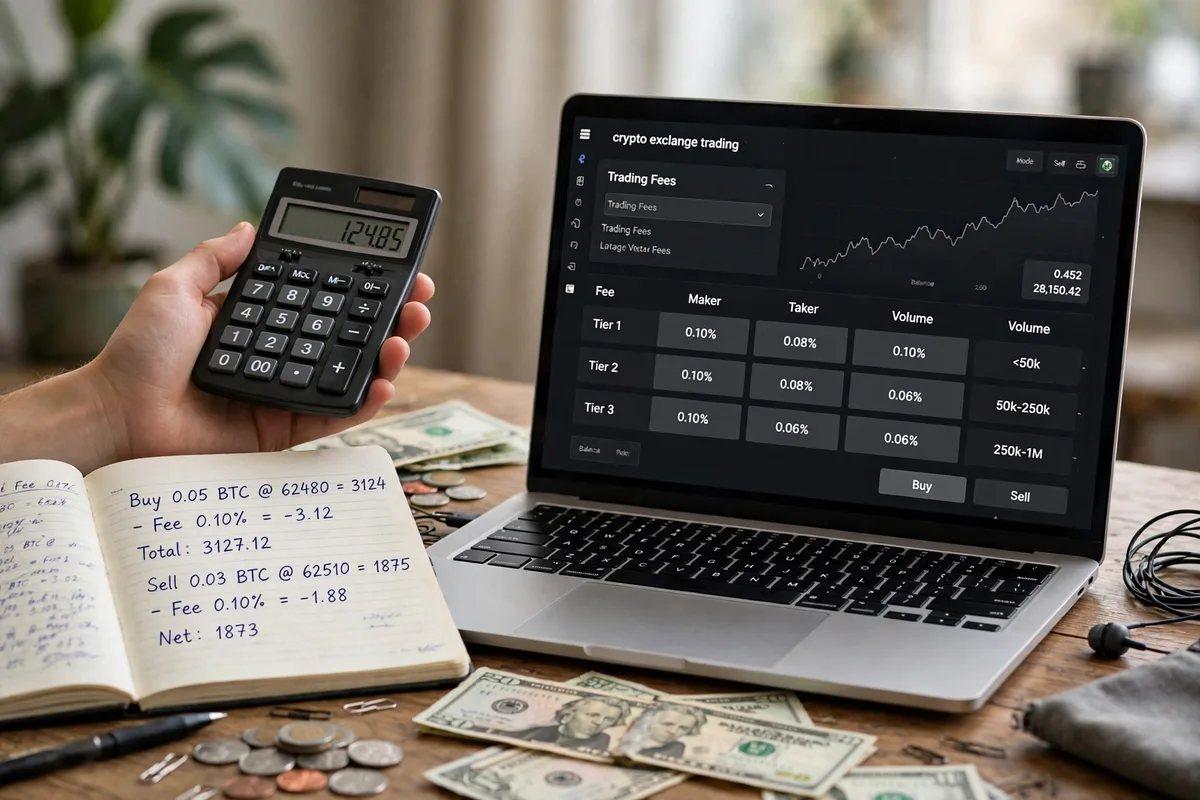
Ignoring fees means paying more than you think on every trade, and the fix is to check the full cost, including spread and slippage, before you confirm any order. A spread is the gap between the buy price and the sell price on a platform, and slippage is the gap between the price you expect and the price you actually get when an order fills.
The simple buy button on many exchanges costs up to 10 times more than the advanced trading view for the same asset, and card purchases add fees of several percent on top. A 100 dollar card buy can lose 4 to 5 dollars to fees before the coin even moves, and a 20 percent slippage setting on a swap tells trading bots exactly how much they can take from your order. Frequent trading adds exchange fees on every move, so a busy beginner can pay hundreds of dollars a year in fees alone.
Fix it with 3 checks: use a bank transfer instead of a card, use the advanced trading view instead of the simple buy button, and keep slippage at 1 percent or less unless the trade truly needs more. When I compared the simple buy screen with the advanced view on my first exchange, the fee gap was so large that I moved every later order to the advanced view, and that one change still saves me money on each buy.
Mistake 7: Leaving Your Seed Phrase Unprotected
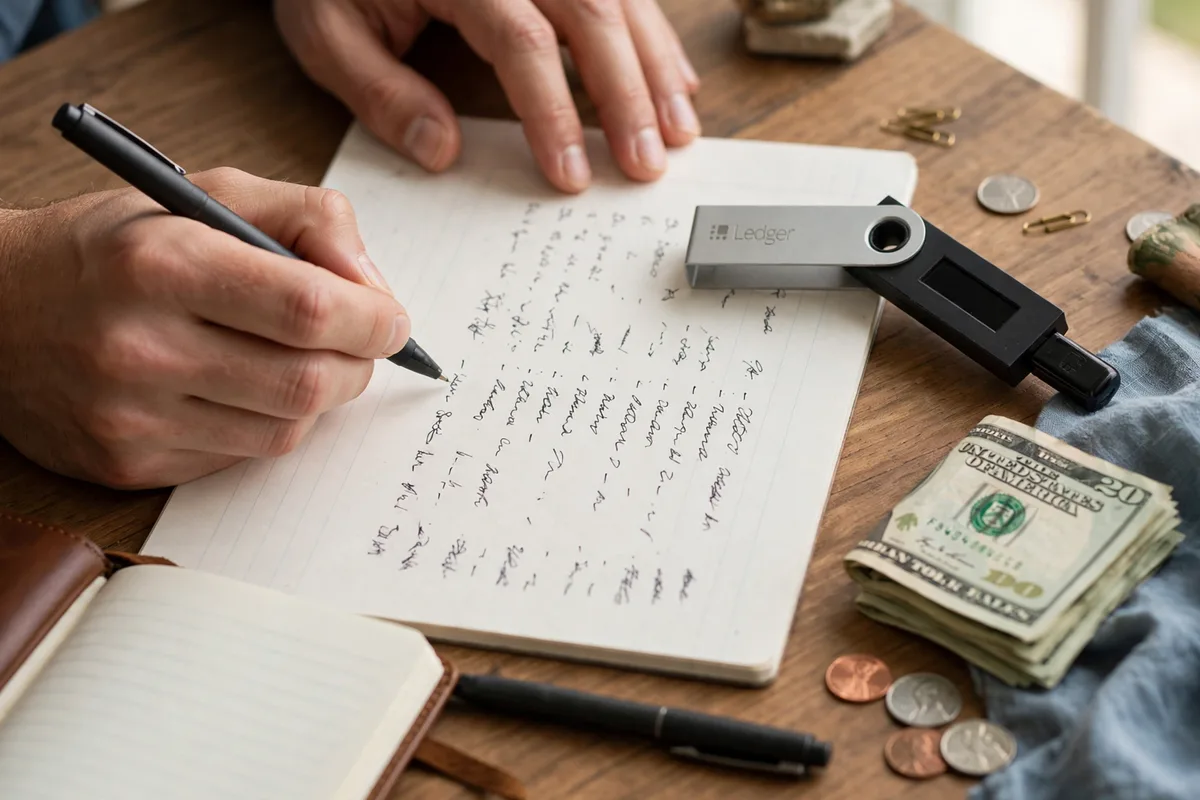
Leaving your seed phrase unprotected means storing the 12-word or 24-word recovery phrase on a phone, in an email, or in a photo, and the fix is paper or metal backup in 2 separate safe places. A seed phrase is a list of words that gives full access to a crypto wallet, and anyone who reads those words can move every coin in the wallet.
Beginners lose whole balances this way: they screenshot the phrase, save it in cloud notes, or type it into a fake support form. No one should ever ask you for your seed phrase, not support staff, not a project founder, and not a moderator. Every unsolicited message that asks for it is an attack, and every site that asks you to type it in is a fake.
Fix it in 5 minutes: write the words on paper before you deposit anything, store the paper in a safe place, and keep a second copy somewhere else. Use a hardware wallet for long-term holdings, turn on two-factor authentication on every exchange account, and read the hot vs cold crypto wallets guide to pick the right wallet type for your amount.
Mistake 8: Sending Crypto to the Wrong Address or Network
Sending crypto to the wrong address or network means the coins land in a wallet you do not control, and the fix is a small test transaction before every first transfer. A blockchain transaction is permanent, and once coins leave your wallet, no bank and no support team can pull them back.
Ethereum, Base, Arbitrum, and Polygon all use the same address format, so withdrawing to a Base address while selecting the Ethereum network sends funds somewhere you may not control. A single wrong character in a pasted address has the same result. The cost is the full amount sent, whether that is 20 dollars or 20,000 dollars.
Fix it with the test transaction habit: send a small amount first, confirm it arrives, then send the rest. It costs pennies in fees and it blocks the most expensive category of error there is. Always check the first 4 and last 4 characters of the address against the source, and never type an address by hand.
Mistake 9: Keeping Everything on One Exchange
Keeping everything on one exchange means your full balance is a claim on one company, and the fix is to move long-term holdings to a wallet you control. An exchange account holds your coins for you, but if the exchange halts withdrawals, fails, or gets hacked, your balance is stuck inside a company you do not control.
Exchanges have failed while looking perfectly healthy, and the FTX collapse in November 2022 showed that even a large, famous platform can lock up customer funds overnight. Hot wallets suit small amounts and frequent use, because they stay connected to the internet for fast trades. Cold wallets suit larger amounts and long-term holding, because they keep private keys offline.
Fix it with a split: keep a small trading amount on the exchange, and move the rest to your own wallet. That split caps the damage if any single platform has a bad day. For the scam side of the same risk, read the guide on how to avoid crypto scams before you trust any new platform with a deposit.
Mistake 10: Forgetting Taxes and Records
Forgetting taxes means treating crypto trades as tax-free, and the fix is a simple record of every buy, sell, swap, and fee from day one. The IRS treats crypto as property, not currency, so selling, swapping, or spending it can create a capital gain or loss, even when no dollars change hands.
Swapping one token for another is a taxable event in the United States, and the IRS requires records that show the date, the amount, and the fair market value in dollars for each transaction. Brokers must report gross proceeds on Form 1099-DA for transactions on or after January 1, 2025, and basis reporting starts for certain transactions on or after January 1, 2026. Source: IRS (2026). Rebuilding a year of swaps across 4 chains from memory is slow and painful, and most beginners only learn that at tax time.
Fix it with a 2-minute habit: log each trade in a spreadsheet on the same day, with date, coin, amount, price, and fee, or use a crypto tax tool that pulls your exchange history. The IRS digital assets page explains how the IRS treats digital assets and which forms apply to each type of transaction.
Crypto Mistakes vs Smart Habits: A Quick Comparison
The table below pairs each of the 10 crypto mistakes with the smart habit that replaces it, so you can check your own setup in one pass.
| Mistake | What it costs | Smart habit |
|---|---|---|
| Buying on hype and FOMO | Buying at the top of a move | 48-hour wait plus a written reason |
| Skipping your own research | Buying a coin with no real use | 3-question check before every buy |
| Risking money you need | Losses that hit rent or bills | Hard cap, emergency fund kept separate |
| Going all in at one price | Full loss if the top was the entry | Dollar-cost averaging on a schedule |
| Many small coins as diversification | One risky position in disguise | Core of large coins plus small extras |
| Ignoring fees and slippage | 4 to 10 percent lost per order | Bank transfer, advanced view, low slippage |
| Unprotected seed phrase | Whole balance stolen at once | Paper backup in 2 places, 2FA on |
| Wrong address or network | Full amount sent, unrecoverable | Test transaction before every transfer |
| Everything on one exchange | Balance frozen if the platform fails | Long-term holdings in your own wallet |
| Forgetting taxes and records | Tax bill plus a rebuild of records | Same-day trade log or tax tool |
How Do You Build a Beginner Crypto Safety Routine?
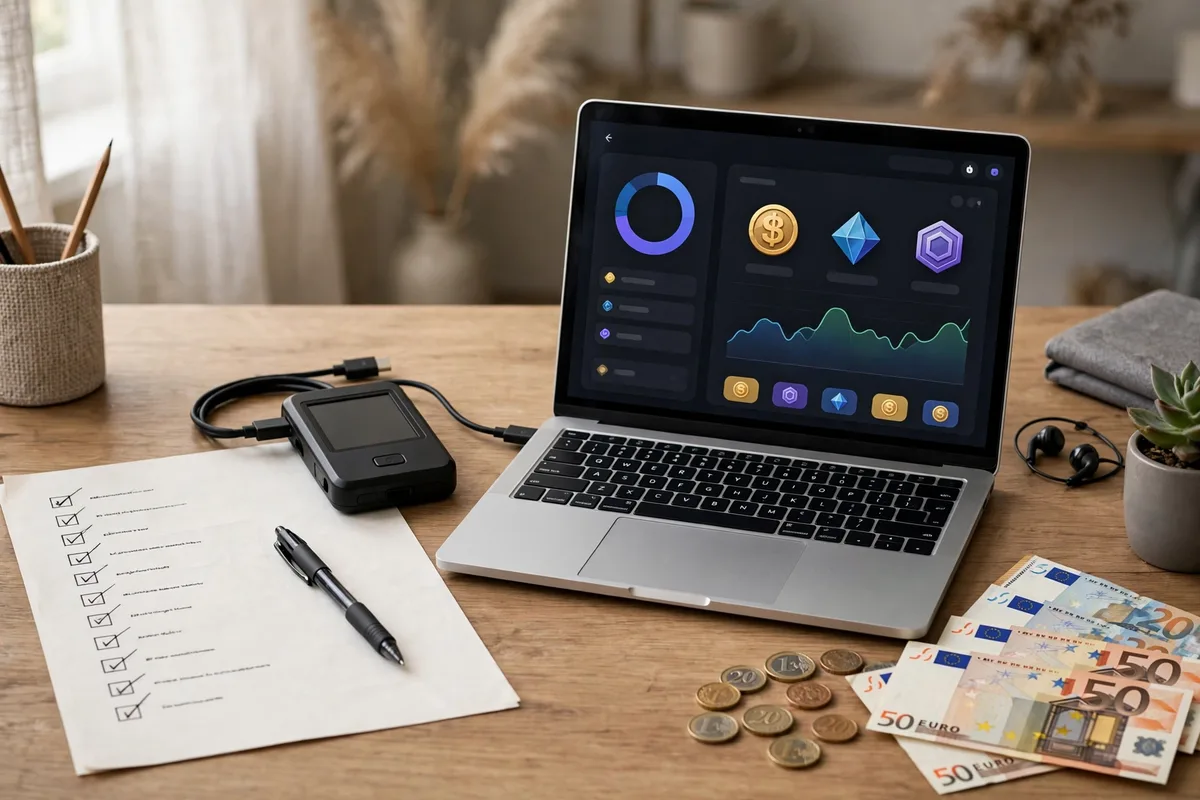
A beginner crypto safety routine is a 7-step checklist you run before every buy and every transfer, and it takes about 10 minutes the first time and 2 minutes after that.
- Write your plan: set your budget, your buy schedule, and your response to a 50 percent drop.
- Check the coin: answer the 3 research questions and skip any coin that fails one.
- Check the fee: compare the simple buy price with the advanced view and pick the cheaper route.
- Check the address: confirm the first 4 and last 4 characters before you send anything.
- Send a test transaction: move a small amount first, confirm it arrives, then send the rest.
- Back up the seed phrase: write it on paper, store it in 2 safe places, and never share it.
- Log the trade: record the date, coin, amount, price, and fee on the same day.
Run the list in order until it feels automatic. A calm system beats a fast system in crypto, because most errors are speed errors: someone was in a hurry, skipped a step, and paid for it.
What Should You Do If You Already Made One of These Mistakes?
If you already made one of these mistakes, stop, secure what is left, and fix the cause before you make another trade. A mistake you catch early costs far less than the same mistake repeated with a larger amount.
If funds went to a wrong address, treat them as settled in most cases, because blockchain transfers do not reverse. If the transfer went to an exchange deposit address on the wrong network, contact that exchange support team, because some platforms recover it for a fee and many cannot. If you suspect your seed phrase leaked, move everything to a brand new wallet at once and treat the old wallet as permanently unsafe.
If you bought on hype and the price fell, do not panic sell on the same day. Review the written reason you had for the buy, check whether it still holds, and decide from the plan, not from the red chart. If fees ate your first trades, switch to bank transfers and the advanced trading view before your next order. Every beginner makes at least 2 of these mistakes, and the difference is that experienced buyers made them with 20 dollars rather than 20,000 dollars.
Conclusion
Crypto mistakes beginners should avoid come down to 3 rules: plan before you buy, check before you send, and record before you forget. A written plan blocks FOMO and panic selling. A test transaction blocks wrong addresses and wrong networks. A paper seed phrase backup and a wallet you control block the thefts that wipe out whole balances.
Start small, start slow, and let the routine do the work. Pick one fix from this guide today, such as the seed phrase backup or the test transaction habit, and add the next fix with each new buy. Savvy Cash Flow covers crypto basics in plain language, and the guides linked in this article walk you through buying, wallets, scams, and taxes step by step.
Frequently Asked Questions
What is the biggest mistake new crypto investors make?
The biggest mistake is letting emotion drive timing. New investors buy after a big rally and sell after a sharp drop, which locks in losses and misses recoveries. A written plan and a regular buying schedule help prevent it, and a 48-hour wait before hype buys removes most of the urge.
How much money should a beginner put into crypto?
A beginner should only put in money they would not need for several years and could watch fall 70 percent without real harm. For many beginners, that is a small share of total savings. Build the position slowly with dollar-cost averaging, and keep an emergency fund outside crypto.
Should I sell my crypto when the market crashes?
No, not by default. Selling in a crash turns a temporary loss into a permanent one, and some of the best recovery days often come soon after the worst days. Decide in advance what you will do in a big drop, such as holding, rebalancing, or pausing new buys.
How do I keep my crypto safe as a beginner?
Keep crypto safe with 3 steps: a hardware wallet for long-term holdings, a paper backup of the seed phrase in 2 safe places, and two-factor authentication on every account. Never share the seed phrase, never click links in unsolicited messages, and send a test transaction before every first transfer.
Are crypto losses tax deductible?
Yes, capital losses from crypto can offset capital gains and, within limits, other income, under United States tax rules. The IRS treats crypto as property, so a sale, swap, or spend creates a gain or loss. Keep records of every transaction, because the loss only counts if you can show the date, amount, and basis.
Is crypto a good investment for beginners?
Crypto can fit a small part of a beginner portfolio, but only as a high-risk slice with money you can afford to lose. It suits patient buyers with a written plan, a small position size, and secure storage. It does not suit money needed for rent, bills, or an emergency fund.