

Last updated: October 2026
Written by Emma for Savvy Cash Flow.
To start a cleaning business from scratch, pick one cleaning niche, register the business, buy general liability insurance and a janitorial bond, buy a starter kit, set prices from true costs, and win 3 trial clients before you hire staff.
A cleaning business is a paid service that cleans homes, offices, or rental properties for clients who pay per visit, per package, or per contract. This guide covers what a cleaning business is, startup costs, niches, licenses and insurance, pricing, equipment, first clients, hiring, profit mistakes, and a 90-day launch plan. Readers also get a startup cost table, a residential compared with commercial table, a pricing table, and answers to 6 common questions about how to start a cleaning business from scratch.
Key Takeaways
- Start with one niche, one service area, and 3 core services, not a full service menu.
- A lean solo cleaning business starts for $500 to $2,000 in this guide.
- Residential cleaning pays on the visit day, while commercial cleaning pays on net-30 or net-60 terms.
- Prices must cover work time, drive time, supplies, insurance, taxes, and a profit margin.
- A checklist, a cancellation rule, and a 25 percent tax set-aside protect profit from day 1.
- Trial clients, reviews, and referrals fill the first schedule fast.
Table of Contents
- What Is a Cleaning Business?
- Is a Cleaning Business Worth Starting?
- How Much Does It Cost to Start a Cleaning Business?
- Which Cleaning Niche Should You Pick First?
- What Licenses and Insurance Does a Cleaning Business Need?
- How Do You Price Cleaning Services?
- What Equipment and Supplies Do You Need?
- How Do You Get Your First 10 Clients?
- When Should You Hire Your First Cleaner?
- What Mistakes Cut Cleaning Business Profits?
- Your First 90 Days: A Simple Launch Plan
- Conclusion
- FAQs
What Is a Cleaning Business?
A cleaning business is a service business that cleans homes, offices, or rental properties for a set fee, and the cleaning business sends cleaners to a client site, cleans rooms and surfaces to a written checklist, and collects payment per visit, per package, or per contract.
A cleaning business sells time, reliability, and trust, because clients pay for clean rooms, not for cleaning products. A residential cleaning business cleans private homes and apartments, including kitchens, bathrooms, bedrooms, and living rooms. A commercial cleaning business cleans offices, shops, and clinics to a contract with set visit days and set tasks. You can read how housekeeping tasks cover dusting, vacuuming, mopping, and disinfecting surfaces.
Browse the Business Ideas & Side Hustles guides to compare a cleaning business with other low-cost service businesses.
Is a Cleaning Business Worth Starting?
Yes, a cleaning business is worth starting for a beginner who wants low startup costs, repeat local clients, and a business that can start solo, because a cleaning business needs no shop rent at launch, no large stock order, and no degree, while demand for home and office cleaning stays steady in most towns.
A cleaning business works when the owner can do physical work for 3 to 6 hours per day, follow a checklist with care on every visit, and ask happy clients for reviews and referrals on delivery day. A cleaning business fails as a plan when prices stay too low, routes spread across town, or clients pay late and costs fall due first.
How Much Does It Cost to Start a Cleaning Business?
A cleaning business costs $500 to $2,000 to start as a lean solo operation and $5,000 or more to start with a team, a vehicle setup, and commercial equipment, and the lean start range covers supplies, insurance, bonding, registration, and launch marketing in the planning ranges in this guide.
A lean start uses gear you own plus a starter kit, a city business license where the city requires one, general liability insurance, and a janitorial bond. A team start adds hiring, payroll software, a work vehicle setup, and commercial floor equipment. Residential clients pay on the visit day in most cases, while commercial clients pay later, so a commercial start needs a cash reserve.
| Startup cost item | Lean solo range | Team start range |
|---|---|---|
| Supplies and equipment | $200 to $500 | $1,000 to $3,000 |
| Insurance and bonding, year 1 | $200 to $800 | $800 to $2,000 |
| Registration and licenses | $50 to $300 | $200 to $600 |
| Website, cards, and launch marketing | $0 to $300 | $300 to $1,000 |
| Software, year 1 | $0 to $100 | $300 to $1,200 |
| Total startup cost | $500 to $2,000 | $2,600 to $7,800 |
Which Cleaning Niche Should You Pick First?
To pick a first cleaning niche, choose residential cleaning for fast first clients and same-day pay, choose commercial cleaning for larger contracts and set schedules, or choose one specialty niche for premium prices, and start with one niche only until 10 weekly clients fill the schedule.
Residential cleaning fits most beginners, because neighbours, local groups, and referrals produce the first bookings in weeks, not months, and residential cleaning needs light equipment only. Commercial cleaning fits an owner who can wait for payment and sell to property managers. Commercial cleaning pays more per contract and gives set weekly visits, while most managers ask for proof of insurance and bonding before signing.
| Factor | Residential cleaning | Commercial cleaning | Specialty cleaning |
|---|---|---|---|
| First booking speed | 1 to 4 weeks | 4 to 12 weeks | 2 to 6 weeks |
| Payment timing | Same day in most cases | Net-30 or net-60 in most contracts | Same day or weekly |
| Startup cost | Low | Medium to high | Medium |
| Equipment needs | Light kit | Floor machines and bulk supplies | Job-type tools |
| Best first stage | Start and solo growth | Growth after cash reserves exist | Later add-on |
What Licenses and Insurance Does a Cleaning Business Need?
A cleaning business needs a city business license where the city requires one, a registered business name, general liability insurance, a janitorial bond, and workers compensation cover once the cleaning business hires staff, and a cleaning business needs no single federal cleaning license in most cases.
A Limited Liability Company (LLC) is a legal form that separates personal assets from business debts in most states. A sole proprietorship is a form with no legal separation between owner and business. A beginner can start as a sole proprietorship and form a Limited Liability Company (LLC) after clients arrive and income grows. An Employer Identification Number (EIN) is a free federal tax number from the Internal Revenue Service (IRS), and banks ask for an Employer Identification Number (EIN) for a business account, so apply through the IRS online EIN application before opening a business account. Check city and county rules before the first paid job, because license and sales tax rules differ by city and state.
How Do You Price Cleaning Services?
To price cleaning services, add work time cost, drive time cost, supplies cost, fixed cost share, and a profit margin of 20 to 40 percent, then set one package price per job type, and a cleaning business prices packages, not hours, so clients see one clear price per job.
Follow 5 pricing steps for each package:
- Time each job type on 3 real cleans and record hours.
- Add drive time and setup time to work time.
- Add supplies cost per job from actual product use.
- Add a fixed cost share for insurance, software, and marketing.
- Add a profit margin of 20 to 40 percent for a solo operator.
A $150 job that takes 3 hours plus 1 hour of driving pays $37.50 per hour before costs, while the same $150 job with 2 hours of driving pays $30 per hour before costs. Drive time decides hourly income, because drive time pays $0 unless the price covers drive time. A travel fee beyond a set radius and a minimum job price protect hourly income.
| Pricing model | Best use | Strength | Risk |
|---|---|---|---|
| Hourly rate | First cleans and unknown homes | Easy to explain, protects time | Caps income as speed rises |
| Flat rate per job | Repeat cleans and packages | Simple for clients, rewards speed | Needs tight scope control |
| Per square foot | Offices and large spaces | Scales with space size | Needs accurate area and task data |
See how a related service business prices starter work in Car Detailing Business: Is It Profitable?

What Equipment and Supplies Do You Need?
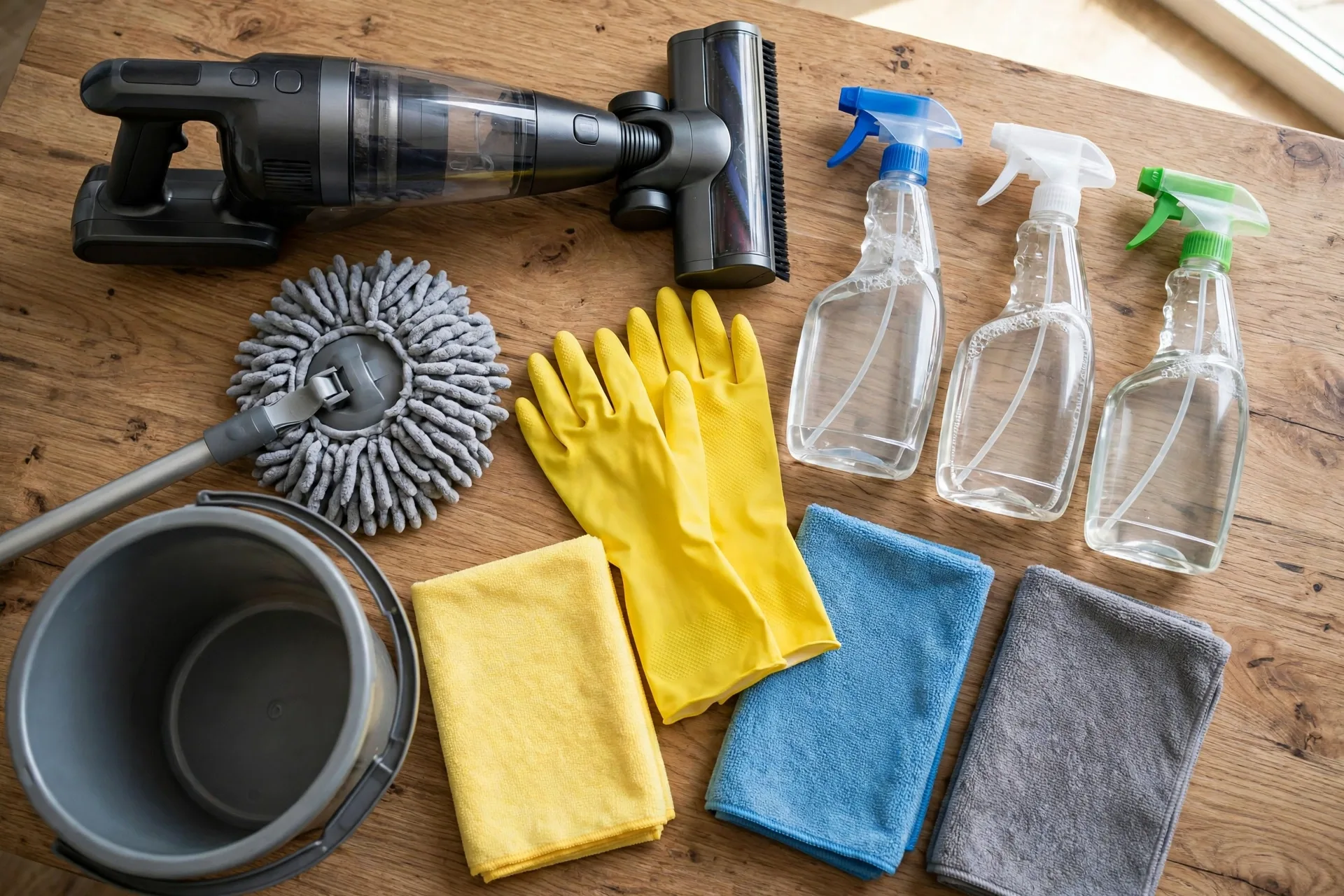
A cleaning business needs a starter kit of an all-purpose cleaner, a disinfectant, a glass cleaner, a bathroom cleaner, microfiber cloths, a mop and bucket, a broom and dustpan, a vacuum with attachments, gloves, and a carrying caddy, and a cleaning business adds commercial equipment only after contracts require commercial equipment.
Buy quality basics first and skip bulk buys before the first 10 clients. Colour-coded cloths stop cross-contamination between bathrooms and kitchens, because one cloth colour serves bathrooms only and one cloth colour serves kitchens only. A vacuum with a HEPA filter suits allergy-sensitive homes. Label every spray bottle, keep Safety Data Sheets for each chemical in one folder, and store chemicals away from food areas in client homes. I timed a trial clean with a checklist at 2 hours 10 minutes and the same rooms without a checklist at 2 hours 45 minutes, so a checklist saved 35 minutes on one trial clean.
How Do You Get Your First 10 Clients?
To get the first 10 cleaning clients, offer 3 trial cleans at an intro price to neighbours and local groups, collect before and after photos with permission, ask each trial client for a review, and turn trial clients into weekly or biweekly packages with a fixed rebooking date.
Savvy Cash Flow readers can use 4 channels in week 1: message 20 personal contacts with one offer, one price, and one start date; post in 2 neighbourhood groups with photos and prices; leave flyers at estate agent offices with staff permission; and set up a Google Business Profile with services, area, and photos. Ask for a review on delivery day, while the clean home sits in front of the client. Read how a related low-cost service wins starter clients in Dog Walking Business: Startup Costs and Earnings.

When Should You Hire Your First Cleaner?
A cleaning business should hire the first cleaner when the owner turns away 3 or more jobs per week, when the wait list holds 5 or more repeat clients, or when one route fills 5 days per week, because hiring before demand exists adds payroll costs with no jobs to fund payroll costs.
Hiring changes the business from a solo job into a team operation, where the owner sells, schedules, checks quality, and handles payroll, while cleaners do the site work. Pay math must come first: the median hourly wage for janitors and cleaners was $17.27 in May 2024 (Source: U.S. Bureau of Labor Statistics, 2024), and payroll taxes, workers compensation cover, travel time, and supplies sit on top of that wage. A hire needs a training plan of 7 to 10 days, a background check before any solo home visit, and a clear rule for keys, alarms, and damage notes. Learn client outreach steps that also work for a cleaning team in How to Start a Freelancing Business From Zero.

What Mistakes Cut Cleaning Business Profits?
The mistakes that cut cleaning business profits are spread-out routes, underpricing, free add-on work, no cancellation rule, and skipped damage photos, and each mistake costs time, cash, or trust even when job count looks high and monthly bookings look strong.
Spread-out routes burn unpaid drive time, so cap the service area at 2 neighbourhoods until 10 weekly clients fill that area. Underpricing traps a cleaner at a full schedule with low pay: a $100 price with $2,000 monthly costs needs 20 jobs per month to cover costs, while a $200 price needs 10 jobs. Free add-on work adds time with $0 pay, so a written add-on price list stops free work at the booking stage. No cancellation rule leaks booked revenue, so a 50 percent same-day cancellation fee and a full fee for a no-show protect the schedule.
Your First 90 Days: A Simple Launch Plan
A simple 90-day launch plan for a cleaning business sets prices and insurance in days 1 to 30, wins 10 weekly clients in days 31 to 60, and fills one tight route with weekly packages in days 61 to 90.
Days 1 to 30 cover setup: pick one niche and one service area, set 3 package prices, buy insurance and bonding, register the name, and buy the starter kit. Book 3 trial cleans in days 21 to 30. Days 31 to 60 cover client growth: message 20 contacts, post in 2 local groups each week, and list on a Google Business Profile. Convert trial cleans into weekly or biweekly packages and target 10 weekly clients by day 60. Days 61 to 90 cover route tightening: drop out-of-area clients or raise out-of-area prices by $10 per visit, then review job times, prices, and costs at day 90.

Conclusion
How to start a cleaning business from scratch comes down to 5 moves: pick one niche, register and insure the business, price from true costs, win trial clients with reviews, and hire only when demand fills the route and the wait list keeps growing.
A cleaning business rewards steady work, clear prices, and honest service terms. Start lean, track every job time, and let repeat clients fund each next step. Set the first 3 trial cleans this week. Visit Savvy Cash Flow for more practical guides on service businesses, budgeting, and side income.
FAQs
Do you need a license to start a cleaning business?
No single federal cleaning license covers a cleaning business in most cases, but most cities or counties require a general business license, and some states add sales tax registration or home-based business rules, so check city and county rules with the city clerk office before the first paid job.
How much does it cost to start a cleaning business from scratch?
A lean solo cleaning business costs $500 to $2,000 to start in the planning ranges in this guide, and the range covers supplies, insurance, bonding, registration, and launch marketing, while a team start with a vehicle setup and commercial equipment costs $5,000 or more.
Can you start a cleaning business with no money?
No, a cleaning business needs some cash for supplies, insurance, and registration, but a lean start can stay near $500 when you own a vacuum and a car, and the first paid jobs can fund better equipment, booking software, and marketing after week 1.
Is a cleaning business profitable?
Yes, a cleaning business is profitable when each job price covers work time, drive time, supplies, insurance, taxes, and a profit margin, and a cleaning business turns unprofitable when prices stay too low, routes spread across town, or commercial clients pay late while payroll falls due.
How much should you charge for house cleaning?
Charge house cleaning from true costs, not from a guess, by adding work time, drive time, supplies, fixed costs, and a profit margin of 20 to 40 percent, then set one flat package price per home size, with a higher price for a first clean and a lower price per visit for repeat cleans.
Do you need an LLC to start a cleaning business?
No, a cleaning business can start as a sole proprietorship, but most owners form a Limited Liability Company (LLC) for liability protection and client trust once bookings grow, and a Limited Liability Company (LLC) separates personal assets from business debts in most states.