


Introduction
What is DeFi? DeFi is a set of financial services that run on public blockchains through smart contracts, with no bank or broker in the middle. You lend, borrow, trade, and earn interest from a crypto wallet, and code enforces the rules instead of a company. DeFi stands for decentralized finance. About $95 billion sat locked in DeFi apps in September 2026 (Source: DefiLlama, 2026). This guide explains what DeFi is, how DeFi works, what you can do with it, what you can earn, the real risks, and how to start safely with small steps. Savvy Cash Flow covers crypto basics in plain English, and this guide follows that same approach: no jargon left undefined, no step skipped.
Key Takeaways
- DeFi is finance run by code: smart contracts replace banks, brokers, and exchanges for lending, borrowing, trading, and earning yield.
- You keep custody: your crypto stays in your wallet, and you approve each transaction yourself.
- Yields run higher than bank rates: stablecoin lending paid about 3.5% to 9% APY in 2026, against a 0.41% US average savings rate (Source: NIFM Academy, 2026).
- There is no safety net: no deposit insurance, no support desk, and no way to reverse a bad transaction.
- Start small and learn first: a $50 test teaches the same steps as a $5,000 deposit, with far less downside.
What Is DeFi in Simple Terms?
Decentralized finance (DeFi) is a financial system that runs on public blockchains and uses smart contracts to provide lending, borrowing, trading, and interest-earning services without a bank, broker, or exchange in the middle. A smart contract is a program stored on a blockchain that runs exactly as written when its conditions are met. DeFi apps are called dApps, short for decentralized applications.
In a bank, the bank holds your money, sets the rate, and approves your loan. In DeFi, you hold your own crypto in a self-custody wallet, and you connect that wallet to a dApp. The smart contract holds the deposit, sets the rate by supply and demand, and settles the trade or loan on its own. No branch, no opening hours, and no application form stand between you and the service.
Most DeFi runs on Ethereum, the blockchain built to run smart contracts. Ethereum held about 55% of all DeFi value in 2026 (Source: DefiLlama, 2026). Other chains such as Solana, BNB Chain, Arbitrum, and Base also host DeFi apps. The idea is the same on every chain: open code replaces the company in the middle. For more beginner crypto guides, browse the Cryptocurrency guides on this site.
Three traits define real DeFi. First, it is non-custodial: no company holds your funds for you. Second, it is permissionless: anyone with an internet connection and a wallet can use it, with no credit check and no approval. Third, it is transparent: the code and every transaction are public, so anyone can check how an app works. Wikipedia defines decentralized finance the same way, as financial services built through smart contracts on a programmable, permissionless blockchain.
How Does DeFi Work?
DeFi works by turning each financial rule into a smart contract that runs on a blockchain, and you use those contracts from your own crypto wallet. You never open an account. You connect a wallet, sign a transaction, and pay a network fee, called gas, to have the blockchain process it.
Here is what happens when you use a DeFi app, step by step:
- Connect a wallet. You link a self-custody wallet such as MetaMask. The app reads your public address and balances. Connecting alone gives the app no control over your funds.
- Pick the action. You choose a swap, a deposit, or a loan, and you enter the amount. The app shows the expected result, the fee, and the rate before you commit.
- Approve and sign. Your wallet asks you to approve the transaction. Your signature authorizes the smart contract to move only the tokens you named.
- The contract runs. The code executes on its own and records the result on the blockchain. A lending deposit starts earning interest at once, and a swap settles in seconds or minutes.
- You stay in control. You can withdraw when the contract allows it. You also carry all the risk, because no company can undo a mistake or refund a loss.
Gas is the fee you pay for every on-chain action. On Ethereum, gas is paid in ETH, and a busy network can push a single swap to $5 or more. Layer 2 networks such as Base and Arbitrum run the same apps with fees of a few cents to a couple of dollars. Beginners who want low fees should start on a Layer 2, not on Ethereum mainnet.
Before you connect a wallet to any DeFi app, read how to store crypto safely.

What Can You Do With DeFi?
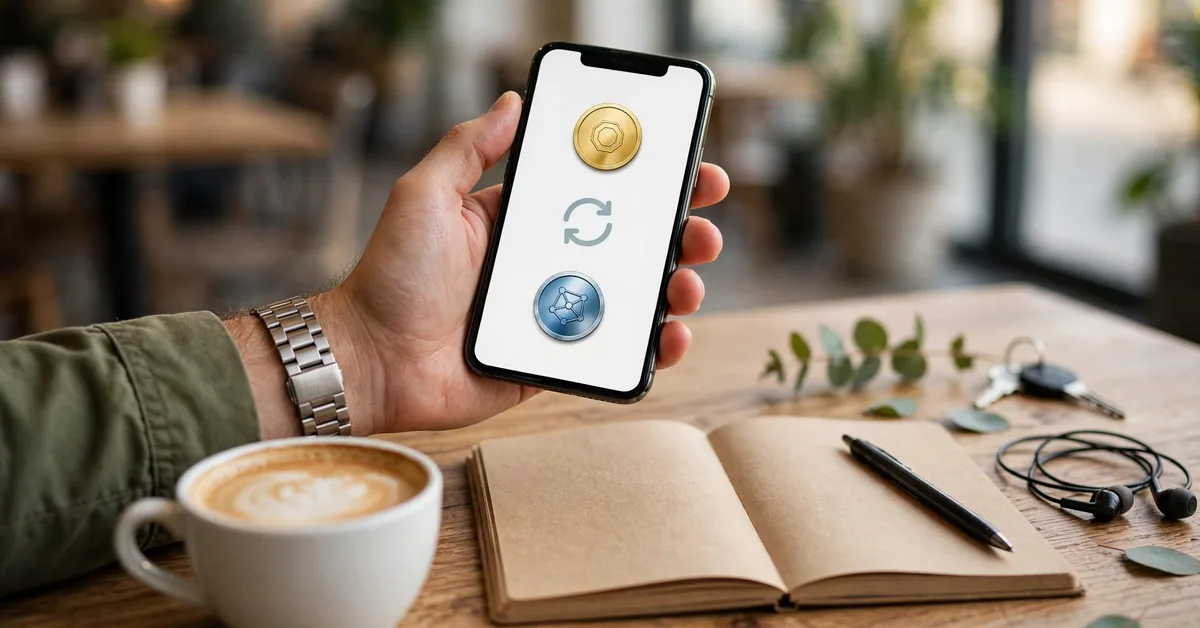
DeFi recreates most bank and brokerage services on-chain, and 5 uses cover nearly everything beginners meet first: trading, lending, borrowing, earning yield, and settling in stablecoins. Each use runs on smart contracts, and each one works 24 hours a day.
Trade on a decentralized exchange (DEX). A DEX lets you swap one token for another straight from your wallet. Uniswap is the largest DEX. Instead of an order book run by a company, a DEX uses liquidity pools, which are pots of two tokens that traders swap against at prices set by a formula. Uniswap alone processed more than $4.7 trillion in total trading volume by October 2026 (Source: Atomic Wallet Academy, 2026).
Lend your crypto and earn interest. You supply tokens to a lending market such as Aave, and borrowers pay you interest. Rates move with demand, so the rate you see today can change tomorrow. Stablecoin lending paid about 3.5% to 9% APY in 2026 (Source: NIFM Academy, 2026).
Borrow against your crypto. You deposit crypto as collateral and borrow a stablecoin against it, without selling your crypto. A typical rule asks for $150 of collateral for each $100 borrowed. If your collateral falls below the required level, the contract sells part of it at once. This automatic sale is called a liquidation, and it has no grace period and no phone call first.
Earn yield in other ways. You can provide liquidity to a DEX pool and earn a share of trading fees. You can also use liquid staking, which lets you stake ETH and receive a token that represents your staked ETH while it keeps earning rewards. Staking itself is a separate topic, and what staking is explains how those rewards work.
Hold and settle in stablecoins. Most DeFi runs on dollar-pegged tokens such as USDC and USDT. Stablecoins are the quiet settlement layer of the whole system, with about $310 billion in supply in 2026 (Source: NIFM Academy, 2026). They let you move in and out of trades without touching a bank.
DeFi vs CeFi: What Is the Difference?
DeFi and CeFi differ in one clear way: DeFi runs on code and your own wallet, while CeFi runs on a company that holds your funds and sets the rules. CeFi means centralized finance: a crypto exchange, a lender, or a fintech app. The table below shows the real differences.
| Factor | DeFi | CeFi (centralized finance) |
|---|---|---|
| Who holds your money | You do, in your own wallet | The company holds it |
| Access | Permissionless, 24/7, global | Account, ID check, business hours |
| Who sets the rules | Smart contract code, public | Company policy, private |
| Typical stablecoin yield (2026) | About 3.5% to 9% APY | About 0% to 5% APY on exchanges |
| Deposit protection | None | Varies by company, often none for crypto |
| If a transaction goes wrong | Final, no reversal, no support desk | Support desk, possible refund |
| Transparency | Fully on-chain, auditable by anyone | Private books, disclosed in part |
| Cost to use | Gas fee per transaction | Trading fee or spread per trade |
CeFi is easier. You get a password reset, a support team, and a familiar app. DeFi is more open. You get full control, full transparency, and no gatekeeper, but you also take full responsibility when something goes wrong. Many people use both: CeFi to buy crypto with dollars, DeFi to lend, swap, or earn yield with that crypto.
Decentralized exchanges are closing the gap with centralized ones. DEXs handled 13.6% of spot crypto trading in January 2026, up from 6.9% in January 2024 (Source: NIFM Academy, 2026). Centralized exchanges still processed about 86% of spot volume in early 2026, so CeFi remains the larger market today.

How Much Can You Earn With DeFi?
You can earn more with DeFi than with a bank, but the extra yield is payment for risk a bank absorbs for you. In 2026, supplying a dollar stablecoin to a reputable lending market paid about 3.5% to 9% APY, against a US national average savings rate of 0.41% (Source: NIFM Academy, 2026). A top high-yield savings account paid about 4.75% in the same period, with a government guarantee behind it.
The table below shows what $500 of USDC earns in one year at four rates. The math uses simple interest so you can check it yourself.
| Where the $500 sits | Rate | Interest in 1 year |
|---|---|---|
| Average US savings account | 0.41% APY | $2.05 |
| Top high-yield savings account | 4.75% APY | $23.75 |
| DeFi lending, low end | 3.50% APY | $17.50 |
| DeFi lending, mid range | 6.00% APY | $30.00 |
| DeFi lending, high end | 9.00% APY | $45.00 |
At 6% APY, $500 earns $30.00 in a year. At 9% APY, the same $500 earns $45.00. The $15.00 gap between the top savings account and the high-end DeFi rate is the price of the extra risk: no deposit insurance, smart contract bugs, and stablecoin depegs. At $5,000, the same rates give $237.50 in a top savings account and $300.00 to $450.00 in DeFi lending.
Where does DeFi yield come from? Yield comes from 4 sources, and none of them is free money. Borrowers pay interest to lenders. Traders pay fees to liquidity providers. Blockchains pay rewards to stakers. Protocols pay incentives, often in their own token, to attract deposits. When a protocol offers 40% APY, the yield usually comes from incentives that can stop at any time, not from steady borrower demand.
While I checked rates for this guide, the USDC supply rate on one lending app moved between two visits on the same day. That shift is why I treat every DeFi rate as a live number, not a fixed promise. Rates change with demand, so check the live rate on the app itself before you deposit.

Is DeFi Safe? The Real Risks
No, DeFi is not safe in the way a bank is safe. DeFi removes the safety nets you are used to, and the failures are final. A US bank deposit carries FDIC insurance up to $250,000 per depositor, per bank (Source: FDIC, 2026). DeFi has no such cover. If the code fails, the money is simply gone.
Smart contract bugs are the largest risk. DeFi runs on code, and code can hold a bug. Total crypto theft reached $3.4 billion in 2025 (Source: Chainalysis, 2026). In 2026, about $2.37 billion had been stolen by November (Source: MERGE, 2026). An audit lowers the risk, but no audit proves a contract is bug-free.
Impermanent loss hits liquidity providers. If you add two tokens to a pool and one token doubles in price, the pool rebalances by selling your winner and buying your loser. A 2x price move leaves you about 5.7% behind simply holding the tokens (Source: NIFM Academy, 2026). A 5x move widens the gap to about 25.5%. Fees can offset the loss, but they often do not.
Rug pulls and approval phishing drain wallets. Anyone can launch a token or a pool. Bad actors build one, attract deposits, then drain it. A common trick is a fake dApp site that asks you to sign a wallet approval, which then hands over your funds. There is no fraud department to call. Our guide on how to avoid crypto scams lists 7 red flags that apply to DeFi too.
Stablecoins can lose their peg. A dollar stablecoin can trade below $1.00 when its backing is doubted or its reserves are thin. Your $500 of stablecoins can become $480 in a day, and no insurer makes up the gap.
Liquidations are automatic. If you borrow against crypto and the collateral value falls, the contract sells your collateral at once. You get no warning call and no extra day to add funds.
Contagion spreads fast. DeFi protocols plug into each other, so one failure can spread. In 2026, an exploit of one bridge triggered a liquidity crisis on a major lending market (Source: NIFM Academy, 2026). A problem in one place became a problem somewhere else entirely.

How to Start With DeFi Safely
You start with DeFi safely by learning wallets first, starting with a small test amount, and using only established, audited protocols. Treat your first few months as tuition. A $50 deposit teaches you the same steps as a $5,000 one, at a fraction of the downside.
- Learn wallets first. Understand seed phrases, self-custody, and transaction signing before you deposit anything. Most beginner losses are wallet mistakes, not protocol failures.
- Buy a small amount of crypto. Start with $50 to $100 of ETH and a stablecoin such as USDC. Our guide on how to buy your first crypto safely walks through the 5 steps.
- Pick a Layer 2 network. Use Base or Arbitrum for your first try, so gas costs a few cents instead of several dollars per action.
- Choose one established app. Start with Uniswap for a swap or Aave for a lending deposit. Both have run for years and hold large deposits.
- Do a test transaction first. Swap $10 before you swap $100. Check that the tokens land where you expect them.
- Read every approval before you sign. Reject any request for unlimited token approval. Revoke old approvals you no longer use.
- Keep records from day one. Save the date, amount, and fee of each transaction. You will need those records at tax time.
Never deposit money you cannot afford to lose. Never chase a yield above 20% APY without asking where that yield comes from. Never click a DeFi link from a social media post or a search ad; type the app address yourself or use a bookmark you made.

What Taxes Apply to DeFi?
DeFi income and gains are taxable in the US, and the IRS treats digital assets as property, not currency. Swapping one token for another, selling for dollars, and earning yield can each create a taxable event. The absence of a bank in the middle does not remove your tax duty.
Brokers must report digital asset sales on Form 1099-DA, starting with transactions on or after January 1, 2025, and basis reporting phases in for transactions on or after January 1, 2026 (Source: IRS, 2026). Decentralized, non-custodial brokers that never take possession of your crypto are not covered by that rule, so many DeFi users will receive no form at all. That gap makes your own records the only proof of what you bought, sold, and earned.
Keep 4 facts for each DeFi transaction: the date and time, the type of asset, the number of units, and the fair market value in dollars at that moment. The IRS digital assets page explains which records you must keep and how gains and losses are reported. For a fuller walkthrough, read our crypto taxes for beginners guide. Tax rules differ by country, so check your local rules or ask a tax professional before you file.
When Should You Skip DeFi?
You should skip DeFi when you need your money soon, when you cannot afford a total loss, or when you have not yet learned how wallets work. DeFi suits learning money and spare money. It does not suit rent money, emergency funds, or money you need in the next 12 months.
Skip DeFi for now if any of these 4 cases fits you:
- You need the money within a year. DeFi returns swing with the market, and a stablecoin can depeg. A high-yield savings account fits short-term money better.
- You have no emergency fund yet. Build 3 to 6 months of expenses in a savings account first. DeFi is a learning step, not a safety net.
- You do not understand seed phrases yet. If you cannot explain what happens when you lose a seed phrase, you are not ready to connect a wallet to a live app.
- The yield is the only reason you are looking. A 40% APY offer is a warning sign, not a gift. High yield means high risk, every time.
Use DeFi when you have spare money you can lose, time to learn, and a clear reason beyond the yield, such as learning how smart contracts work or moving stablecoins across borders without a bank. If you are unsure, wait. DeFi will still be there after you learn wallets and build your emergency fund.
Frequently Asked Questions
What is DeFi in one sentence?
DeFi is financial services such as lending, trading, and earning interest that run automatically by smart contracts on a public blockchain, with no bank or broker in the middle and no one holding your money but you.
Do you need Ethereum (ETH) to use DeFi?
Yes, you need ETH to pay gas if you use DeFi on Ethereum, since every on-chain action charges a fee in ETH. Other chains charge fees in their own token, such as SOL on Solana or BNB on BNB Chain, so every network charges something to process a transaction.
What is the difference between DeFi and CeFi?
CeFi means a company, such as an exchange or lender, holds your funds and runs the service. DeFi replaces that company with code, and you keep custody of your funds. CeFi is easier to use, while DeFi is more transparent and removes the intermediary.
Can you lose money in a liquidity pool?
Yes, you can lose money in a liquidity pool. Beyond hacks, providing liquidity exposes you to impermanent loss: if the pooled tokens change in price, you can end up worse off than simply holding them, about 5.7% behind on a 2x price move.
Is DeFi legal?
Using DeFi is legal in most Western markets, but regulation is still developing and varies by country. Tax rules on crypto income and gains apply, so treat yields as taxable and keep records, since the absence of an intermediary does not remove your tax duties.
How much money do I need to start using DeFi?
There is no fixed minimum to start using DeFi, but gas costs set a practical floor. On a Layer 2 such as Base or Arbitrum, a swap or a lending deposit costs a few cents to a couple of dollars in gas, so $20 to $50 is enough to try the mechanics without fees taking over.
Conclusion
What is DeFi? DeFi is finance run by smart contracts on public blockchains, open to anyone with a wallet and an internet connection. It gives you lending, borrowing, trading, and yield without a bank in the middle, and it pays higher rates than a savings account. It also takes away deposit insurance, support desks, and reversals, so every mistake lands on you.
The smart way in is slow. Learn wallets first, start on a Layer 2 with $50, use one established app, test with $10, read every approval, and keep tax records from day one. Skip DeFi until you have an emergency fund and spare money you can lose. Savvy Cash Flow will keep covering crypto basics in plain English, so you can learn each step before you put money behind it.