


Last updated: October 2026
Written by Emma for Savvy Cash Flow.
Bitcoin is a decentralized digital currency that lets people send value to each other over the internet without a bank in the middle. Bitcoin (BTC) exists only in digital form, Bitcoin transactions are recorded on a public ledger called a blockchain, and Bitcoin supply is capped at 21 million coins.
Bitcoin sounds complex because Bitcoin mixes money, software, and cryptography in one system. This guide covers what Bitcoin is, how Bitcoin works, who created Bitcoin, how mining works, what a wallet does, how to buy Bitcoin, and what risks to check first.
Key Takeaways
- Bitcoin is digital money with no central bank, no physical coins, and a fixed supply cap of 21 million coins.
- The Bitcoin blockchain is a public ledger that records Bitcoin transactions in blocks, in order, across many computers.
- A Bitcoin wallet stores keys, not coins: a public key receives Bitcoin, and a private key controls Bitcoin.
- You can buy a fraction of one Bitcoin, and one Bitcoin divides into 100 million satoshis.
- Bitcoin prices move sharply, Bitcoin payments are hard to reverse, and lost keys can mean lost access.
Table of Contents
- What Is Bitcoin?
- How Does Bitcoin Work?
- Who Created Bitcoin and Why Does Bitcoin Exist?
- How Is New Bitcoin Created?
- What Is a Bitcoin Wallet and What Are Public and Private Keys?
- How Do You Buy Bitcoin in 5 Steps?
- Bitcoin vs US Dollar: What Is Different?
- What Can You Do With Bitcoin?
- What Are the Risks of Bitcoin?
- Should Beginners Buy Bitcoin?
- Frequently Asked Questions
- Conclusion
What Is Bitcoin?
Bitcoin is a decentralized digital currency that lets two people transfer value directly over the internet without a bank, a payment company, or a government office approving the transfer. Bitcoin is the first decentralized cryptocurrency, Bitcoin uses the code BTC, and Bitcoin has no physical coins, notes, or cards.
Bitcoin has 3 uses: a payment method for sellers that accept Bitcoin, a store of value for long holders, and a traded asset on exchanges. Bitcoin is not legal tender in most countries, so no shop is forced to accept Bitcoin.
Bitcoin value comes from supply, demand, and trust in Bitcoin rules. Bitcoin supply is fixed at 21 million coins, Bitcoin demand rises and falls with news and market mood, and no central bank prints more Bitcoin to meet demand.
Browse the Cryptocurrency guides to compare Bitcoin with other crypto basics before you go deeper.
How Does Bitcoin Work?
Bitcoin works through a network of computers that share one public ledger, check each transaction with cryptography, and add approved transactions to the ledger in blocks. Bitcoin nodes are computers that run Bitcoin software, Bitcoin nodes keep a copy of the blockchain, and Bitcoin nodes reject a transaction that breaks Bitcoin rules.
To send Bitcoin, follow these steps:
- Open a Bitcoin wallet and enter the recipient address and amount.
- Sign the transaction with the private key in the wallet.
- Broadcast the signed transaction to Bitcoin nodes.
- Wait for miners to include the transaction in a block.
Bitcoin blocks link to the block before them, so history forms a chain, and each new block makes older blocks harder to change. Bitcoin transactions are public, but Bitcoin addresses are strings of letters and numbers, not names, so Bitcoin is pseudonymous rather than fully anonymous.

Bitcoin confirms a transaction in about 10 minutes per block on average. Bitcoin fees vary with network demand, so a busy network can raise the fee for a fast confirmation.
Who Created Bitcoin and Why Does Bitcoin Exist?
Bitcoin was created by a person or group using the name Satoshi Nakamoto, who published the Bitcoin white paper in 2008 and released Bitcoin software in 2009. Satoshi Nakamoto identity remains unknown, Satoshi Nakamoto stopped posting in public years ago, and Bitcoin runs today without a founder, a CEO, or a head office.
Bitcoin was built to stop the same digital coin from being spent twice. Banks solve that problem with a private ledger and a central check. Bitcoin solves that problem with a public ledger, cryptography, and independent computers that agree on the same ledger.
Bitcoin history gives beginners 4 dates to know: the white paper in 2008, the network start in January 2009, the first known commercial purchase of two pizzas for 10,000 BTC in May 2010, and the first US spot Bitcoin ETFs in January 2024.
How Is New Bitcoin Created?
New Bitcoin is created through Bitcoin mining, a process where specialized computers compete to verify transactions, add a new block to the blockchain, and earn a block reward in new Bitcoin. Bitcoin mining secures the network, Bitcoin mining confirms transactions, and Bitcoin mining releases new Bitcoin on a fixed schedule.
Bitcoin mining uses proof of work, a system where computers spend computing power to solve a hard puzzle for each block. The first miner to solve the puzzle adds the block, and the network checks the block before accepting the block. Bitcoin mining started on ordinary computers, and Bitcoin mining now uses specialized machines, so home mining with a laptop is no longer practical for most beginners.
Bitcoin supply follows a strict schedule. Bitcoin block reward started at 50 BTC per block, Bitcoin block reward halves every 210,000 blocks (about every 4 years), and Bitcoin block reward stands at 3.125 BTC per block as of 2026 (Source: Wikipedia, 2026). Bitcoin total supply will never pass 21 million coins, Bitcoin circulating supply stood at 20,057,778 BTC as of 12 June 2026 (Source: Wikipedia, 2026), and Bitcoin mining will end near the year 2140 at the current schedule. After the last Bitcoin is mined, miners will earn only transaction fees.
Read the history of Bitcoin on Wikipedia for the full timeline of Bitcoin halvings, forks, and rule changes.
What Is a Bitcoin Wallet and What Are Public and Private Keys?
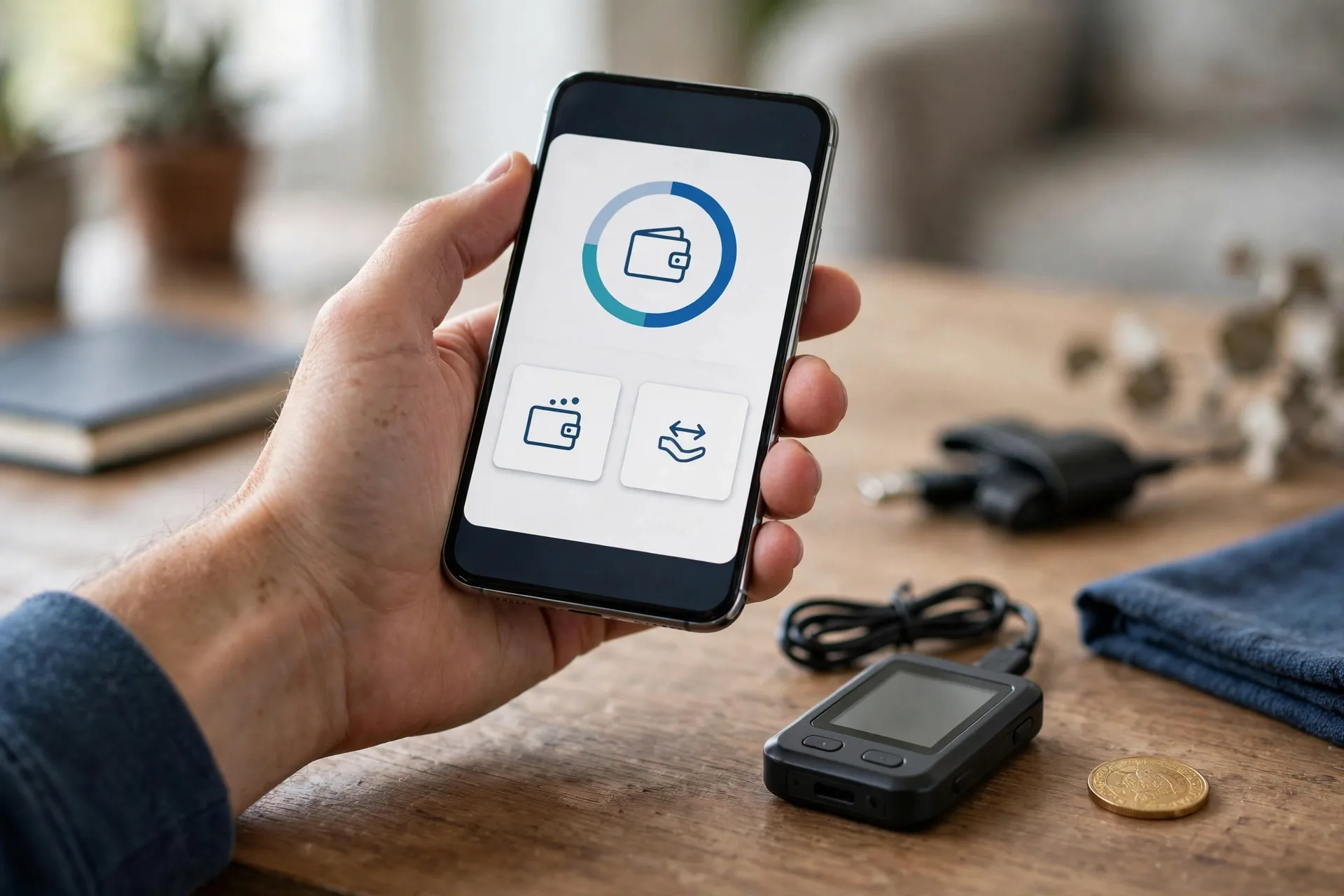
A Bitcoin wallet is software or a device that stores keys, creates transactions, and shows a Bitcoin balance, while Bitcoin coins stay on the blockchain. A Bitcoin wallet does not hold coins inside the wallet, a Bitcoin wallet holds the keys that control coins on the blockchain, and a Bitcoin wallet balance is read from the blockchain.
Bitcoin keys come in 2 parts. A public key gives a Bitcoin address that other people use to send Bitcoin to the wallet, and a private key signs transactions and proves control of Bitcoin in the wallet. Anyone with the private key can move Bitcoin from the wallet, so a private key must stay secret, and a lost private key can mean lost access to Bitcoin in that wallet.
Bitcoin wallets fall into 2 main types. A hot wallet connects to the internet and suits small amounts, and a cold wallet stays offline and suits larger amounts. When I set up my first practice wallet, the recovery phrase step took longest, and writing the 12-word phrase on paper felt slow until I understood that the phrase was the only backup.
How Do You Buy Bitcoin in 5 Steps?
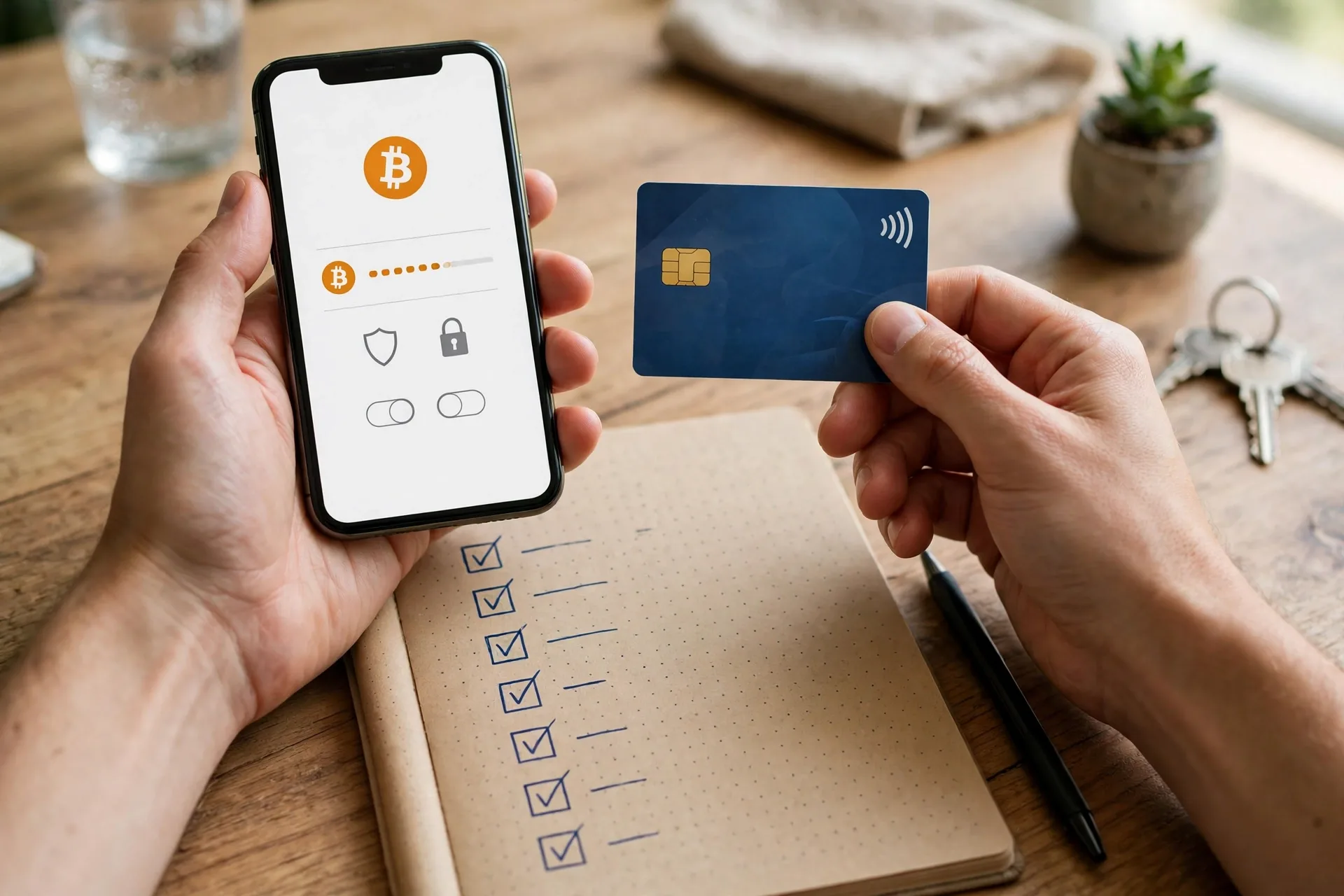
You buy Bitcoin in 5 steps: choose a regulated exchange, verify identity, add a payment method, place a small order, and move Bitcoin to a wallet you control for long holding. You do not need to buy one whole Bitcoin, you can buy a fraction of one Bitcoin, and you can start with a small test amount.
- Choose an exchange that operates legally in your country and offers clear fees.
- Complete identity checks with a government ID, as most regulated exchanges require identity checks.
- Link a bank account or a debit card, and check deposit fees before you fund the account.
- Place a market order for a small amount, and check the total cost with fees before you confirm.
- Record the purchase, set up two-factor authentication, and move Bitcoin to your own wallet for long holding.
Read our guide on how to start investing with 100 dollars to plan a first small amount that fits a beginner budget.
Bitcoin fees come in 2 parts: exchange fees and network fees. Both fees must be checked before each order. In the United States, selling or spending Bitcoin can count as a taxable event, so keep purchase dates, amounts, and sale records from the first buy.
Bitcoin vs US Dollar: What Is Different?
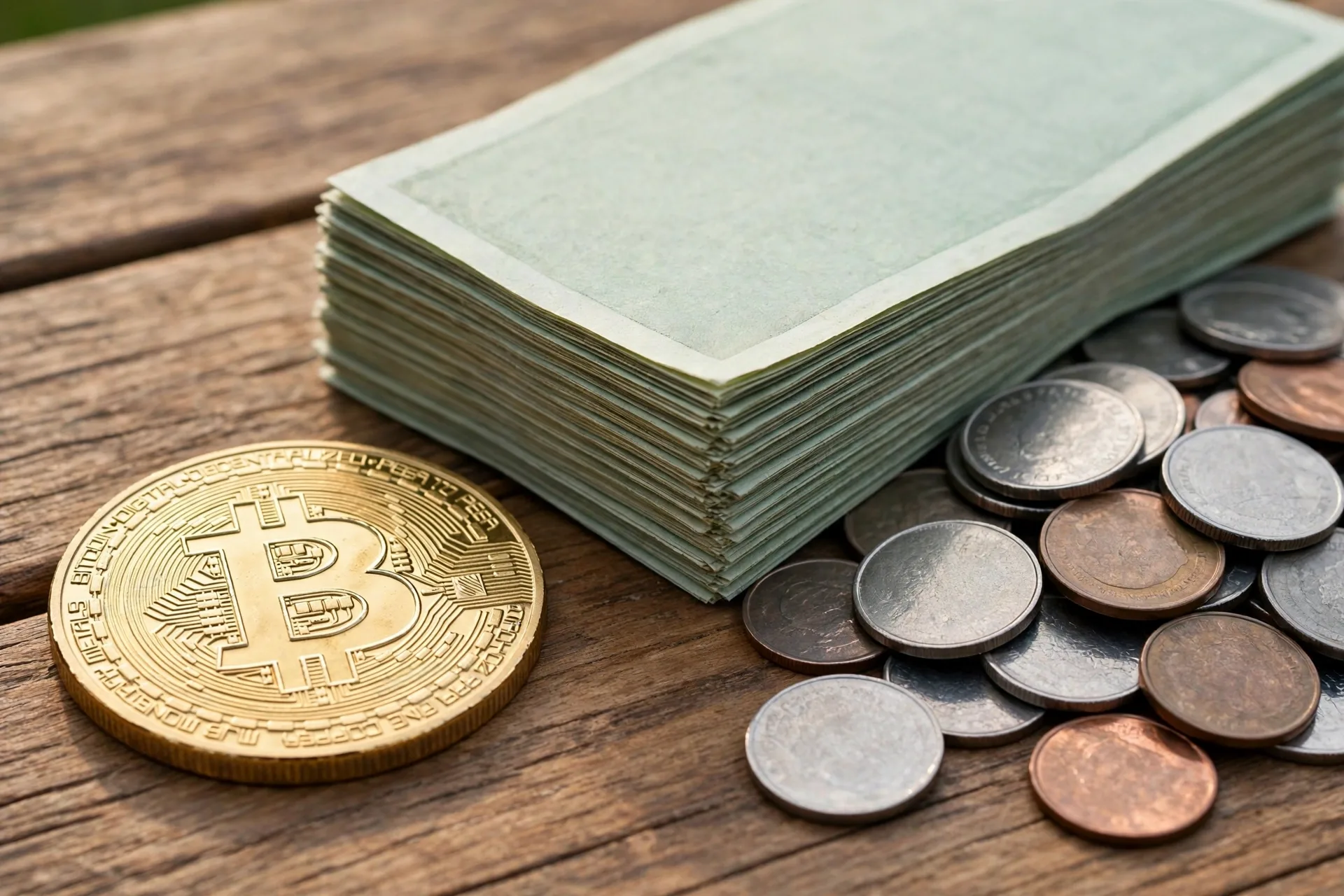
Bitcoin differs from the US dollar in control, supply, form, and backing, while Bitcoin and the US dollar share 2 roles: both can pay for goods, and both can store value for a time. Bitcoin control sits with a network, US dollar control sits with the Federal Reserve and US law, Bitcoin supply is capped at 21 million coins, and US dollar supply has no fixed cap.
| Feature | Bitcoin | US Dollar |
|---|---|---|
| Issuer | No central issuer, Bitcoin network rules | US government, Federal Reserve system |
| Form | Digital only, no physical coins | Physical cash plus digital bank money |
| Supply cap | 21 million coins, fixed in code | No fixed cap, set by policy |
| Transfer approval | Network nodes check the transaction | Banks and payment firms check the transfer |
| Reversal | Hard to reverse after confirmation | Card and bank payments can often be reversed |
| Insurance | No FDIC insurance for Bitcoin holdings | Bank deposits covered up to FDIC limits |
| Divisibility | 1 Bitcoin = 100 million satoshis | 1 dollar = 100 cents |
Use Bitcoin for a borderless digital transfer or a fixed-supply asset. Use the US dollar for stable day-to-day prices, wide acceptance, deposit insurance, or easy reversal of a mistaken payment.
What Can You Do With Bitcoin?
You can use Bitcoin to pay sellers that accept Bitcoin, send Bitcoin across borders, hold Bitcoin as a long-term asset, or learn crypto basics with a small amount. You can send Bitcoin at any hour, you can send Bitcoin to any country with internet access, and you can send Bitcoin without opening a bank account in the recipient country.
Bitcoin payments suit digital goods, donations, and cross-border transfers where bank fees are high. Bitcoin holding suits people who accept sharp price moves and plan to hold for years. Bitcoin does not suit rent or food for most beginners, because Bitcoin price can fall sharply before a bill date.
Bitcoin limits matter for beginners: acceptance is narrow, speed is slower than card payments for small buys, and tax rules add record work to each sale. Savvy Cash Flow covers Bitcoin basics here and beginner investing plans in separate guides.
What Are the Risks of Bitcoin?
Bitcoin risks include sharp price falls, scams, lost keys, exchange failure, and rule changes, and each risk can cause a real loss even when Bitcoin technology works as designed. Bitcoin price has risen and fallen by large amounts in past cycles, Bitcoin scams copy real exchanges and wallets, Bitcoin keys lost without a backup lock the wallet, and Bitcoin exchanges can be hacked or closed.
Check these 5 safety rules before any Bitcoin buy:
- Buy only on a known exchange, and type the exchange address yourself.
- Turn on two-factor authentication on the exchange and on email.
- Never share a private key or a recovery phrase with any person or website.
- Treat any promise of guaranteed Bitcoin returns as a scam signal.
- Keep only a small amount on an exchange, and move long-term Bitcoin to your own wallet.
Bitcoin scams use 4 common tricks: fake support staff who ask for keys, fake giveaways that ask for a small payment first, fake apps that copy a real wallet name, and pressure messages that demand an urgent transfer. A real exchange never asks for a private key, and a real investment never guarantees a return.
Read our guide on how to diversify a small portfolio to see where a small crypto amount fits inside a wider beginner portfolio.
Should Beginners Buy Bitcoin?
No, Bitcoin is not a required first investment for beginners, and beginners should build an emergency fund and a basic diversified plan before adding a volatile asset like Bitcoin. Bitcoin suits a small, separate amount only after bills, debts, and emergency savings are covered, and Bitcoin suits beginners who can accept a sharp fall without selling in panic.
A beginner checklist for Bitcoin starts with 4 checks. Check that an emergency fund covers 3 to 6 months of costs, check that high-interest debt is under control, check that a core portfolio uses broad funds for most of the money, and check that any Bitcoin amount is money you can afford to lose. If any check fails, fix that check first, and return to Bitcoin later. If all 4 checks pass, a small Bitcoin amount can serve as a learning step, not as a main plan.
For a balanced next step after this Bitcoin explainer, read our guide on Is Crypto Dead? for a plain view of crypto market cycles and risks.
Frequently Asked Questions
Is Bitcoin real money?
Yes, Bitcoin works as money for people who accept Bitcoin, but Bitcoin is not legal tender in most countries. Shops can refuse Bitcoin, and Bitcoin price swings make Bitcoin less stable than dollars for daily bills. Bitcoin still works well as a transfer and holding tool for users who accept that price risk.
How much is one Bitcoin worth in dollars?
One Bitcoin price changes every minute with supply and demand, so check a live exchange price at the moment of a buy. Bitcoin price can differ slightly from one exchange to another. Check the total cost with fees before you confirm any order, since fees change the final amount.
Can you buy less than one Bitcoin?
Yes, you can buy a fraction of one Bitcoin, and one Bitcoin divides into 100 million satoshis. A 10 dollar buy still moves with Bitcoin price in percent terms and still needs the same wallet safety steps. Small fractions help beginners learn the system without risking a large amount.
Is Bitcoin safe for beginners?
No, Bitcoin is not safe in the same way as a bank deposit, because Bitcoin has no FDIC insurance, Bitcoin payments are hard to reverse, and Bitcoin keys can be lost. Treat Bitcoin as a volatile asset, not as a savings account. Use strong passwords, two-factor authentication, and a private key backup for every wallet.
What is the difference between Bitcoin and blockchain?
Bitcoin is a digital currency and a payment network, while blockchain is the public ledger technology that records Bitcoin transactions. Bitcoin uses blockchain to track ownership, but the two terms are not the same. Other networks also use blockchain ledgers for data that has nothing to do with Bitcoin.
Do you pay tax on Bitcoin?
Yes, selling or spending Bitcoin can create a tax duty in the United States, so keep records of each buy, sale, and spend. A tax professional can confirm the rules for a specific case. Keep a simple record sheet from the first buy, with dates, amounts, fees, and sale prices.
Conclusion
Bitcoin is a decentralized digital currency that lets people send value over the internet without a bank, with a fixed supply of 21 million coins and a public blockchain ledger. Bitcoin works through nodes, mining, wallets, and keys, Bitcoin suits small, careful learning after basic finances are covered, and Bitcoin carries sharp price, scam, and key-loss risks that beginners must respect.
Start with the basics here, set up safety steps before any buy, and keep any first amount small. At Savvy Cash Flow, we publish plain money guides for beginners.
This guide gives general information only, not personal financial advice. Check current rules and prices before any purchase.
[…] what Bitcoin is in our beginner guide to Bitcoin before you pick a coin for the test […]
[…] our guide on What Is Bitcoin? for the full Bitcoin explainer, from wallets and keys to the 21 million supply […]
[…] support and resistance check pairs well with a What Is Bitcoin? read, because Bitcoin price zones shape how smaller crypto assets […]