

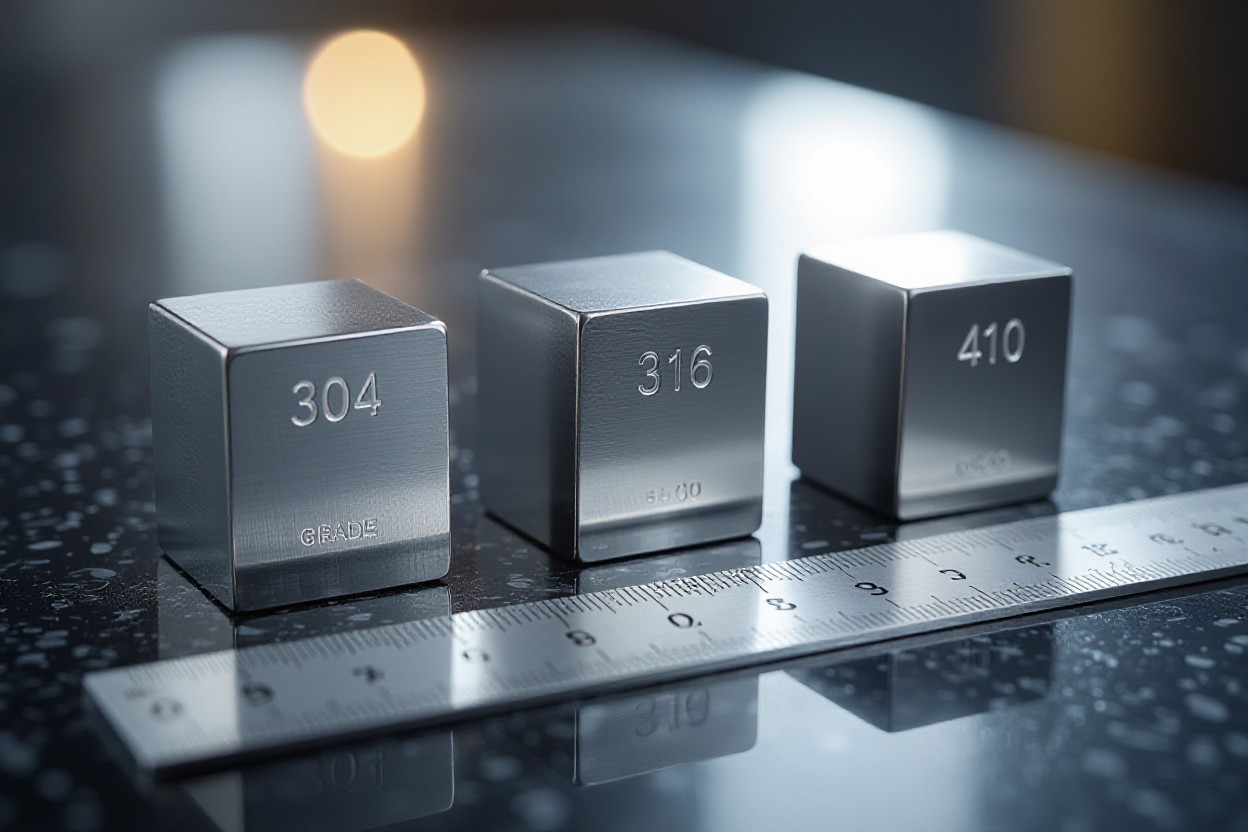
Just as you select materials, you should evaluate 304, 316 and 410 stainless steel by their corrosion resistance, strength, weldability and cost so you can choose the right alloy for marine, food processing, hardware or tool applications. This guide gives clear comparisons and practical recommendations to help you make informed specifications for your projects.
Key Takeaways:
- 304 – General-purpose austenitic stainless with good corrosion resistance and formability; non-magnetic in annealed condition; common for kitchen equipment and food service where chloride exposure is limited.
- 316 – Austenitic with added molybdenum for superior resistance to chlorides and chemical attack; preferred for marine, chemical, and medical environments; higher cost than 304.
- 410 – Martensitic, heat-treatable for high hardness and wear resistance but lower corrosion resistance and ductility; magnetic and suited for cutlery, valves, shafts, and fasteners where strength/wear matter more than corrosion performance.
Overview of Stainless Steel Grades
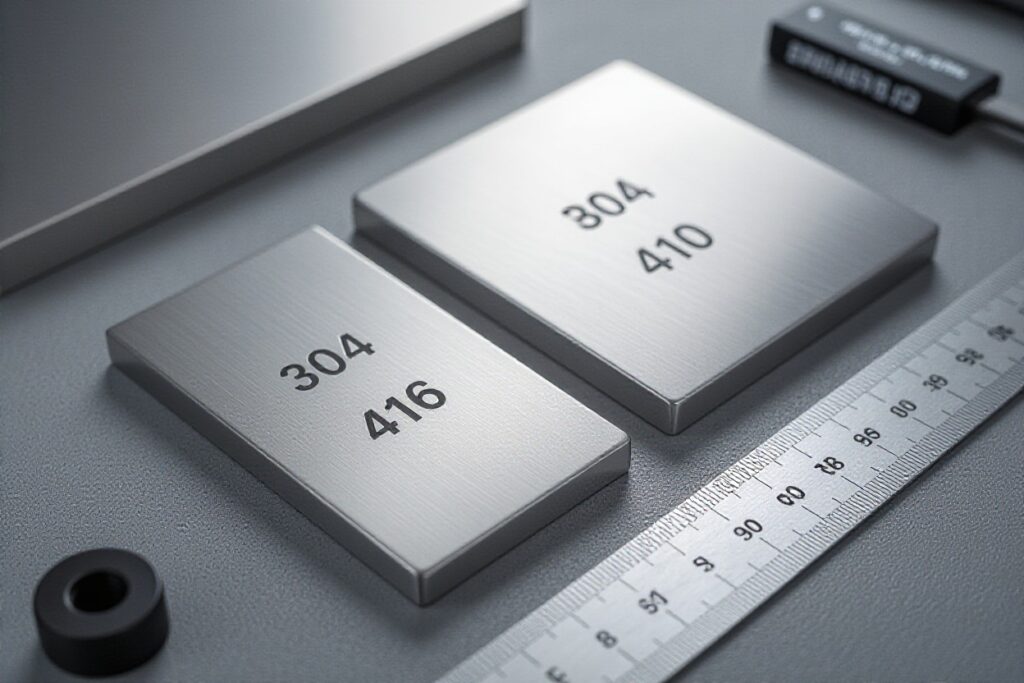
You’re comparing 304, 316 and 410 within the broader stainless family: austenitic 300-series (304, 316) and martensitic 400-series (410). 304 contains ~18-20% Cr and 8-10.5% Ni; 316 has ~16-18% Cr, 10-14% Ni and 2-3% Mo for better chloride resistance; 410 has ~11.5-13.5% Cr and is heat-treatable for hardness. Use these composition differences to match corrosion resistance, formability and strength to your application.
What is Stainless Steel?
Stainless steel is an iron-based alloy with a minimum of 10.5% chromium that forms a passive oxide film to resist corrosion. You’ll see distinct microstructures- austenitic (non-magnetic, highly ductile), ferritic, and martensitic (heat-treatable, magnetic)- each tailored to different uses: 304 for food equipment, 316 for marine and chemical service, and 410 for cutlery, fasteners and valves requiring hardness.
Key Characteristics of Stainless Steel
Corrosion resistance, strength, formability and heat resistance vary by grade: 300-series delivers excellent ductility and weldability but moderate strength; 316 adds 2-3% molybdenum to improve pitting resistance in chloride environments; 410 can be hardened by heat treatment for wear resistance and becomes magnetic after processing. You should weigh these traits against cost and fabrication needs.
For practical selection, pick 316 when chloride exposure is likely-its molybdenum significantly reduces pitting-choose 304 for cost-effective food-contact applications and easy forming, and opt for 410 when you need abrasion resistance and edge retention; tempered 410 performs well in knives and valve seats. Welding behavior differs too: 304 welds readily, 316 tolerates harsher environments but may need post-weld treatment, and machining/finishing rates will influence manufacturing cost and lead time.
Detailed Comparison of Stainless Steel 410 vs 316 vs 304
Quick comparison
| Corrosion resistance | 304: good in air and mild chemicals; 316: superior in chlorides and marine environments due to 2-3% Mo; 410: poor in chloride-rich environments, better in dry air. |
| Chemical highlights | 304: ~18% Cr, ~8% Ni, C ≤0.08%; 316: ~16-18% Cr, 10-14% Ni, 2-3% Mo; 410: 11.5-13.5% Cr, low Ni, C up to ~0.15%. |
| Mechanical behavior | 304/316: high ductility and toughness (good formability); 410: martensitic-can be hardened for high strength and wear resistance. |
| Typical applications | 304: kitchenware, tanks; 316: marine fittings, chemical process equipment; 410: cutlery, turbine blades, shafts when heat-treated. |
| Heat treatment | 304/316 are austenitic and non-hardenable by quench; 410 responds to quench and tempering to raise tensile strength and hardness. |
Chemical Composition
You can differentiate the grades by composition: 304 is the classic 18-8 austenitic alloy (~18% Cr, ~8% Ni, C ≤0.08%), 316 adds 2-3% Mo and typically 10-14% Ni to resist chlorides, while 410 is a martensitic grade with 11.5-13.5% Cr, very low Ni and higher C (up to ~0.15%), which gives it the capacity for hardening but lowers corrosion resistance compared with 304/316.
Mechanical Properties
You’ll find 304 and 316 deliver similar ductility and toughness-typical tensile strengths near 500-520 MPa with yield around 200-300 MPa and elongation ~35-50% depending on temper-whereas 410 in annealed form shows moderate strength (roughly 450-600 MPa) but can be heat-treated to exceed 800 MPa tensile and much higher hardness for wear-critical parts.
You should consider service needs: for shaft or blade applications you might heat-treat 410 to achieve tensile >800-900 MPa and hardness in the 40-50 HRC range, giving excellent wear resistance but reduced corrosion performance; for welded pressure vessels and food-contact parts you’ll prefer 304/316 because their austenitic microstructure keeps toughness and elongation high after forming or welding. In practical case studies, marine pump housings exposed to seawater use 316 with Mo to avoid pitting, while industrial knives and bearings often use quenched-and-tempered 410 to hold edges and resist abrasive wear.
Corrosion Resistance Analysis
304 Stainless Steel
You’ll find 304 (about 18% Cr, 8% Ni) forms a stable passive film that resists general oxidation and many food‑industry acids; it’s ideal for sinks, kitchen equipment, and indoor fittings. However, you should avoid prolonged chloride exposure-coastal air or deicing salts can cause pitting and crevice corrosion where 304 often fails within weeks to months without protective maintenance.
316 Stainless Steel
316 (≈16-18% Cr, 10-14% Ni, 2-3% Mo) adds molybdenum to markedly improve pitting resistance in chloride environments, so you’ll see it on boat fittings, desalination plants, and chemical tanks. In environments where chloride-induced corrosion is likely, 316 typically outlasts 304 by years and reduces downtime and replacement costs.
For more detail, consider PREN: 316’s pitting resistance equivalent number usually falls around 24-26, while 304 is nearer 18-20, which quantifies why 316 performs better in seawater. You’ll also choose 316L (C ≤0.03%) when welding to avoid carbide sensitization; in practice, specifying 316L for welded marine structures cuts intergranular corrosion risk significantly.
410 Stainless Steel
410 is a martensitic grade with roughly 11.5-13.5% chromium and 0.15-0.75% carbon, so you’ll get good hardness and wear resistance after heat treatment but noticeably lower corrosion resistance than 304/316. It works well for cutlery, valves, and shafts in dry or mildly corrosive atmospheres, but it’s a poor choice for seawater or chloride‑rich settings without protective coatings.
When you need strength and hardness, 410 can be quenched and tempered to reach high hardness (often up to ~HRC 48-52) for abrasion‑resistant parts, yet in salt‑spray tests it corrodes far faster than austenitic grades. If your application faces periodic wetting or salt exposure, you’ll either coat/plating 410 or upgrade to 316/17‑4PH to avoid premature failure.
Strength and Durability
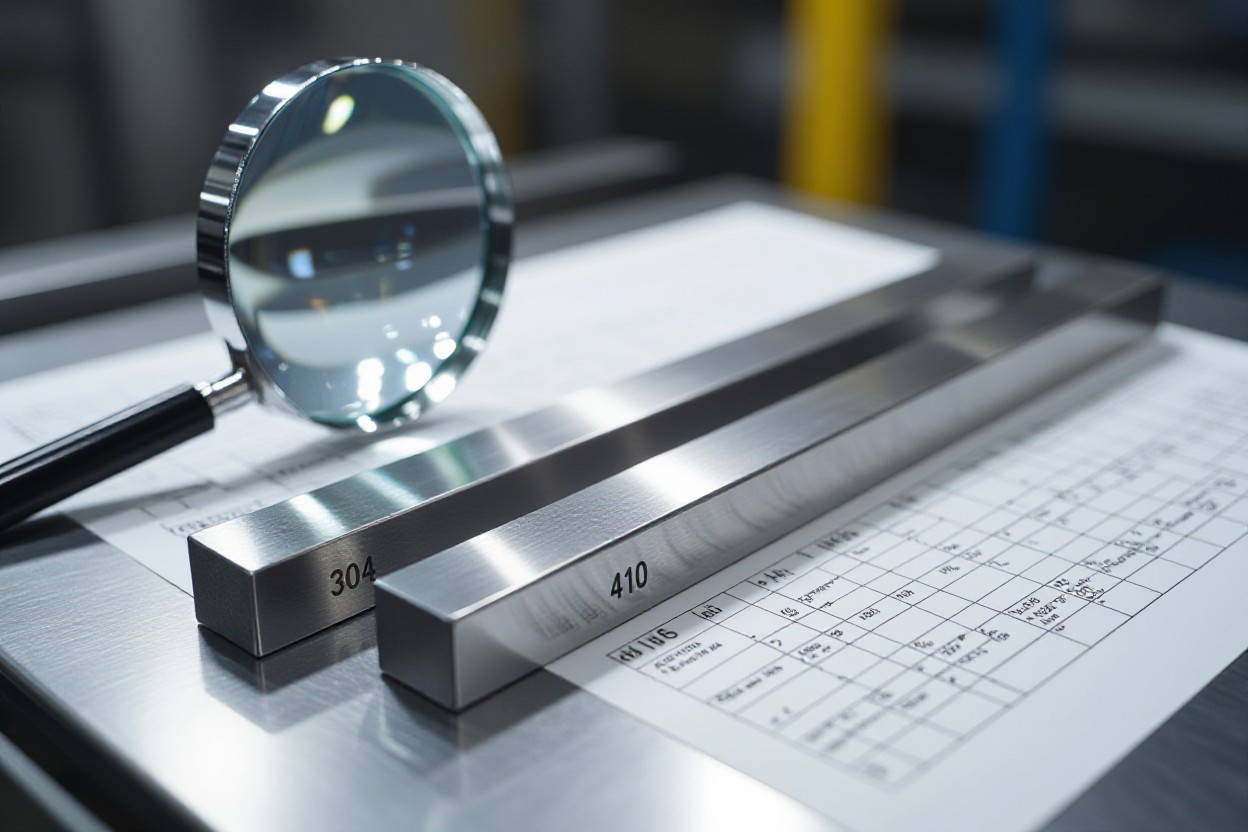
You’ll notice 304 and 316 offer comparable ductility and corrosion-resistant strength in annealed form (around 515 MPa/75 ksi tensile), while 410 is much more variable: annealed 410 sits lower, but when quenched and tempered it can exceed 900 MPa, trading toughness for hardness-so you pick 316 for sustained structural exposure and 410 when wear resistance and edge retention matter more.
Tensile Strength
You can expect annealed 304 and 316 tensile strengths near 515 MPa (≈75 ksi) with yields around 205 MPa (≈30 ksi); 316 may show modest gains after cold work. 410’s tensile range spans roughly 450-600 MPa annealed and climbs above 800-900 MPa after heat treatment. For bolted assemblies you favor the austenitics for predictable elongation, while you choose heat-treated 410 for high-strength pins or blades.
Impact Resistance
You’ll find 304 and 316 maintain high impact toughness even at low temperatures, making them suitable for cryogenic vessels and pressure parts, whereas 410 is more brittle in the annealed state and becomes less notch-tolerant unless properly tempered; in practice, you use 316 in marine fittings and 410 for cutlery and valve seats where impacts are limited but hardness is needed.
You should note Charpy-style comparisons: typical annealed austenitics often show relatively high absorbed energies (commonly exceeding tens to over a hundred joules at room temperature), while annealed 410 frequently measures much lower unless tempering raises its toughness. Welding can reduce 410’s HAZ toughness, so you either post-weld temper or select 304/316 for welded, impact-prone components to avoid brittle failure in service.
Best Uses for Each Stainless Steel Grade
You’ll pick 304 for general-purpose corrosion resistance, 316 when chlorides or harsh chemicals are present, and 410 when strength and hardness outweigh formability. 304 typically contains 18-20% Cr and 8-10.5% Ni; 316 adds 2-3% Mo (16-18% Cr, 10-14% Ni) for pitting resistance; 410 is martensitic with 11.5-13.5% Cr and is heat-treatable for high hardness.
Applications for 304 Stainless Steel
You’ll use 304 in foodservice and sanitary applications-restaurant equipment, sinks, brewing tanks, processing conveyors-because it’s readily formed and welded. With its 18-20% chromium and 8-10.5% nickel, it resists routine corrosion and handles intermittent temperatures up to about 870°C, making it common for HVAC ductwork, architectural trim, and cosmetic automotive parts.
Applications for 316 Stainless Steel
If you need resistance to chlorides and chemicals, you’ll choose 316 for boat fittings, seawater pumps, chemical tanks, and pharmaceutical equipment. The 2-3% molybdenum content markedly reduces pitting in saline environments, so you’ll see 316 on heat exchangers, offshore fasteners, and surgical instruments-316L is preferred where low carbon is required for welding or implants.
In marine or chemical plants you’ll notice 316’s longevity: it outperforms 304 in chloride-heavy settings and is the industry standard for seawater service. When fabricating, specify 316L to avoid sensitization; typical uses you’ll encounter include propeller shafts, coastal architectural elements, and pharmaceutical process lines where reduced maintenance and longer service life matter.
Applications for 410 Stainless Steel
When your application calls for wear resistance and hardness over deep corrosion resistance, you’ll pick 410 for knives, cutlery, valve components, shafts, and pump parts. As a martensitic grade with roughly 11.5-13.5% chromium, it’s heat-treatable to increase hardness (up to about 50 HRC), making it suitable for cutting edges and high-wear components.
By heat treating 410 you’ll tailor tensile strength and toughness, so manufacturers specify it for firearm parts, injector nozzles, and high-strength fasteners where corrosion is moderate. You’ll also find 410 chosen for cost-effective, hard-wearing components when nickel-containing austenitics would be overkill.
Cost Considerations and Availability
Price Comparison
You’ll typically find 410 at the lowest price, 304 at a mid-range, and 316 at the highest cost due to added molybdenum. Expect 316 to carry roughly a 20-40% premium over 304, while 410 can be 10-25% cheaper than 304 depending on market scrap and mill surcharges; bulk buying and long lead times can narrow those gaps.
Price snapshot (typical relative cost)
| Grade | Typical relative cost / notes |
|---|---|
| 304 | Baseline; widely stocked, moderate price volatility |
| 316 | +20-40% vs 304; premium for corrosion resistance (molybdenum) |
| 410 | -10-25% vs 304; cheaper martensitic option, price varies by form |
Market Availability
You can usually source 304 almost anywhere-sheets, coils, pipe, and bar are standard; 316 is common too but less stocked in wide-gauge plate or specialty finishes, and 410 is plentiful for fasteners, cutlery, and spring stock but less so in large-format sheet. Local distributors and mills determine lead times and minimum order quantities for each form.
In practice, North American and European distributors often show 304 and 316 in real-time inventory, while 316 lead times for custom sizes can run 2-8 weeks; 410 is frequently available off-the-shelf in bars and flat stock with 1-3 week delivery. If you need consistent supply, lining up a mill agreement or ordering standard stock sizes will reduce cost and shorten lead times.
Final Words
Summing up you should choose 304 for general corrosion resistance and formability, 316 when you need superior marine/chemical resistance, and 410 when high strength and wear resistance with lower corrosion tolerance suffice; consider weldability, cost and service environment to match alloy properties to your application, balancing toughness, hardness and longevity for optimal performance.
FAQ
Q: What are the main chemical and corrosion-resistance differences between 304, 316, and 410 stainless steels?
A: 304 is an austenitic alloy with about 18-20% chromium and 8-10.5% nickel, offering good general corrosion resistance in atmospheric and mild chemical environments. 316 is also austenitic but adds molybdenum (about 2-3%) along with similar Cr and higher Ni, which significantly improves resistance to pitting and crevice corrosion in chloride-containing and marine environments. 410 is a martensitic stainless steel with lower chromium (≈11.5-13.5%) and little or no nickel; it provides limited corrosion resistance compared with 304/316 and performs poorly in chloride or strongly oxidizing media. Corrosion-resistance ranking: 316 > 304 >> 410.
Q: How do strength, hardness, and heat-treating behavior compare among these grades?
A: 304 and 316 are austenitic, not hardenable by heat treatment; they gain strength primarily through cold work and have high ductility and toughness. Their annealed tensile strength is moderate and they remain tough at low temperatures. 410 is martensitic and can be hardened and strengthened by quenching and tempering, achieving much higher hardness, wear resistance, and tensile strength than annealed 304/316.
Magnetic behavior differs: 410 is magnetic in all conditions; 304/316 are necessaryly non-magnetic when annealed but can become slightly magnetic after cold working. Weldability: 304 and 316 weld readily; 410 requires controlled preheat/postheat and may need tempering after welding to avoid cracking and loss of toughness.
Q: Which applications are each grade best suited for, and what selection factors should be used?
A: Choose 304 for foodservice equipment, kitchen appliances, architectural trim, and general-purpose fabrication where good formability, weldability, and moderate corrosion resistance are needed at a lower cost. Choose 316 for marine hardware, chemical processing equipment, medical implants, and environments with chlorides or strong corrosives where superior pitting and crevice resistance justifies higher cost.
Choose 410 for cutlery, valves, shafts, fasteners, and wear-resistant parts that require high strength or hardness after heat treatment and where the environment is not highly corrosive. Selection factors: required corrosion resistance (especially to chlorides), need for heat treatment/hardness, weldability and formability, magnetic properties, and budget.